

Article
Леонид Гозман, Michael McFaul
{
  "authors": [
    "Michael McFaul"
  ],
  "type": "legacyinthemedia",
  "centerAffiliationAll": "dc",
  "centers": [
    "Carnegie Endowment for International Peace"
  ],
  "collections": [],
  "englishNewsletterAll": "ctw",
  "nonEnglishNewsletterAll": "",
  "primaryCenter": "Carnegie Endowment for International Peace",
  "programAffiliation": "russia",
  "programs": [
    "Russia and Eurasia"
  ],
  "projects": [],
  "regions": [
    "Ukraine"
  ],
  "topics": [
    "Political Reform",
    "Economy"
  ]
}
Source: Getty
Source: National Post

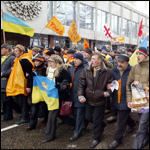
In the year after the revolution, economic growth slowed, exports declined dramatically, as did investment in every sector of the economy except transportation, manufacturing and real estate. Ukrainians blamed this on the "Orange" government, especially former prime minister Yulia Timoshenko and President Viktor Yushchenko.
Analysts blamed Timoshenko for her alleged "populist" policies of price controls, trade restrictions and reprivatization plans. Yushchenko also was seen as ineffectual and tainted with the brush of corruption in the aftermath of a scandal surrounding a new gas deal between Ukraine and Russian involving a mysterious company, RosUkrenergo. The government was then rocked with charges of incompetence that compelled key figures from the Orange Revolution to be dismissed from government.
In a poll conducted last month, only 19% of Ukrainian respondents said they believe the country is going in the right direction, while 60% believe it is going in the wrong direction. Public support for Yuschenko's party, Our Ukraine, is hovering around 20%, while Yulia Timoshenko's bloc has even less support. The party poised to win the largest percentage of votes on Sunday is Regions of Ukraine, the one-time villain in the Orange Revolution drama.
And yet, it is too early to declare the Orange Revolution a failure. True, Ukraine is at risk of drifting back to autocratic and corrupt practices. But it still seems more likely that the Orange Revolution has thrust Ukraine's political trajectory along a different, more competitive, more transparent path.
Many of the so-called disappointments in the aftermath of the Orange Revolution were actually signs of democracy taking root. There is always a let down after a revolution, as no new regime cam meet the inflated expectations such upheavals produce. Moreover, coalitions that bring down bad governments always split apart after the revolution: In the absence of a common enemy, their policy differences become apparent.
Acknowledging that Ukraine is similar to many post-revolutionary situations is no excuse for bad government. But what is more interesting is the process by which political elites are dealing with the situation. Ms. Timoshenko was accused of incompetence. President Yushchenko lost faith in her and dissolved the government, and a majority of the Ukrainian people supported his decision. That's how it's supposed to work in a democracy.
Timoshenko now has the chance to go before the voters and convince them that her policies were correct. She was not arrested or forced into exile just because she had a disagreement with the President. That's another sign of democracy.
In addition, there were charges of corruption against other government officials, who in turn were eventually were forced to resign. Why? Because Ukraine has an aggressive and investigative press -- another sign of a healthy democracy.
Finally, another positive democratic development from the Orange Revolution is the shift from a presidential system to a parliamentary system of government. Although many of the Orange leaders now lament this change, the new rules of the game mean that the next prime minister will have to win the support of more than her or his party in order to form a majority government -- something which forces compromise.
In the short run, there have been disappointments. In the long run, however, if the Orange Revolution truly does manage to propel Ukraine down a democratic path, then no one will remember these short-term hiccups. A hundred years, one hopes they still will be celebrating the Orange Revolution on the Maidan as a defining moment in Ukraine's transition to a Western, democratic, and market-oriented country.
Michael McFaul is a Hoover Institution fellow, a professor of political science at Stanford University, and Senior Associate at the Carnegie Endowment for International Peace. With Anders Aslund, he is editor of Revolution in Orange: The Origins of Ukraine's Democratic Breakthrough (Carnegie 2006).

Former Senior Associate
In addition to his role at Carnegie, McFaul is Peter and Helen Bing Senior Fellow at the Hoover Institution and associate professor of political science at Stanford University.
Recent Work
Леонид Гозман, Michael McFaul
Michael McFaul, Sanja Tatic
Carnegie does not take institutional positions on public policy issues; the views represented herein are those of the author(s) and do not necessarily reflect the views of Carnegie, its staff, or its trustees.

China’s political future will be shaped between now and next October. As the Communist Party enters its intense “campaign season” to prepare for a major political transition in 2027, reading Beijing's actions and responses may become more difficult as domestic politics weigh on its behavior more than usual.

Damien Ma

The EU can impose sanctions but struggles to enforce them without the United States. With Washington increasingly disinterested in backing European interests, the bloc must now fend for itself.


Nicu Popescu, Tiago Antunes

Rubio’s recent visit brought welcome attention, but more capital requires governance changes that may be a hard sell for regional governments.

Jennifer B. Murtazashvili

Russia is testing the waters of NATO’s mutual defense clause. What do strikes in Romanian territorial waters mean for the alliance’s posture toward Moscow?

Dimitar Bechev

China has showcased its engineering prowess with small modular reactor demonstration projects. But turning these technological achievements into commercial success will be a greater challenge.

Tong Zhao