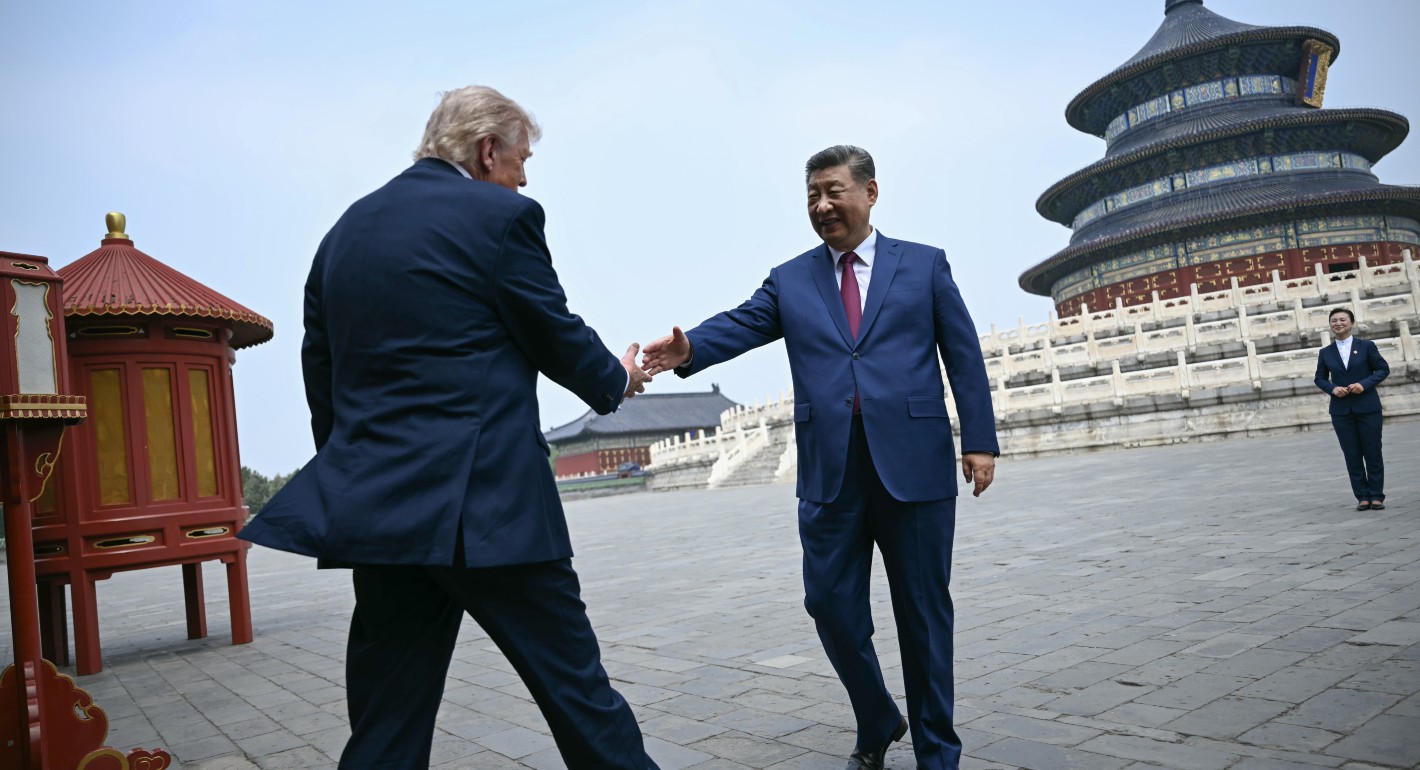
For more than 15 years, through the past three presidential administrations, American foreign policy has fluctuated from realism to idealism to some strange mix of the two. But in all that time, one aspect of policy has not changed: relations with China. Under George H.W. Bush, the United States championed economic engagement with China as a way to eventually open up the country politically. Under Bill Clinton, the White House promoted a "strategic partnership" with China, assuring that these close economic ties would remain intact. In the current Bush administration, after some initial pre-September 11 tensions with Beijing, which disappeared after the administration focused instead on terrorism, the White House settled into the familiar. Secretary of the Treasury Henry Paulson heads up a "strategic dialogue" with senior Chinese leaders in which Washington and Beijing together build consensus on critical economic issues.
But America's China policy consensus may be breaking down. In February, the White House filed a major trade complaint against China over Chinese government subsidies. Then, in late March, it slapped new duties on imports of Chinese paper--the first time in 23 years the United States had used such measures and a decision that could open the door to many new duties against Chinese products. And, hard on the heels of these sanctions, the administration filed new complaints against China at the World Trade Organization for alleged intellectual piracy. Reacting quickly, Beijing warned that the complaints would "seriously damage" U.S.-China relations, but, so far, its warnings seem to have gone unheeded. In fact, Washington and Beijing should prepare for more "damage" ahead.
Why this tougher stance toward China? Clearly, the Democrats' victory in the 2006 congressional elections is a factor. New Speaker of the House Nancy Pelosi long has been one of the leading China hawks in Washington (she once unfurled a banner in Tiananmen Square commemorating the victims of the 1989 massacre there), and prominent China critics like Michigan Congressman Sander Levin now head influential bodies like the Ways and Means subcommittee on trade. China currently has a trade surplus with the United States of more than $230 billion. And though much of Chinese manufacturing is actually owned by U.S. companies, as a 2005 study in Foreign Affairs showed, what matters politically is the public perception that China has the United States in its debt. Democrats realized that economic populism may be a winning strategy, since it helped power the campaigns of new senators like Ohio's Sherrod Brown and Montana's Jon Tester. Now, with a Democratic majority, these populists can deliver on their agendas, one of which is taking a tougher economic line on China.
In the last two years, according to Morgan Stanley's Stephen Roach, Congress introduced 27 pieces of anti-China legislation; Democratic Senator Byron Dorgan even suggested cutting off normal trade relations with China. Now, the fact that Democrats have the leverage to pass tougher anti-China bills may be forcing the administration's hand, leading the White House to take actions like taxing the imports on paper. The White House's timing "is clearly [designed]...also to tell the Chinese: 'We're going to thump you as a way of trying to head off congressional legislation,'" Gary Hufbauer, a senior fellow at the Peter G. Peterson Institute for International Economics told The Washington Post.
But it's not just Congress and the White House who are beginning to have second thoughts about the U.S.-China relationship. The American business community, long supportive of closer trade ties with China, is starting to fracture, with smaller companies refusing to back economic engagement with Beijing and charging that China is purposefully devaluing its currency. Even larger American companies have grown angry that China has not moved faster toward a true market economy and continues to tolerate piracy--U.S. Trade Representative Susan Schwab says China makes 80 percent of the counterfeit goods seized in the United States. And these big companies may also be realizing that China actually responds to tougher U.S. trade policy. "When confronted in this way China has capitulated," the Peterson Institute's Fred Bergsten told the Financial Times. "The lesson is that perhaps the US should be more aggressive."
Elsewhere in the political sphere, too, the policy consensus may be shifting. Though a recent task force on China by the centrist Council on Foreign Relations supported "integrating China into the global community," it warned that China had failed to protect intellectual property, must let its currency float, and has growing military capabilities that must be counter-balanced. American diplomats, too, have been surprised and sometimes worried by how quickly China has become a sophisticated and powerful diplomatic actor in regions far from its borders, like Africa and Latin America. China's test use of a missile to blow up one of its satellites in January further heightened concerns, since it shows China could hit some of the lower-orbiting American satellites.
Some policy specialists even are beginning to question the central tenet of U.S.-China relations--that continued engagement with Beijing could eventually deliver some political change in China. Recent reports on China by Human Rights Watch show China actually is regressing, with Beijing engaging in its "largest 'clean-up' of protestors and rights activists in years." Prominent China-watcher James Mann's new book The China Fantasy even challenges the idea that the People's Republic is destined for political change over the coming decades. And if China is not changing, U.S. policy just might.
This article was originally published in the April 17, 2007 online version of The New Republic.
A special correspondent for The New Republic, a columnist for Time, and a senior correspondent for The American Prospect, Kurlantzick assesses China’s relationship with the developing world, including Southeast Asia, Africa, and Latin America.
Carnegie does not take institutional positions on public policy issues; the views represented herein are those of the author(s) and do not necessarily reflect the views of Carnegie, its staff, or its trustees.
More Work from Carnegie Endowment for International Peace
China’s police training infrastructure construction projects provide benefits to recipient countries, promote China’s image as a major global security provider, and are likely to reinforce alignment between Beijing’s security priorities and those of countries in the Global South.
+2
Cameron Waltz, Sheena Chestnut Greitens, Kim Nguyen, …
The Bureau of Industry and Security needs to adjust its focus and practices to maintain its position as the U.S. government’s primary champion of international technological competition.
Depleted financial reserves and a shrinking tax base mean it is no longer possible to simultaneously deliver high defense spending, price stability, and economic growth.