

Commentary
Nikolay Petrov
{
  "authors": [
    "Nikolay Petrov"
  ],
  "type": "legacyinthemedia",
  "centerAffiliationAll": "",
  "centers": [
    "Carnegie Endowment for International Peace",
    "Carnegie Russia Eurasia Center"
  ],
  "collections": [],
  "englishNewsletterAll": "",
  "nonEnglishNewsletterAll": "",
  "primaryCenter": "Carnegie Russia Eurasia Center",
  "programAffiliation": "",
  "programs": [],
  "projects": [],
  "regions": [
    "Caucasus",
    "Russia"
  ],
  "topics": [
    "Political Reform"
  ]
}
Source: Getty
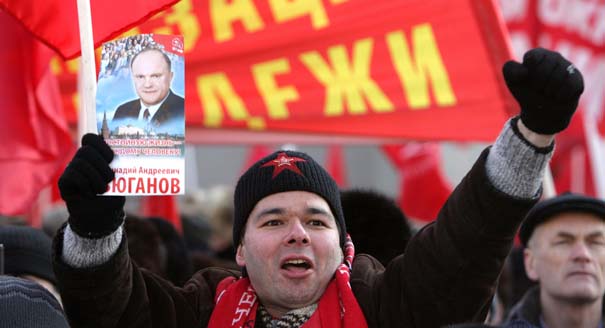
As protests against Moscow spread throughout Russia, regional governors loyal to the Kremlin, but lacking proven leadership skills, may be unable to meet the challenge posed by angry citizens.
Source: The Moscow Times

Dagestan is the only remaining Caucasus ethnic republic that hasn't experienced a change in the generation of leaders. Three years ago, Moscow reached an agreement for the retirement of the republic's previous long-serving leader, Mogamedali Magomedov, on the condition that his son be made speaker of the Dagestani parliament. The opportunities for making decisive changes to the political landscape in the Caucasus are limited. A new wave of terrorism is spreading throughout the region, and Moscow has less financial leverage than it had before.
In Murmansk, Governor Yury Yevdokimov entered into public conflict with United Russia by not only putting forward his personal candidate for the city's mayor, but by accusing his fellow party members of dirty politics.
There are also conflicts in other regions as we approach the elections on March 1. These are especially prominent in elections of parliaments in eight regions and mayoral elections in 10 regional centers. Before, United Russia used the governors as "locomotives" to promote party candidates in regional elections. But now, the party is trying to distance itself from the authorities, particularly since the federal government has come under greater criticism during the economic crisis.
United Russia is conducting an intensive house cleaning of its regional party ranks, most frequently opting for candidates favored more by the regional political elite than by the Kremlin. This is especially true of the speakers of regional parliaments, many of whom also run United Russia's local offices.
It is important to note that the demarches against Moscow took place not in developed, economically independent regions such as Moscow and Tatarstan, as had been the case in the past, but in regions that are relatively weak and that are largely subsidized by the federal budget. These public displays of discontent could easily increase in intensity and frequency as the crisis worsens.
In a deepening economic crisis, it is inevitable that there would be an increasing number of public conflicts in the regions. The real question is the extent to which they can be curbed. In recent years, the Kremlin has given a preference to obedient functionaries to fill gubernatorial positions, passing over other candidates with proven leadership skills. If tomorrow these governors must address angry crowds who are opposed to the authorities, most will be unable to meet the challenge. There are people who could handle this turbulent situation -- most of them are experienced politicians from the Yeltsin era who lived through the demonstrations and protests in the late 1980s and early 1990s. But today, they number fewer than a dozen.
This comment first appeared in The Moscow Times.
Former Scholar-in-Residence, Society and Regions Program, Moscow Center
Nikolay Petrov was the chair of the Carnegie Moscow Center’s Society and Regions Program. Until 2006, he also worked at the Institute of Geography at the Russian Academy of Sciences, where he started to work in 1982.
Recent Work
Nikolay Petrov
Nikolay Petrov
Carnegie does not take institutional positions on public policy issues; the views represented herein are those of the author(s) and do not necessarily reflect the views of Carnegie, its staff, or its trustees.

If the Russian-speaking community in Latvia cannot articulate their interests without being seen as disloyal, they could end up embracing a pro-Kremlin agenda.

Sergejs Potapkins

Russia’s ruling party would have benefited from Putin appearing as its distant patron, but as an active frontman imposing his views on the public, he has done nothing but harm both the party’s election campaign and the ruling system overall.

Andrey Pertsev

European Commission President Ursula von der Leyen is about to give her annual address on the state of the EU. Here’s what she won’t—but should—say.

Rym Momtaz

Depleted financial reserves and a shrinking tax base mean it is no longer possible to simultaneously deliver high defense spending, price stability, and economic growth.

Alexandra Prokopenko
Blurring the line between humans and animals is a long-standing tradition in social utopian prose. In his latest novel, Leonid Bershidsky reminds us that in social experiments, people are often treated no differently than animals.

Alexander Baunov