

Commentary
Nikolay Petrov
{
  "authors": [
    "Nikolay Petrov"
  ],
  "type": "legacyinthemedia",
  "centerAffiliationAll": "",
  "centers": [
    "Carnegie Endowment for International Peace",
    "Carnegie Russia Eurasia Center"
  ],
  "collections": [],
  "englishNewsletterAll": "",
  "nonEnglishNewsletterAll": "",
  "primaryCenter": "Carnegie Russia Eurasia Center",
  "programAffiliation": "",
  "programs": [],
  "projects": [],
  "regions": [
    "Caucasus",
    "Russia"
  ],
  "topics": [
    "Political Reform"
  ]
}
Source: Getty
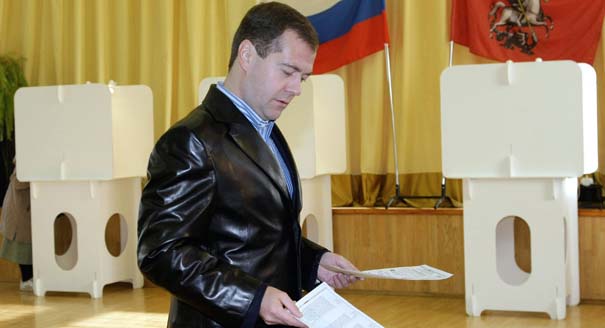
Municipal elections held in Russia on October 11 proved that most Russian voters seem to feel that elections have no direct bearing on their lives and that the authorities feel no impetus to institute change in the current Russian party system.
Source: The Moscow Times

The country’s leaders are spending enormous amounts of money to calm nerves and maintain order. But they are failing to prepare themselves to cope with future problems or to restructure the political system to meet those challenges. They are simply squandering Russia’s accumulated reserves and burying their heads in the sand.
Last spring, the authorities seemed to have gauged the situation accurately and chosen to loosen the reins a bit in the electoral process by introducing a few elements of liberalization. But now their political adaptation to the economic crisis has undergone a reversal. The authorities have apparently concluded that the worst of the crisis is over and that they can gradually tighten the reins again. A perfect illustration of this is the contrast between last weekend’s mayoral election in Astrakhan and the mayoral election in Sochi six months earlier.
What did the Oct. 11 elections reveal?
For one, the vote showed that public order remains relatively undisturbed and ordinary people have yet to feel the full brunt of the economic crisis. It also indicated that people are largely indifferent to elections and violations in electoral procedure. Most people see elections as a type of contest in which they can root for this or that person, not unlike the Russia-Germany football match that many voters stayed up watching so late Saturday night that they slept through the elections Sunday.
In any case, most voters seem to feel that elections have no direct bearing on their lives. Voters are not ready to invest their time and energy into elections or to defend their right to vote for the candidate of their choice, rather than to choose from a list of candidates handpicked by United Russia.
Sunday’s vote also showed that the authorities are satisfied with the current party system — a system that in reality is unable to meet the needs of a huge country in the throes of an economic crisis — and that they are not preparing any alternative to United Russia. Ruling parties in other countries have felt the effects of the crisis or even lost their hold on power as a result of it. But in Russia, as in the Sleeping Beauty fairy tale, time has stopped, and the authorities are reassuring everyone, including themselves, that they are more popular now than before the crisis started. This means that instead of simply preparing to change the ruling party, the authorities may one day face the more colossal task of having to change the entire political system.
The country’s leaders have not only failed to prepare a “backup” political party, but they also have effectively shot themselves in the foot by knowingly compromising the electoral system, making it impossible for two of the few parties that still have some life left in them, Right Cause and Yabloko, to enter the Moscow City Duma.
Were the election results widely falsified? Without doubt, many official election results do not reflect the real picture. It doesn’t really matter if the cheating occurred by misrepresenting the votes cast, having people use absentee ballots to vote in multiple precincts, or disqualifying unwanted candidates or parties. Typically, the first 25 percent to 30 percent of voting results are reported more or less accurately, and all subsequent votes are attributed to United Russia — a tactic for falsifying results that has been recognized since the late 1980s and that was clearly employed in the Moscow elections.
Elections were held in almost all of Russia’s regions. In outlying areas such as the cities of Rzhev and Yuzhno-Sakhalinsk and the Amur region, the authorities exercised looser control over the electoral process and the results were comparatively more realistic — primarily by showing an increase in popularity for the Communist Party. The dirtiest elections turned out to be those in Moscow and Astrakhan. We saw an interesting shift in trends: It used to be that Russia’s largest cities showed the proper way to conduct elections, and their example gradually spread to the provinces. This time, the elections in major cities resembled those in Chechnya and Dagestan, and the most honest elections took place in the more remote regions.
The elections also suggest that the social contract instituted by then-President Vladimir Putin — which saw the authorities guarantee a steadily increasing standard of living in return for the people’s willingness to act as nothing more than passive observers in the country’s political game — is still in place, despite a belief in some circles that the crisis had changed the arrangement.
The belief that those in power will modernize for the sake of their own survival was also proven unfounded by the elections. Karl Marx once said, “What the bourgeoisie therefore produces, above all, are its own grave diggers.” It appears that the authorities already have their shovels in hand.
Former Scholar-in-Residence, Society and Regions Program, Moscow Center
Nikolay Petrov was the chair of the Carnegie Moscow Center’s Society and Regions Program. Until 2006, he also worked at the Institute of Geography at the Russian Academy of Sciences, where he started to work in 1982.
Recent Work
Nikolay Petrov
Nikolay Petrov
Carnegie does not take institutional positions on public policy issues; the views represented herein are those of the author(s) and do not necessarily reflect the views of Carnegie, its staff, or its trustees.

Putin’s conservative staffing policies and search for ever greater control have cemented parliament’s transformation into a bureaucratic appendage of the executive branch.

Andrey Pertsev

Russia’s AI-driven propaganda campaigns operate in a fragmented, chaotic, and often illogical manner. That’s not necessarily a problem for the Kremlin, though: It’s much easier to mimic genuine public debate that way.

Ilya Klishin

Russian strikes are weakening the economy sustaining Ukraine’s war effort. Closing the growing funding gap will require more European support and politically contentious reforms in Kyiv.

Balázs Jarábik

Ex-president Gurbanguly Berdimuhamedov remains interested in politics, but his son Serdar, Turkmenistan’s current president, is becoming increasingly independent and willing to break with his father’s legacy. If their covert rivalry goes too far, both risk losing power.

Galiya Ibragimova

Europe is facing rising populism internally as well as external pressures from Russia, China, Turkey, and the United States.

Dimitar Bechev