

In The Media
Michele Dunne, Robert Kagan
{
  "authors": [
    "Robert Kagan"
  ],
  "type": "legacyinthemedia",
  "centerAffiliationAll": "",
  "centers": [
    "Carnegie Endowment for International Peace"
  ],
  "collections": [],
  "englishNewsletterAll": "",
  "nonEnglishNewsletterAll": "",
  "primaryCenter": "Carnegie Endowment for International Peace",
  "programAffiliation": "",
  "programs": [],
  "projects": [],
  "regions": [
    "North America",
    "United States",
    "Middle East",
    "Iran",
    "Caucasus",
    "Russia"
  ],
  "topics": [
    "Foreign Policy",
    "Nuclear Policy",
    "Nuclear Energy"
  ]
}
Source: Getty
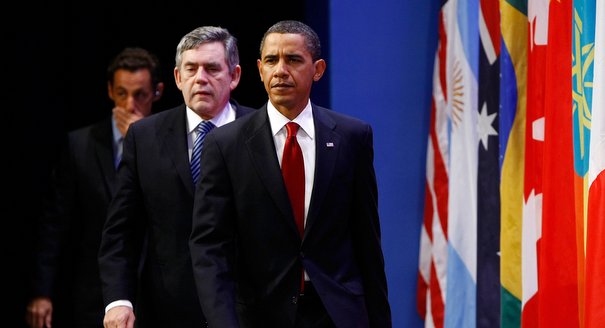
To effectively end Iran's nuclear program, Obama should abandon diplomatic ideals of engagement and instead immediately begin imposing new sanctions.
Source: The Washington Post

The first question is about to be answered. The main object of the "new era of engagement," Iran, has settled back into its old game-playing. The joint proposal agreed to by the United States, France and Russia, to have Iran ship 70 percent of its low-enriched uranium to Russia this year, was a compromise, as administration officials acknowledge. It might theoretically have delayed Iran's bomb program by a year or so -- assuming we know everything about that program -- and thus bought some time to get a better and more definitive agreement with Tehran. But it would not have stopped Iran from continuing to enrich uranium, which has been the goal of the United States and Europe for the better part of a decade. The deal, blessed and promoted by International Atomic Energy Agency chief Mohamed ElBaradei, not exactly a hawk, was really more a test of Iran's intentions than a decisive breakthrough.
So now the test results are in: Iran's intentions, it seems, are not good. Tehran apparently will not accept the deal but will propose an alternate plan, agreeing to ship smaller amounts of low-enriched uranium to Russia gradually over a year. Even if Iran carried out this plan as promised -- every month would be an adventure to see how much, if anything, Iran shipped -- the slow movement of small amounts of low-enriched uranium does not accomplish the original purpose, since Iran can quickly replace these amounts with new low-enriched uranium produced by its centrifuges. Iran's nuclear clock, which the Obama administration hoped to stop or at least slow, would continue ticking at close to its regular speed.
Tehran is obviously probing to see whether President Obama can play hardball or whether he can be played. If Obama has any hope of getting anywhere with the mullahs, he needs to show them he means business, now, and immediately begin imposing new sanctions.
And what about Russia, that other great object of the "new era of engagement"? Administration officials claim to have won Moscow's agreement to join in sanctions should Iran refuse to make a deal, and Obama paid in advance for cooperation by acquiescing to Moscow's demand to cancel planned missile-defense deployments in Poland and the Czech Republic.
So now comes the test. Russia joined France, the United States and ElBaradei in agreeing to the proposal on Iran's low-enriched uranium. Iran is now rejecting that proposal. If the administration's engagement strategy is working, then Moscow should come through by joining in sanctions. If, on the other hand, Moscow declares that Iran's counterproposal is satisfactory, or calls for further weeks or months of negotiations, then we will know that Russia, too, is playing Obama. Here again, Obama will have to show whether he is someone whom other powers have to take seriously, or if he is an easy mark in a geopolitical con game. If Moscow continues to act as Iran's facilitator, then doesn't Obama need to make clear that, just as cooperation brings rewards, noncooperation will have consequences?
Many of us worry that, for Obama, engagement is an end in itself, not a means to an end. We worry that every time Iran rejects one proposal, the president will simply resume negotiations on another proposal and that this will continue right up until the day Iran finally tests its first nuclear weapon, at which point the president will simply begin negotiations again to try to persuade Iran to put its nuclear genie back in the bottle.
Russia, meanwhile, will continue to be accommodated as a partner in this effort, on the perpetually untested theory that if Obama ever did decide to get tough with Iran, Moscow would join in. Russia thus reaps all the rewards of engagement without ever having to make a difficult decision.
The worst of it is that the Tehran regime is now desperately trying to buy time so it can regain full control of the country in the face of widespread anger after the fraudulent presidential elections in June and a still-vibrant Iranian opposition. For the clerics, an endless negotiating process is not merely a means of putting off any real concessions on its nuclear program. It is also, and more important, a way of putting off any Western sanctions that could produce new and potentially explosive unrest in their already unstable country. That is the best card in Obama's hand right now. It's time for him to play it -- or admit that poker is not his game.

Former Senior Associate
Kagan, author of the recent book, The Return of History and the End of Dreams (Knopf 2008), writes a monthly column on world affairs for the Washington Post and is a contributing editor at both the Weekly Standard and the New Republic.
Recent Work

Michele Dunne, Robert Kagan
Robert Kagan, Michele Dunne
Carnegie does not take institutional positions on public policy issues; the views represented herein are those of the author(s) and do not necessarily reflect the views of Carnegie, its staff, or its trustees.

Minsk clearly expected the dialogue with Washington to yield more results, in particular the lifting of EU sanctions and permission to export potash.

Artyom Shraibman

A summer of escalation in the Black Sea has hurt Ukraine economically and is exacerbating world food security. A truce is needed—as is a broader reframing of Europe’s Ukraine strategy.

Thomas de Waal

As the U.S. stumbles in its war with Iran, we are likely to see an acceleration of its disengagement from the region.

Michael Young
Why governance of rapidly evolving technology will be distributed and complex.


Stewart Patrick, Scott Singer
It should address the shortcomings of previous crisis communication efforts and adapt to the demands of frontier AI.

Lucy Luo