

Paper
Adam Baczko, Gilles Dorronsoro, Arthur Quesnay
{
  "authors": [
    "Gilles Dorronsoro"
  ],
  "type": "legacyinthemedia",
  "centerAffiliationAll": "dc",
  "centers": [
    "Carnegie Endowment for International Peace"
  ],
  "collections": [],
  "englishNewsletterAll": "ctw",
  "nonEnglishNewsletterAll": "",
  "primaryCenter": "Carnegie Endowment for International Peace",
  "programAffiliation": "SAP",
  "programs": [
    "South Asia"
  ],
  "projects": [],
  "regions": [
    "North America",
    "United States",
    "South Asia",
    "Afghanistan"
  ],
  "topics": [
    "Political Reform",
    "Security",
    "Military",
    "Foreign Policy"
  ]
}
Source: Getty
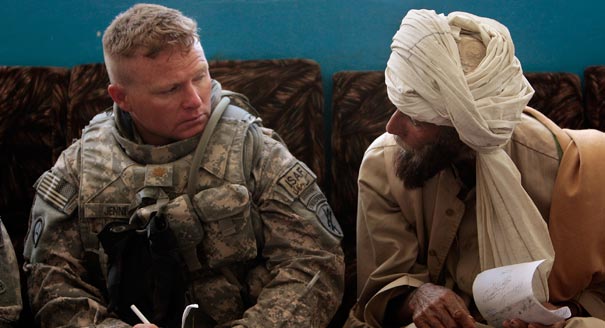
The cultural misunderstandings between Western forces and the Afghan people make it unlikely any counterinsurgency mission in the countryside will succeed.
Source: Los Angeles Times

So goes the plan. But after eight years of war, this approach is surprisingly ignorant of both the realities of Afghan society and the limitations of America's tolerance for casualties.
I was in Afghanistan during the summer, as 20,000 coalition troops tried to retake Helmand province, one of 11 provinces now under de facto Taliban control. But over three months, during which they sustained significant casualties, the troops failed to take control of even a third of the area. The coalition had built an archipelago of small outposts, leaving much of the territory between unsecured. As one Afghan told me in Kandahar, "The Americans control what they see." Imagine how many troops -- and how many casualties -- it would take to secure every one of those provinces, even under the most promising circumstances.
History is not encouraging. In two centuries, the Pashtuns have never once tolerated a permanent presence of armed foreigners. Defending families and villages is a cultural duty of local men, and the presence of outsiders is generally perceived as a threat, especially when they are non-Muslim. Historical memories are long in this part of the world. Some Afghans still say prayers for mujahedin who fought against the British -- in the 19th century.
Because the Afghan culture highly values politeness, Westerners rarely understand how unpopular they are in the region. Locals are annoyed by the road-hogging conduct of NATO patrols. They have a suspicion of men wearing sunglasses. They are outraged at the mistreatment of prisoners and the killings of civilians.
In the countryside, Westerners are essentially perceived as corrupt and threatening to traditional Afghan or Muslim values. Contrary to our self-perception, the villagers see the foreigners as the main providers of insecurity. The presence of coalition troops means IEDs, ambushes and airstrikes, and consequently a higher probability of being killed, maimed or robbed of a livelihood. Any incident quickly reinforces the divide between locals and outsiders, and the Afghan media provide extensive and graphic coverage of botched airstrikes and injured civilians.
The cultural misunderstandings between the Pashtuns and Western forces provide fodder for the Taliban. Its members have capitalized on Afghans' natural distrust of outsiders to propagate conspiracy theories, including the claim that the Americans are helping the Taliban to give themselves an excuse to stay in the country and exploit its natural resources.
Even the U.S. attempts at soft power are largely failing. There is a worrisome correlation between the amount of aid for civilian projects per capita and the strength of the insurgency. Helmand province receives the highest amount per capita -- $250 a year, which is still not a lot, compared with the Balkans -- but it has the highest level of coalition casualties. The first Provincial Reconstruction Team in Afghanistan, based in Gardez, has spent tens of millions dollars helping the local population, but the Taliban has captured the area and U.S. troops are basically unable to move outside their posts without huge security measures.
Funding reconstruction programs in places dominated by the insurgency fuels the war economy and thus the Taliban itself. In August, one Afghan contractor in Kandahar told me that in order to work outside the city, he had to pay hundreds of dollars a month to local insurgents. In addition, the population can easily reap the benefits of reconstruction programs and still support the insurgency. Not far from Kabul, some members of a Western-funded shura (tribal council) were recently unable to participate in a session because of wounds suffered in battle against coalition forces the previous night.
Aid always has the potential to create trouble. Contrary to what is often supposed, an Afghan village is rarely a "community," in the sense that its residents are accustomed to working together toward common goals. Afghans are much more individualistic than that. Foreign aid imposes cooperation at a local level, creating tensions about how to define projects. (Should we build a school or a clinic? An irrigation system or a road?) These processes can easily upset local hierarchies, creating lasting resentment.
Frankly, we don't have the human resources to do work of this kind. Very few Westerners speak a local language, and it is too much to expect soldiers carrying heavy packs to have sustained contact with the population in hostile villages, where the threat of IEDs is always present. The population rarely confronts foreigners directly -- it is not polite -- but it pursues indirect means of negotiation and fighting.
What, then, of "an Afghan partner"? The Afghan police force, the crucial element in any counterinsurgency strategy, remains weak, routinely infiltrated by the Taliban and rarely able to help the coalition. Without local help, U.S. troops cannot distinguish between civilians and Taliban, most of whom are locals anyway.
NATO's current projections of building a 250,000-strong Afghan army are not realistic. To build an army of 150,000 by 2015 would be a good result. But with troop levels like that, pursuing McChrystal's counterinsurgency plan will require the majority of the coalition's forces in Afghanistan for the next 10 years. So far this year, 130 coalition troops have died trying to implement this "clear, hold and build" strategy in Helmand, with no results so far.
If the White House heeds McChrystal's advice and sends more troops to the south and east of Afghanistan in hopes of retaking Pashtun population centers, American casualties will likely rise above 800 a year, about what they were in the worst years in Iraq. This will leave President Obama with worse choices and fewer options.
To succeed, the coalition must focus on securing Afghanistan's cities, where institution-building can take place and the population is neutral or even favorable to the coalition. The Afghan army and, in certain cases, small militias must protect cities, towns and the roads linking them. Fewer casualties will buy the coalition time to build up the Afghan security forces, stabilizing the country and allowing it to focus on Al Qaeda, the enemy that attacked the United States on 9/11.
Former Nonresident Scholar, South Asia Program
Dorronsoro’s research focuses on security and political development in Afghanistan. He was a professor of political science at the Sorbonne in Paris and the Institute of Political Studies of Rennes.
Recent Work
Adam Baczko, Gilles Dorronsoro, Arthur Quesnay
Gilles Dorronsoro
Carnegie does not take institutional positions on public policy issues; the views represented herein are those of the author(s) and do not necessarily reflect the views of Carnegie, its staff, or its trustees.

As the U.S. stumbles in its war with Iran, we are likely to see an acceleration of its disengagement from the region.

Michael Young
Why governance of rapidly evolving technology will be distributed and complex.

Stewart Patrick, Scott Singer

It should address the shortcomings of previous crisis communication efforts and adapt to the demands of frontier AI.

Lucy Luo

If the Russian-speaking community in Latvia cannot articulate their interests without being seen as disloyal, they could end up embracing a pro-Kremlin agenda.

Sergejs Potapkins
Washington’s decision to support some UN functions while letting others wither is pulling the organization apart at the seams.
Stewart Patrick, Theodore Zaritsky