

Commentary
Michael Pettis
{
  "authors": [
    "Michael Pettis"
  ],
  "type": "legacyinthemedia",
  "centerAffiliationAll": "dc",
  "centers": [
    "Carnegie Endowment for International Peace",
    "Carnegie China"
  ],
  "collections": [],
  "englishNewsletterAll": "asia",
  "nonEnglishNewsletterAll": "",
  "primaryCenter": "Carnegie China",
  "programAffiliation": "AP",
  "programs": [
    "Asia"
  ],
  "projects": [],
  "regions": [
    "East Asia",
    "China"
  ],
  "topics": [
    "Political Reform",
    "Economy",
    "Domestic Politics"
  ]
}
Source: Getty
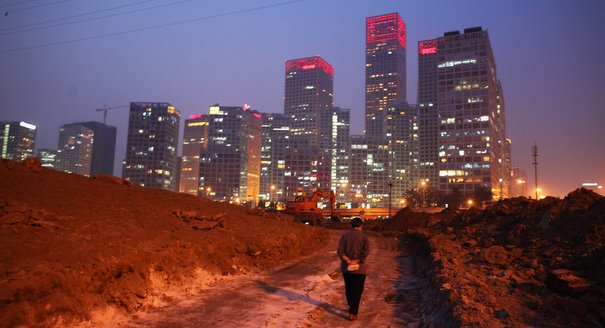
China’s recent surge in infrastructure investment may improve economic conditions for now, but if it continues to slow household income growth, its net effect may be to simply constrain consumption and prevent a more rapid rebalancing of the economy.
Source: South China Morning Post

After all, if China has fewer good roads, bridges, airports, and high-speed railways than rich countries do, how can the mainland suffer from too much infrastructure investment?
It can. Infrastructure investment in China is different than that of rich countries because while high levels of infrastructure may cost as much to build on the mainland as in rich countries, their economic benefits are likely to be much lower.
To see why, let's assume that China builds a high-speed railway similar to France's TGV. As someone who has travelled on the TGV, I can say that it is a remarkable train and it may very well create so much convenience for French commuters that it justifies its considerable cost.
But would it have the same economic benefit in China? The Chinese, after all, are as eager to travel in comfort and convenience as are the French, and so shouldn't a TGV line on the mainland provide the same benefits as it would in France?
Maybe not. Aside from the fact that fewer Chinese might be able to afford it, the French are also more likely to put a higher economic value on their time and convenience, in part because of much higher incomes and productivity levels. An hour saved of French time has a greater economic value than an hour saved of Chinese time.
Some egalitarians might dismiss this line of reasoning and insist that there should be no difference in the economic value of time in China and France. But there is. An easy way to see why might be to ask French and Chinese households how much they would pay a month to save an hour of commuter time every day.
For a typical French household, paying US$100 a month, or less than 4 per cent of their income per capita, might be considered perfectly reasonable. For a typical Chinese household that same price would represent one-quarter of per capita income, and would almost certainly be considered much too high.
When China builds very high-quality infrastructure, directly or indirectly Chinese households will be required to pay for it, usually in the form of sluggish wage growth and very low interest rates on their bank deposits, and if they are asked to pay a much larger share of their income than they would normally choose to, they will be worse off, not better off.
This matters especially to consumption. Everyone agrees that without a strong recovery in American consumption, the only hope for China to continue its high economic growth rates in a sustainable way is if mainland consumption surges.
But the growth in Chinese consumption will necessarily be limited by the growth in Chinese household income, and Chinese household income cannot grow quickly enough if they are forced to pay for infrastructure that's not economically justified.
That is why there is a limit to how much infrastructure China can build. Ironically, China's problem may very well be that it already has the best infrastructure in the world for its level of development.
That means that it is much closer to the economically optimal level of infrastructure than most countries, including the rich ones. In that case, it also has the least room for a significant improvement.
A surge in infrastructure investment may have positive economic effects for now, but if it is paid for over the medium term by much slower household income growth, its net effect may be simply to subtract from future consumption growth.
That will slow China's growth in the medium term and prevent a more rapid rebalancing of the economy away from investment and exports and towards consumption.
Infrastructure investment can be too good for a country's development level.

Nonresident Senior Fellow, Carnegie China
Michael Pettis is a nonresident senior fellow at the Carnegie Endowment for International Peace. An expert on China’s economy, Pettis is professor of finance at Peking University’s Guanghua School of Management, where he specializes in Chinese financial markets.
Recent Work
Michael Pettis
Michael Pettis
Carnegie does not take institutional positions on public policy issues; the views represented herein are those of the author(s) and do not necessarily reflect the views of Carnegie, its staff, or its trustees.

The European far right might fail to steer EU policy in the direction Russia wants, but they will create enough chaos inside Europe to benefit the Kremlin.

Dimitar Bechev

A summer of escalation in the Black Sea has hurt Ukraine economically and is exacerbating world food security. A truce is needed—as is a broader reframing of Europe’s Ukraine strategy.

Thomas de Waal

Why governance of rapidly evolving technology will be distributed and complex.


Stewart Patrick, Scott Singer
It should address the shortcomings of previous crisis communication efforts and adapt to the demands of frontier AI.

Lucy Luo

If the Russian-speaking community in Latvia cannot articulate their interests without being seen as disloyal, they could end up embracing a pro-Kremlin agenda.

Sergejs Potapkins