

Other
- +1
Dmitri Trenin, Sergei Aleksashenko, Sam Greene, …
{
  "authors": [
    "Sam Greene"
  ],
  "type": "legacyinthemedia",
  "centerAffiliationAll": "dc",
  "centers": [
    "Carnegie Endowment for International Peace",
    "Carnegie Russia Eurasia Center"
  ],
  "collections": [],
  "englishNewsletterAll": "ctw",
  "nonEnglishNewsletterAll": "",
  "primaryCenter": "Carnegie Russia Eurasia Center",
  "programAffiliation": "SCP",
  "programs": [
    "Sustainability, Climate, and Geopolitics"
  ],
  "projects": [],
  "regions": [
    "Caucasus",
    "Russia",
    "North America"
  ],
  "topics": [
    "Political Reform",
    "Democracy",
    "Climate Change"
  ]
}
Source: Getty
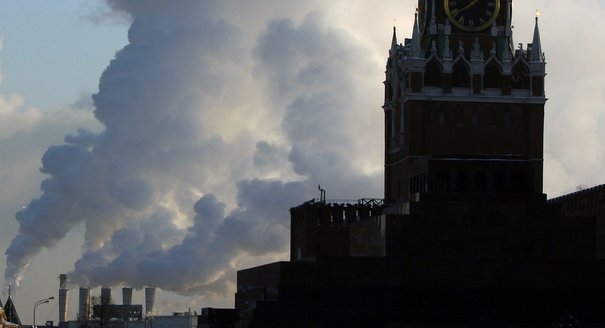
As the world headed to Copenhagen to talk about climate change, Russians were largely silent on the subject; by most accounts, the average Russian citizen doesn’t think about global warming at all.
Source: Blog di Vision

In some ways, the low profile of climate change in Russia bodes well for a robust eventual Russian contribution to reducing carbon emissions. The salient issue for the Kremlin is efficiency: Russia, along with Saudi Arabia, is one of the world’s least energy efficient economies, placing strains on government, public utilities, power generators and hydrocarbon exporters such as Gazprom. Increasing efficiency, in order to reduce overall energy usage in Russia per household and unit of economic production, and thus to maximize gains to corporations and the budget, is a top priority, at least rhetorically. If that rhetoric ever becomes reality, a more efficient Russia will become a powerful contributor to whatever agreement emerges from Copenhagen, even if Russia never had the climate in mind.
The problem, of course, is that there is little sign of Russia moving beyond the rhetoric. Already, one of Russia’s envoys to Copenhagen, has signaled that Russia will not sacrifice growth for the sake of meeting emission reduction targets, and that signals an intention to continue with carbon-intensive approaches. That is unfortunate, but it is understandable, if you take into account how Russia works. Despite the fact that there is a broad consensus among government officials at all levels and virtually all sectors of the economy that energy use has to be addressed systematically, large-scale progress will require massive, coordinated investment by government and business across sectors, which will bring returns only in the mid to long term. Given weak property rights, rampant corruption and shallow political institutionalization, however, economic actors – and, in Russia, that includes government officials and bureaucrats – operate with very short time horizons. As a result, no one can be sure that coordinated efforts will be sustained, and that rules, such as tax benefits, meant to stimulate beneficial investment, will remain in place long enough for investments to pay off. The outcome is paralysis.
While Russia is not constructively at the table in Copenhagen, if climate negotiators want a deal that will work – and that means a deal that is at least potentially acceptable to Russia now and in the future – there are things they can do to help overcome these difficulties. The key will be to provide institutional frameworks outside Russia with which Russian actors can integrate, thus providing some of the stability and long-term perspectives sorely lacking in Moscow itself. A global carbon market can be one such mechanism, if it allows Russian companies to invest at home with the prospect of making profits abroad. International financial institutions might also provide financing on favorable terms to Russian utilities, municipalities and other key players, replacing incentives that are not likely to be forthcoming from the Kremlin. It is clichéd to say that, if anything is to be achieved in Copenhagen, negotiators will have to think outside the box. But if they are creative, they may well find a way to bring a reluctant Russia inside the box.
Former Deputy Director for Operations, Moscow Center
Sam Greene was a deputy director for operations at the Moscow Center. He joined the Moscow Center in 2005. Previously, he was senior media program advisor for the New Eurasia Foundation, and a London and Moscow correspondent for FT Business.
Recent Work
Dmitri Trenin, Sergei Aleksashenko, Sam Greene, …
Sam Greene
Carnegie does not take institutional positions on public policy issues; the views represented herein are those of the author(s) and do not necessarily reflect the views of Carnegie, its staff, or its trustees.

The domestic impacts of how long it is taking to end the war in Ukraine have pushed the French electorate to the political extremes and compromised the country’s diplomatic capacity.

Rym Momtaz

Sergei Kiriyenko used Russia’s parliamentary vote to further hone his strategy of corporate mobilization that is designed to maximize votes for United Russia.

Andrey Pertsev

Before the next wave of EU enlargement takes place, the union needs to grapple with thorny questions of how power is distributed among its members.


Emil Sondaj Hansen, Ditte Brasso Sørensen

The European far right might fail to steer EU policy in the direction Russia wants, but they will create enough chaos inside Europe to benefit the Kremlin.

Dimitar Bechev

A summer of escalation in the Black Sea has hurt Ukraine economically and is exacerbating world food security. A truce is needed—as is a broader reframing of Europe’s Ukraine strategy.

Thomas de Waal