

Q&A
Mark Medish
{
  "authors": [
    "Mark Medish"
  ],
  "type": "legacyinthemedia",
  "centerAffiliationAll": "dc",
  "centers": [
    "Carnegie Endowment for International Peace",
    "Carnegie Russia Eurasia Center"
  ],
  "collections": [],
  "englishNewsletterAll": "ctw",
  "nonEnglishNewsletterAll": "",
  "primaryCenter": "Carnegie Endowment for International Peace",
  "programAffiliation": "russia",
  "programs": [
    "Russia and Eurasia"
  ],
  "projects": [],
  "regions": [
    "Eastern Europe",
    "Ukraine"
  ],
  "topics": [
    "Political Reform",
    "Economy",
    "Foreign Policy"
  ]
}
Source: Getty
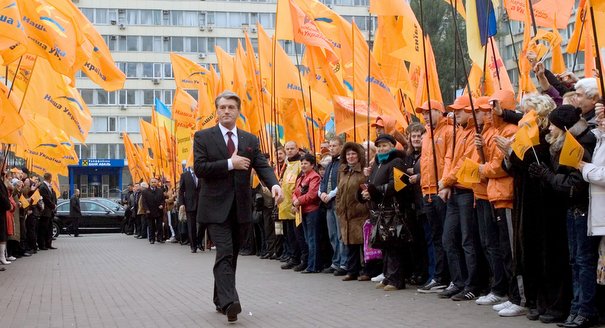
Whoever wins the upcoming presidential election in Ukraine must lead a country divided by identity issues and hit hard by the global financial meltdown, while maintaining a delicate balance between Western integration and Eastern cultural roots and affinities.
Source: International Herald Tribune

The country of 46 million has been one of the hardest hit by the global financial meltdown, suffering a sharp currency devaluation and a projected 14 percent GDP drop this year.
President Viktor Yushchenko, once the Orange hero, is now polling in low single digits. Much like Lech Walesa in Poland a generation ago, the out-of-touch Yushchenko has unceremoniously morphed from national icon of change into political footnote.
The January ballot is likely to lead to a run-off between Prime Minsiter Yulia Tymoshenko, a feisty populist, and Viktor Yanukovich, a drab but steady former premier and Yushchenko rival, whose Party of Regions boasts the strongest organization.
Both are pragmatic leaders. But whichever wins will face enormous challenges, foremost restarting the anti-crisis program with the IMF, which suspended its $16 billion lending facility last month due to the bitter political impasse between Yushchenko and Tymoshenko.
The winner will also need to remember that to lead Ukraine is to balance East and West. This imperative reflects the pressures of both external geopolitics and internal demographics.
Russia and the United States tend to view Ukraine as a key battleground in a cosmic proxy war between East and West. Both have a bad habit of trying to pick winners in Ukrainian politics. These interventions, naïve in their own ways, tend to backfire, often at Ukraine’s expense.
Russian meddling fueled the Orange backlash against the mediocre Leonid Kuchma and his cronies and ended in a series of crippling winter gas cut-offs and sabre-rattling over Crimea.
Meantime, the U.S. expected far more from Yushchenko than he could deliver, deepening his isolation at home. The curse of U.S. foreign-policy idealism, whether neoconservative or liberal, is to make the best the enemy of the good.
By putting more emphasis on the symbolism of a failed NATO membership bid than the unglamorous work of energy reform, the U.S. did no favor for Ukraine’s security. It should be clear that an independent Ukraine must not consume Russian-sourced energy as though it were still part of the U.S.S.R.
By contrast, Russia’s designs on Ukraine are hardly idealistic. At the NATO summit last year, Vladimir Putin reportedly remarked to former president George W. Bush, “You understand, George, that Ukraine isn’t even a country. What is Ukraine? Part of its territory is Eastern Europe, and part of it, a significant part, was given by us.”
Political bullies can be clever at implanting a grain of truth in their predatory barbs. Like other European nations, Ukraine’s ethnicity is mixed and its borders were not God-given. These things emerged through collisions of tribes, ethnic intermingling and considerable bloodshed over centuries.
Western Ukraine — Galicia and Bukovina — were Habsburg lands and never part of the czarist empire. The Crimean peninsula was transferred from the Russian Republic to Soviet Ukraine by Nikita Khrushchev in 1954, when both were part of the Soviet Union.
Ukraine faces deep identity issues. Ethnic Russians are roughly 20 percent of the population, and many more Ukrainians speak Russian. The languages are close, like High German and Bavarian or Danish and Swedish.
Europe prides itself on what Freud called “the narcissism of small differences.” However, Ukrainian nationalists would be wise not to overplay their hand, as Yushchenko often has done on sensitive language and historical issues.
In the 21st century, Ukraine needs to pursue its own path as a pluralist democracy and emerging market, balancing Western integration with a respect for its older cultural roots and affinities. Despite the present economic crisis and wide dissatisfaction with the political elite, Ukraine has a bright future. It has fertile land, solid industry and well-endowed human capital.
It also has a libertarian Cossack streak that explains how Ukraine came into being — precisely because of the proud self-reliance of its diverse people. The streets of Kiev, Lvov, Kharkov, Dniepropetrovsk and Simferopol (forgive the Russian transliterations) today have a distinct whiff of freedom, and they should keep it.
What should the West do to help? The U.S. needs to continue balancing its important “reset” policy with Russia by reassuring its neighbors, foremost Ukraine, of its active commitment.
It is the fate of the post-Soviet countries to be part of what Moscow calls the “near abroad.” While these states will always be near, it must be the policy of the U.S. and European Union to make sure they remain “abroad,” and free and prosperous.
Earlier this year, a senior Ukrainian official, anxious about the reset, asked me whether the Obama adminsitration would “trade us for something like cooperation on Iran.” I told her that the U.S. was rooting for Ukraine even when Leonid Kravchuk and Leonid Kuchma, less than stellar figures, were its elected leaders. This will not change.
Yet Ukrainians remember lost dreams of statehood during the two great European wars in the 20th century. And they remember the “Chicken Kiev” speech of President George H.W. Bush to the Ukrainian Supreme Soviet on Aug. 1, 1991, just months before the unraveling of the U.S.S.R., when he said, “Americans will not support those who seek independence in order to replace a far-off tyranny with a local despotism.” Bush had uncannily bad timing, but his underlying point about the need for political maturity remains important.
Ukrainians and their Western partners alike should stick to a balanced path of reform and long-term sustainability, not quick fixes and grand gestures. The end of the Orange era will not be the end of Ukraine's independence — nor of its Euro-Atlantic identity.
Former Visiting Scholar
Medish served in the Clinton administration as special assistant to the President and senior director for Russian, Ukrainian, and Eurasian Affairs on the National Security Council from 2000 to 2001.
Recent Work
Carnegie does not take institutional positions on public policy issues; the views represented herein are those of the author(s) and do not necessarily reflect the views of Carnegie, its staff, or its trustees.

For every ruble allocated to social policy, health, and education in 2027, double that amount is earmarked for the army, the police, and the security services.

Alexandra Prokopenko

The acknowledgment has sparked fears of a new arms race with China and Russia.

Chris O’Meara
Smaller powers cannot go it alone, but Canadian history shows that integration with the United States will not always be benign.
Paul Samson

The European Commissioner for Trade is headed to China. But after President Xi’s bridge-building visit to Washington, can a more isolated EU overcome Beijing’s stranglehold on critical raw materials? Who will blink first?

Rym Momtaz, ed.

The summit may be remembered as a fatal blunder, when Washington, Beijing, and the AI industry collectively chose ceremony over action.

Jeffrey Prescott