• Research
  • Emissary
  • About
  • Experts
Carnegie Global logoCarnegie lettermark logo
DemocracyIran
  • Donate
{
  "authors": [
    "Tiffany Ng"
  ],
  "type": "other",
  "centerAffiliationAll": "dc",
  "centers": [
    "Carnegie Endowment for International Peace"
  ],
  "collections": [],
  "englishNewsletterAll": "asia",
  "nonEnglishNewsletterAll": "",
  "primaryCenter": "Carnegie Endowment for International Peace",
  "programAffiliation": "AP",
  "programs": [
    "Asia"
  ],
  "projects": [],
  "regions": [
    "South Asia",
    "Afghanistan",
    "East Asia",
    "China"
  ],
  "topics": [
    "Economy",
    "Security"
  ]
}
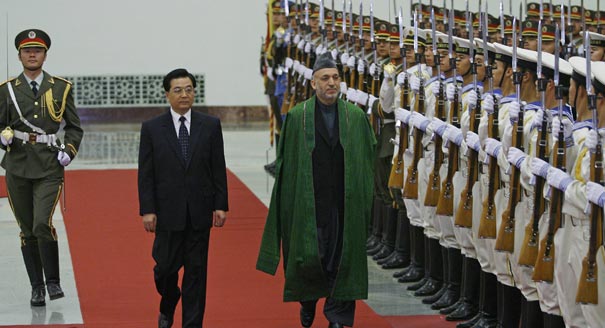
Source: Getty

Other

China’s Role in Shaping the Future of Afghanistan

China's economic investment in Afghanistan provides an opportunity for Afghan development that could help stabilize the country—an outcome that would benefit not only Afghanistan and China, but also the United States.

Link Copied
By Tiffany Ng
Published on Sep 1, 2010
Program mobile hero image

Program

Asia

The Asia Program in Washington studies disruptive security, governance, and technological risks that threaten peace, growth, and opportunity in the Asia-Pacific region, including a focus on China, Japan, and the Korean peninsula.

Learn More

  • China has steadily increased its economic aid and investment in Afghanistan, most notably with a $3.5 billion deal to develop the Aynak copper mine. At the same time, it plays a very limited security role and has refused any direct military involvement.
  • Western commentators have eyed China’s approach to Afghanistan with suspicion and resentment, accusing China of “free-riding” and snapping up investment deals at the expense of the United States, which is paying dearly in blood and treasure.
  • While the United States and China share the goal of a stable and prosperous Afghanistan, fundamental differences in their basic strategies exist. China does not want to pressure Pakistan, nor does it want to align itself too closely with the United States, for fear of exacerbating the terrorist threat to itself or facilitating a long-term American presence in the region. By maintaining its distance and even-handed diplomacy, Beijing is positioning itself to work with whoever controls Kabul.
  • China has the potential to make important contributions to Afghan stability. State-owned Chinese corporations are uniquely risk-tolerant and can help pave the way for future investments. The Chinese also enjoy a more positive relationship with Afghans, making their investments less likely to be targeted for attack by insurgents. These investments can stimulate economic growth that aid money alone cannot.
  • U.S. policy makers should work with Afghanistan to ensure that such investment benefits the local people. Given China’s reluctance to openly cooperate with the United States in Afghanistan, Washington should help Kabul to effectively manage and maximize the positive impact of China’s involvement in Afghanistan through better aid coordination, transparency, and training.

About the Author

Tiffany Ng

Former Junior Fellow, Asia Program

Tiffany Ng
Former Junior Fellow, Asia Program
EconomySecuritySouth AsiaAfghanistanEast AsiaChina

Carnegie does not take institutional positions on public policy issues; the views represented herein are those of the author(s) and do not necessarily reflect the views of Carnegie, its staff, or its trustees.

More Work from Carnegie Endowment for International Peace

  • Commentary
    China’s Energy Security Doesn’t Run Through Hormuz but Through the Electrification of Everything

    Across Asia, China is better positioned to withstand energy shocks from the fallout of the Iran war. Its abundant coal capacity can ensure stability in the near term. Yet at the same time, the country’s energy transition away from coal will make it even less vulnerable during the next shock.


      • Damien Ma

      Damien Ma

  • Ukraine's President Volodymyr Zelensky (R) and Poland's Prime Minister Donald Tusk attend a press conference at the Mariinskyi Palace in Kyiv on February 5, 2026, amid the Russian invasion of Ukraine.
    Article
    Kindred Nations, Uneasy Neighbors: Polish-Ukrainian Relations in the Crucible of Russia’s War

    The full-scale invasion cemented Ukraine’s determination to sever its ties with Russia; reimagining the Poland-Ukraine partnership can accelerate Kyiv’s westward alignment and improve the security of both countries.

      Eric Green

  • Commentary
    Southeast Asia’s Agency Amid the New Oil Crisis

    There is no better time for the countries of Southeast Asia to reconsider their energy security than during this latest crisis.

      Gita Wirjawan

  • Commentary
    Fuel Crisis Forces Politically Perilous Trade-Offs in Indonesia

    As conflict in the Middle East drives up fuel costs across Asia, Indonesia faces difficult policy trade-offs over subsidies, inflation, and fiscal credibility. President Prabowo’s personalized governance style may make these hard choices even harder to navigate.

      Sana Jaffrey

  • Commentary
    Emissary
    In Its Iran War Debate, Washington Has Lost the Plot in Asia

    The United States ignores the region’s lived experience—and the tough political and social trade-offs the war has produced—at its peril.

      Evan A. Feigenbaum

Get more news and analysis from
Carnegie Endowment for International Peace
Carnegie global logo, stacked
1779 Massachusetts Avenue NWWashington, DC, 20036-2103Phone: 202 483 7600Fax: 202 483 1840
  • Research
  • Emissary
  • About
  • Experts
  • Donate
  • Programs
  • Events
  • Blogs
  • Podcasts
  • Contact
  • Annual Reports
  • Careers
  • Privacy
  • For Media
  • Government Resources
Get more news and analysis from
Carnegie Endowment for International Peace
© 2026 Carnegie Endowment for International Peace. All rights reserved.