

Commentary
Thomas de Waal
{
  "authors": [
    "Thomas de Waal"
  ],
  "type": "legacyinthemedia",
  "centerAffiliationAll": "dc",
  "centers": [
    "Carnegie Endowment for International Peace",
    "Carnegie Europe",
    "Carnegie Russia Eurasia Center"
  ],
  "collections": [],
  "englishNewsletterAll": "ctw",
  "nonEnglishNewsletterAll": "",
  "primaryCenter": "Carnegie Europe",
  "programAffiliation": "russia",
  "programs": [
    "Russia and Eurasia"
  ],
  "projects": [],
  "regions": [
    "Middle East",
    "Türkiye",
    "Caucasus",
    "Azerbaijan",
    "Armenia"
  ],
  "topics": [
    "Security"
  ]
}
Source: Getty
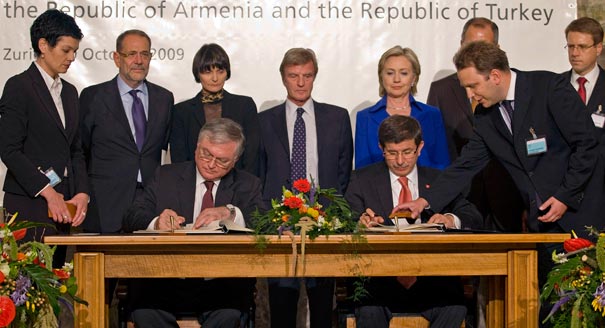
A revival of the Turkish-Armenian Protocols would benefit the entire region, but it will require increased effort to convince both the Turkish public and Azerbaijan to support the normalization process.
Source: ArmInfo Independent News Agency

There is a very negative mood in Armenia at the moment about the Protocols process with Turkey and the way it came to an end in April. Many Armenians are saying that Turkey entered the normalization process in bad faith and never intended to pursue it to the end.
Do you think it is not true?
I understand Armenian frustration but I do believe that the Turkish side was sincere about the normalization process and that it still has life in it. In the last few months I have had discussions with American, Swiss, Turkish and Armenian officials and the view that the Protocols process was genuine but that it was hurried and mismanaged.
What do you think is the problem?
I think there were two main problems. Firstly, there were internal disagreements amongst the Turkish elite as to the importance of the process. Turkish President Abdullah Gul adopted it as his personal initiative while Prime minister Erdogan was more cautious. Perhaps more time was needed for domestic discussions inside Turkey. Secondly, not enough was done to convince the Azerbaijanis that an Armenian-Turkish agreement was in their long-term interest. Clearly, if the Armenia-Turkey border were to open it would be a symbolic defeat for Azerbaijan. But within quite a short time, I believe the “opening up” of Armenia and the lifting of the Armenians’ psychological burden of seeing Turkic enemies on either side would change the atmosphere over the Nagorny Karabakh dispute and make it more liable to resolution.
Do you think elaboration of this document would give positive results?
This argument was not made sufficiently to Azerbaijan and the Azerbaijanis felt they were being deliberately excluded from the process—by for example the non-invitation of President Ilham Aliev to President Obama’s nuclear summit in April. This made them work hard to do everything to spoil it. I believe that if U.S. Secretary of State Hillary Clinton had travelled to the Caucasus not in July, but in January, for example, and publicly made the case in Baku that Armenia-Turkey normalization would not hurt Azerbaijan, then it might have helped stop the Azerbaijanis from intervening to stop the process.
What is your forecast for the future in Armenia-Turkey relations? What may make the parties normalize relations?
The situation does not look good at the moment but there is still a fairly good chance that the Turkish government can come back to the Protocols next summer after the next election. This is dependent on the AK Party winning a majority in parliament—something that seems more likely after their success in the parliamentary referendum. And it will require pressure from Western countries to make this issue, rather than many others, a foreign policy priority for Turkey. But it is still quite possible. Opening the border with Armenia is a lot easier for Turkey than resolving its problems with Israel.
You have published a new book on the Caucasus: “The Caucasus: An Introduction”. What specificity does it have?
My new book, The Caucasus: An Introduction, is more intended for the Western English-speaking reader than for the reader in the Caucasus. It is intended as a general guide to the South Caucasus, its history, politics and conflicts. It is quite short—around 230 pages—with plenty of maps and a chronology. So it is a really a book about this region for the busy person who does not have time to read ten books.
How may it be beneficial for the decision-makers in the region?
This is not intended as a “policy book” but there are several conclusions I can draw, having written it. One is that history is a deceptive thing and that national narratives are more “constructed” than real. In the 19th century for example Armenians and Shiite Azerbaijanis both fought in the tsarist Russian army against Sunni Turks. In that period the biggest enemies for the Georgians were the Turks and for the Abkhaz it was the Russians. So that makes me conclude that political circumstance rather than deep cultural or ethic differences that makes people enemies.
Another conclusion is that the best future for the South Caucasus is as an integrated region and transport hub, connecting Russia, Iran and Turkey, the Black and Caspian Seas. That means that outsiders must work harder on regional initiatives and not just treat policy towards the South Caucasus as a relationship with three different governments in Baku, Tbilisi and Yerevan. At the moment that is a Utopian vision, given the smoldering volcano of the Karabakh conflict but it is one we should aim for in the future.

Senior Fellow, Carnegie Europe
Thomas de Waal is a senior fellow at Carnegie Europe, specializing in Eastern Europe and the Caucasus.
Recent Work
Thomas de Waal
Thomas de Waal
Carnegie does not take institutional positions on public policy issues; the views represented herein are those of the author(s) and do not necessarily reflect the views of Carnegie, its staff, or its trustees.

Japan’s long-term security policy is driven by concerns about China, and there is little appetite for (or interest in) pursuing a confrontation with Moscow.

James D.J. Brown

Russia is testing the waters of NATO’s mutual defense clause. What do strikes in Romanian territorial waters mean for the alliance’s posture toward Moscow?

Dimitar Bechev
Why Pakistan, Saudi Arabia, and Turkey are joining forces on regional security.


Alper Coşkun, Amr Hamzawy
The truth of the strategic situation is that Europe and Russia are extremely unlikely to be able to “turn the page” on their confrontation within the next two decades.
Arkady Moshes
Protests in Iran follow a similar pattern: Economic grievances turn into political protests that spread nationwide. But increased state repression has begun to shift the arrangement.

Eric Lob