

Paper
Adam Baczko, Gilles Dorronsoro, Arthur Quesnay
{
  "authors": [
    "Gilles Dorronsoro"
  ],
  "type": "legacyinthemedia",
  "centerAffiliationAll": "dc",
  "centers": [
    "Carnegie Endowment for International Peace"
  ],
  "collections": [],
  "englishNewsletterAll": "ctw",
  "nonEnglishNewsletterAll": "",
  "primaryCenter": "Carnegie Endowment for International Peace",
  "programAffiliation": "SAP",
  "programs": [
    "South Asia"
  ],
  "projects": [],
  "regions": [
    "South Asia",
    "Afghanistan"
  ],
  "topics": [
    "Foreign Policy"
  ]
}
Source: Getty
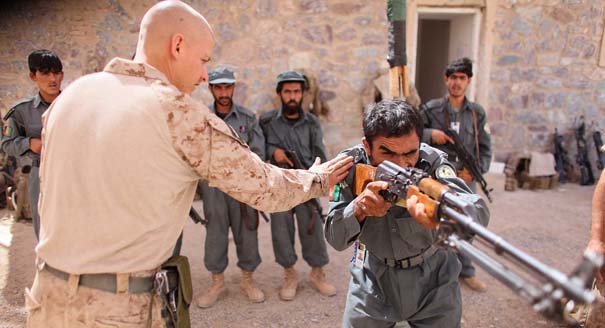
With the Europeans set to withdraw from Afghanistan by 2014, politicians in Washington risk an open-ended American commitment to the war with little benefit to U.S. security if they do not negotiate a settlement with the insurgents.
Source: The National Interest

The two crucial elements of the Afghan strategy defined late last year are now gone. The July 2011 date for the start of the withdrawal seems to be forgotten and General David Petraeus is replacing the population-centered strategy of minimizing civilian casualties with search and destroy operations focused on killing as many Taliban as possible that are reminiscent of the Vietnam War.
During the November NATO summit in Lisbon, NATO and Afghanistan leaders agreed that the end of combat operations should be in 2014 after the completion of a phased transfer of security responsibility to Afghan forces. But leaders admit that there will be a continuous presence of foreign troops in an advisory role. Will the new time frame and strategy achieve results?
In the best-case scenario, a weak government in Kabul will still be totally dependent on foreign aid, especially to pay its overdeveloped military, and it won't control more than the big cities and some roads. And the Taliban will keep control of the Pashtun countryside—at a minimum—where they are currently building a shadow state.
So, even though the war is justified in Washington by the risk of al-Qaeda coming back to Afghanistan, it's obvious that the group will have a sanctuary, as the Taliban will retain power in large portions of the country. This means that the new strategy—even in the most optimistic outcome—will not protect U.S. interests. Only a negotiated settlement with the insurgents could achieve American objectives, but, so far, the political cost in Washington of "surrender" is perceived to be too high.
And this is the best-case scenario. The most likely course of events will look quite different. The dissymmetry between the European and the American commitments at the Lisbon summit was quite clear. On the one hand, whatever the situation is on the ground, it's clear that the Europeans will be out of Afghanistan in four years—or earlier. On the other, the U.S. commitment is now open-ended. This point is not a mere nuance, it's incredibly important.
Contrary to the rosy narrative often heard in Washington, 2010 has been an excellent year for the insurgents. They made significant gains in the North and the East and their morale is excellent, as demonstrated by the failure of the Karzai government to entice insurgents toward its leadership. In addition, Pakistan's support for the Taliban has never been more active. This is partially due to the feeling in Pakistan that the United States is definitively moving toward India.
In contrast to the success enjoyed by the insurgency, the coalition's progress in the South is debatable at best. And even then, it is only short term and tactical, as there is no Afghan state to continue its efforts. Compounding the problems, the intensity of the fight—there are more operations today than in Iraq during the surge—alienates the Afghan population and helps to explain the growing number of insurgents nationwide. The Afghan army is still unable to operate independently and, with the disappearance of the state structure in districts, the very survival of government institutions is doubtful.
If this, more sober, analysis turns out to be right, 2011 will see a growing Taliban presence across the country and the fight in the South will be a stalemate. With the Europeans set to withdraw, the unavoidable conclusion is that the United States will have to send reinforcements just to contain the Taliban. The new strategy must then be seen as a definitive Americanization of the Afghan war, with an open-ended commitment and no hope to achieve anything meaningful for U.S. security.
The projected cost of the war in Afghanistan from 2001 to 2014—thousands of casualties and expenditures of over $1 trillion—is the price tag for a dysfunctional political system in Washington. It's time for the United States and its allies to face the facts on the ground, and negotiate a settlement with the insurgents before it's too late.
Former Nonresident Scholar, South Asia Program
Dorronsoro’s research focuses on security and political development in Afghanistan. He was a professor of political science at the Sorbonne in Paris and the Institute of Political Studies of Rennes.
Recent Work
Adam Baczko, Gilles Dorronsoro, Arthur Quesnay
Gilles Dorronsoro
Carnegie does not take institutional positions on public policy issues; the views represented herein are those of the author(s) and do not necessarily reflect the views of Carnegie, its staff, or its trustees.

The EU can impose sanctions but struggles to enforce them without the United States. With Washington increasingly disinterested in backing European interests, the bloc must now fend for itself.


Nicu Popescu, Tiago Antunes
Global and rising powers will need to engage with Africa’s priorities and agency in order to secure the continent’s increasingly attractive partnerships.

Fonteh Akum

Rubio’s recent visit brought welcome attention, but more capital requires governance changes that may be a hard sell for regional governments.

Jennifer B. Murtazashvili
America’s foreign-policy objectives have grown more demanding while Americans have demanded greater focus on their own affairs.
Stephen Wertheim

Japan’s long-term security policy is driven by concerns about China, and there is little appetite for (or interest in) pursuing a confrontation with Moscow.

James D.J. Brown