

Commentary
The Bureau of Industry and Security needs to adjust its focus and practices to maintain its position as the U.S. government’s primary champion of international technological competition.
Geoffrey Irving
{
  "authors": [
    "Matt Ferchen",
    "Alicia García-Herrero"
  ],
  "type": "legacyinthemedia",
  "centerAffiliationAll": "",
  "centers": [
    "Carnegie Endowment for International Peace",
    "Carnegie China"
  ],
  "collections": [
    "China and the Developing World",
    "China’s Foreign Relations"
  ],
  "englishNewsletterAll": "",
  "nonEnglishNewsletterAll": "",
  "primaryCenter": "Carnegie China",
  "programAffiliation": "",
  "programs": [],
  "projects": [],
  "regions": [],
  "topics": [
    "Economy"
  ]
}
Source: Getty
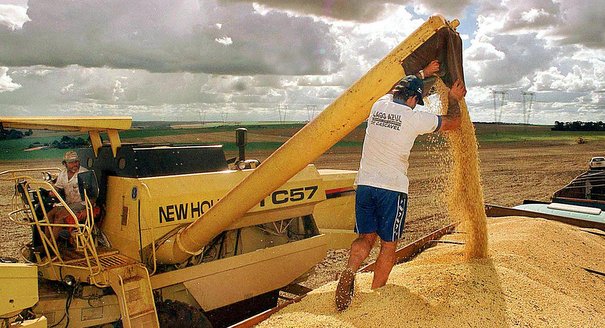
For the last decade South American exports of mining, agricultural, and energy commodities to China have boomed, leading countries like Argentina, Brazil, and Chile to worry about rising commodity dependency on China.
Source: China Economic Quarterly

If China’s economy collapsed tomorrow and Latin America’s China-driven commodity boom turned to bust, how hard would Latin American economies be hit? A decisive answer is impossible, because large fluctuations in China’s economy or demand for commodities would have myriad, global impacts. Instead of diving into the quicksand of infinite possibility, we offer a case study of three countries (Brazil, Chile and Argentina) and three commodities (iron ore, copper and soybeans) to gauge just how dependent major Latin American commodity exporters are on Chinese demand.
Our findings show that, while Latin American commodity exporters have become far more dependent on China since 2002, total exports remain a relatively small and declining part of these countries’ economies. A corollary of this is that, contrary to conventional wisdom, Chinese demand for Latin American commodities played only a limited role in minimizing the impact of the global financial crisis since 2008. Absent Chinese demand, annual GDP growth in Brazil, Chile and Argentina would have slowed by only about one percentage point per year over the past decade.
Take soybeans. Ten years ago, China’s policy of soybean self-sufficiency helped keep its share of global demand to just 6%. But as millions more Chinese citizens demanded unfatty milk with their fatty pork, China abandoned its self-sufficiency policy and turned to world soy markets. Today China gobbles up half of the world’s soybeans, and soybean prices have surged more than threefold over the past decade. That is excellent news for Brazilian soybean farmers, who export more than half of their soybeans to China. And the story is similar for both iron ore and copper: more than half the world’s iron ore exports are shipped to Chinese steel factories, while nearly 30% of the world’s copper is used to wire Chinese homes.

How vulnerable are Latin American commodity exporters to shifts in Chinese demand? To measure this, we have created a “China export dependency index.” The index is a simple average (equal weighting) of three components.

Argentina’s soybean exports are the most dependent on Chinese demand both because China takes an extremely high share of its total soy exports (70%) and because Argentina’s soybean market power is extremely weak, as Argentina accounts for just 5% of world supply. Argentina’s dependence on Chinese demand was dramatically exposed in 2010 when China cut off all imports of Argentinean soy in a bilateral trade dispute. China’s position as the dominant importer enabled it to negotiate a settlement to its advantage. By contrast, Chile’s copper exporters are in a stronger position because they have more market muscle, controlling 35% of global exports.


That does not change the fact that Latin American commodity exporters are heavily and increasingly dependent on Chinese demand. One question, however, remains: how dependent are Latin American economies on Chinese commodity demand? The fact that China imports a lot of soybeans from Brazil, for example, does not necessarily mean that Brazil is economically dependent on those exports.

Calculating the impact of commodity exports on economic growth is tricky. One way is simply to take the contribution made by commodity export revenues, which requires adding the direct value of exports to an estimation of the rise in commodity prices accounted for by the increase in Chinese demand. Based on work done by Professor Rhys Jenkins of the University of East Anglia, who studied China’s effect on the prices of commodity exports for a number of Latin American countries, we estimate that Chinese demand directly contributed just 0.34 percentage points to annual GDP growth in Chile, 0.05 points in Brazil and 0.02 points in Argentina between 2002 and 2007. Of course, the indirect contribution from employment, investment and taxes might be higher – but the overall point stands: Latin America is not economically dependent on its commodity exports.
In fact, export-to-GDP ratios appear to be falling across Latin America, indicating that countries such as Brazil, Chile and Argentina are becoming less economically dependent on commodity exports, even as those exports continue to grow to China. This trend is partially a consequence of the global financial crisis, but also signals the significant role domestic demand has played in the region’s recent economic expansion. Net exports – total exports minus total imports – are not a significant driver of GDP growth in Brazil, Chile or Argentina, nor in Latin America as a whole. Moreover, the conventional wisdom that Latin American economies were saved by Chinese demand in the wake of the global financial crisis is simply false.
Nevertheless, the importance of China’s perceived role in the Latin American economy means that a major drop in Chinese demand would badly damage economic expectations, especially as so many of the region’s largest companies – Brazil’s Vale is a good example – rely so heavily on the Chinese market. If the Chinese commodity boom turned to bust, major exporters would be badly exposed, equity markets would tank, and thousands of farmers would struggle to sell their crops. But Latin America would have a good chance of weathering the storm.
This article originally appeared in China Economic Quarterly

Former Nonresident Scholar, Carnegie-Tsinghua Center for Global Policy
Ferchen specializes in China’s political-economic relations with emerging economies. At the Carnegie–Tsinghua Center for Global Policy, he ran a program on China’s economic and political relations with the developing world, including Latin America.
Alicia García-Herrero
Carnegie does not take institutional positions on public policy issues; the views represented herein are those of the author(s) and do not necessarily reflect the views of Carnegie, its staff, or its trustees.

The Bureau of Industry and Security needs to adjust its focus and practices to maintain its position as the U.S. government’s primary champion of international technological competition.

Geoffrey Irving

Depleted financial reserves and a shrinking tax base mean it is no longer possible to simultaneously deliver high defense spending, price stability, and economic growth.

Alexandra Prokopenko
U.S. trading partners in Asia are closely watching the dispute for signs of how it may affect their own interests.

Barbara Weisel
Amid celebrations of bilateral ties was a deeper focus on stability in the Middle East.

Amr Hamzawy

Xi, Putin, and other regional leaders are back-slapping in Bishkek, but the SCO has yet to answer the most serious questions about continental Asia's economic future.

Evan A. Feigenbaum