

In The Media
Lahcen Achy
{
  "authors": [
    "Lahcen Achy"
  ],
  "type": "legacyinthemedia",
  "centerAffiliationAll": "",
  "centers": [
    "Carnegie Endowment for International Peace",
    "Malcolm H. Kerr Carnegie Middle East Center"
  ],
  "collections": [],
  "englishNewsletterAll": "",
  "nonEnglishNewsletterAll": "",
  "primaryCenter": "Malcolm H. Kerr Carnegie Middle East Center",
  "programAffiliation": "",
  "programs": [],
  "projects": [],
  "regions": [
    "Maghreb"
  ],
  "topics": [
    "Economy"
  ]
}
Source: Getty
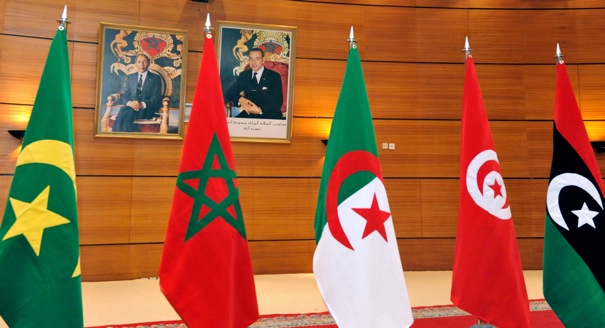
The Arab Maghreb countries are revisiting the long-dormant Arab Maghreb Union agreement in the hopes that regional integration can help them overcome rising instability and become competitive in this era of change.
Source: Al-Hayat

Attempts to achieve political integration in the Maghreb have been made since the AMU’s inception in 1989. A comprehensive strategy adopted in the town of Ras Lanuf, Libya, in 1991 planned for a transition to a free trade zone then to a customs union followed by the establishment of a common market by 2006. This plan failed miserably due to political tensions between member states and resistance to trade liberalization. The last AMU heads of state summit—the union’s decisionmaking body—was held in 1994.
Since then, the Maghreb countries individually signed free trade agreements with the European Union as well as the Arab world as part of the Greater Arab Free Trade Agreement and the Agadir Agreement, which includes Egypt and Jordan in addition to Morocco and Tunisia. The Arab Spring’s winds of change, the economic challenges faced by the Maghreb governments and the stifling economic crisis in Europe—the Maghreb countries’ main partner—have brought the largely inactive AMU back to the forefront.Currently, intraregional trade in the AMU does not exceed 3 percent of the region’s total trade, which is the lowest rate worldwide. Intraregional trade accounts for 60 percent of the trade within the European Union, 22 percent within the Association of Southeast Asian Nations, and 20 percent among the Mercosur countries. The weak integration in the Maghreb is also obvious when compared to that of other economic communities in Africa. Intraregional trade among the Southern African Development Community represents 30 percent of member states’ total trade. Likewise, intraregional trade within the Economic Community of West African States accounts for 20 percent those states’ total trade.
The Maghreb countries share a common historical and cultural heritage. The success of any economic integration project, however, requires a strong political will to overcome existing differences and build on mutual strategic interests to face various economic and security challenges. Today, some of the AMU’s leaders perceive regional integration as a strong response to the challenges facing the region, be it job creation or balanced regional development in the Maghreb countries.
Maghreb countries, currently, are relatively small and segmented markets. The establishment of a free trade zone or common market, with more than 80 million consumers, would create economies of scale and turn the region into an attractive investment hub. The United States and the European Union will seek to strengthen their economic and strategic relations with the Maghreb in the event of such integration.
The creation of a free trade zone among the Maghreb countries could increase intraregional trade by five times the prevailing figures. Economic complementarity already exists among Maghreb countries. Algeria and Libya, for instance, produce some of the largest amounts of oil and gas in Africa. Morocco and Tunisia, meanwhile, have diversified agricultural and manufacturing sectors. International experience reveals economic integration itself creates new opportunities for more complementarity based on the comparative advantages of each country.
Policymakers in the Maghreb must emphasize efficiency in the process of integration and take concrete and realistic measures that, if implemented, would generate short-term tangible results. They must also focus on specific sectors to serve as catalysts for the integration project. The most important steps of an efficient integration process can be summarized as follows:
First, dismantle tariff barriers that hinder the free flow of goods and that reduce trade and economic activity among the Maghreb countries.
Second, reopen roads and railways between Algeria and Morocco and work toward reducing shipping costs between the Maghreb countries. Shipping costs in the Maghreb are currently twice their average level in industrialized countries and exceed by 25 percent their average in developing countries. Intraregional trade in the Maghreb often passes through European ports before it reaches its final destination.
Third, remove administrative and technical barriers that impede fluid trade flows among Maghreb countries. Policymakers should pay attention to those arbitrary and unpredictable barriers imposed at borders with no legal basis.
Fourth, restore the credibility of the integration project by implementing transparent mechanisms to monitor, assess and settle trade disputes between companies operating across the Maghreb.
Fifth, upgrade the investment climate and improve economic governance. Policymakers should not limit integration in the Maghreb to trade policy reform. Existing administrative barriers and regulatory burdens increase transaction costs and have harmful effects on trade and investment.
Finally, Maghreb leaders should pursue regional integration as a complement to and not a substitute for multilateral relations within the World Trade Organization and free trade agreements with Turkey, Europe, the United States, and other regions. Regional integration can help the countries of the Maghreb overcome rising instability and become competitive in this era of change.
This piece was originally published in al-Hayat in Arabic.
Former Nonresident Senior Associate, Middle East Center
Achy is an economist with expertise in development, institutional economics, trade, and labor and a focus on the Middle East and North Africa.
Recent Work
Lahcen Achy
Lahcen Achy

With its public finances in shambles, the far right polling at 35 percent ahead of the 2027 presidential election, and a growing protest movement, is France’s crisis a threat to the EU’s geopolitical awakening?

Rym Momtaz, ed.

Russian strikes are weakening the economy sustaining Ukraine’s war effort. Closing the growing funding gap will require more European support and politically contentious reforms in Kyiv.

Balázs Jarábik
Economic recovery has brought Sri Lanka a modicum of stability, but domestic strains and great-power rivalry could test how long it lasts.

Avinash Paliwal
Policy proposals on sovereign debt must both match the scale of the challenge and be implementable within existing political constraints.
David McNair

For every ruble allocated to social policy, health, and education in 2027, double that amount is earmarked for the army, the police, and the security services.

Alexandra Prokopenko