

Commentary
Dmitri Trenin
{
  "authors": [
    "Dmitri Trenin"
  ],
  "type": "legacyinthemedia",
  "centerAffiliationAll": "",
  "centers": [
    "Carnegie Endowment for International Peace",
    "Carnegie Russia Eurasia Center"
  ],
  "collections": [
    "Arab Awakening"
  ],
  "englishNewsletterAll": "",
  "nonEnglishNewsletterAll": "",
  "primaryCenter": "Carnegie Russia Eurasia Center",
  "programAffiliation": "",
  "programs": [],
  "projects": [
    "Eurasia in Transition"
  ],
  "regions": [
    "Middle East",
    "Syria",
    "Caucasus",
    "Russia"
  ],
  "topics": [
    "Political Reform",
    "Security",
    "Foreign Policy"
  ]
}
Source: Getty
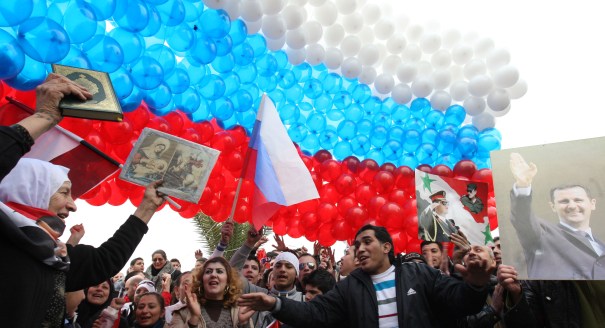
While there are a number of reasons behind Moscow’s stance on Syria, confronting the West and increasing tension in their relations with the broader Middle East is at odds with Russia’s wider interests.
Source: International Herald Tribune

Their mission was not to nudge Bashar al-Assad from power and offer him exile in Russia. Rather, the talk was about dialogue with the opposition, offering a referendum on a new constitution, and the Arab League resuming its “stabilizing” mission. Russia, for its part, would stand firm alongside China at the U.N. Security Council, preventing a formal condemnation of the Syrian regime, any outside military intervention, or any sanctions against it.
Coming so late in the game, the attempt at reconciliation is bound to fail. Syria’s civil war has de facto begun, and it will not end soon. America, Europe, Turkey and the Gulf states have already given Assad a thumbs down.But the Russian mediation might have had a chance if Lavrov and Fradkov had come to Damascus last summer, or even last fall, and kept coming in an exercise of shuttle diplomacy. Given Russia’s role as Syria’s traditional backer and arms supplier, Moscow might have been more successful as a peacemaker than Ankara. Today, Lavrov and Fradkov’s mission looks more like a face-saving gesture.
Russia’s stance on Syria is often explained in terms of Syria’s importance to Moscow. It is true that Syria is positioned in the strategic heart of the Middle East, and that Moscow’s links to the Assad family go back four decades.
None of this, however, should be exaggerated. Syria is not an ally; Tartus is a naval resupply facility rather than a naval base; and the total value of Russia’s arms trade with Syria during the previous decade amounted to around $1.5 billion, which makes Damascus Moscow’s seventh-largest client.
To understand Moscow’s attitude to Syria, and the sources of its disagreement with the West and a number of Arab states, one has to take a broader view.
Last year, Russia abstained in the Security Council on the Libya no-flight zone vote, thus allowing the resolution to pass. Soon what was billed as protection of innocent civilians from a massacre in Benghazi turned into NATO’s offshore war against the Libyan government, which finally resulted in the overthrow of the Qaddafi regime and the killing of the dictator along with many of his supporters and probably a number of civilians. That NATO’s military actions went way beyond the terms of the U.N. resolution did not seem to bother Western governments.
The Russian government is openly conservative; it abhors revolutions. This, however, is more than a self-serving ideological stance. When the Kremlin — or Fradkov’s office — looks at the Arab Awakening, they see democratization leading directly to Islamicization.
If the West’s historical analogy is Europe’s 1848 or 1989, theirs is Russia’s 1917. They cite recent election results in Tunisia and especially Egypt. They point out that post-Qaddafi Libya is chaotic, with a lot of the former regime’s weaponry finding its way into unsavory hands. In their view, Syria’s uprising could have even worse consequences in terms of sectarian violence and the potential to affect the country’s neighbors, particularly Lebanon and Israel.
Revolutions are bad enough, in the Kremlin’s view, but attempts to interfere in other countries’ civil wars can only make things worse.
The Russians appreciate that the United States and other Western powers would only intervene militarily if they could sustain zero losses themselves, as in Libya. Syria, however, is a more difficult case. Arming the Free Syria Army and providing it with intelligence will not be enough to prevail over Assad’s forces. A prospect of a wider war with Arab and Turkish participation looms on the horizon.
Such a war could only make sense if it were the first act of a more serious drama. Russians suspect that the real reason for the West’s pressure on Damascus is to rob Tehran of its only ally in the region. Behind the activity of the Gulf States, particularly Qatar, in the Syrian issue Moscow sees the rising regional influence of Saudi Arabia, Iran’s bitter rival in the region. Turkey’s “neo-Ottoman” ambitions are also playing a role. What the Russians are most worried about, however, is that Israel may strike at Iran, dragging in the United States and thus precipitating a major war with Iran sometime this year.
Russian policy makers may have a point or two when they discuss other people’s policies. They need, however, to step back and look at their own.
Delivering arms into a country going through civil war is damaging, both politically and morally. Confronting both America and Europe, even if Western policies are misguided, is clearly at odds with Russia’s wider interests. Telling Qatar to shut up is not merely undiplomatic, but unwise. And openly quarreling with Turkey and Saudi Arabia has to be avoided.
To this, some would say that, having lost $4 billion in Libyan arms and other contracts and facing the prospect of losing an equal amount in potential Syrian trade, Moscow has no other choice but to take a hard line. It will be a pity if, at the end of the day, this argument prevails.
This article originally appeared in The International Herald Tribune.
Former Director, Carnegie Moscow Center
Trenin was director of the Carnegie Moscow Center from 2008 to early 2022.
Recent Work
Dmitri Trenin
Dmitri Trenin
Carnegie does not take institutional positions on public policy issues; the views represented herein are those of the author(s) and do not necessarily reflect the views of Carnegie, its staff, or its trustees.
A leak of Russian gas price data helps establish that China is paying Russia far less than Central Asian countries and Gazprom’s former European customers.

Sergey Vakulenko

China’s political future will be shaped between now and next October. As the Communist Party enters its intense “campaign season” to prepare for a major political transition in 2027, reading Beijing's actions and responses may become more difficult as domestic politics weigh on its behavior more than usual.

Damien Ma

The EU can impose sanctions but struggles to enforce them without the United States. With Washington increasingly disinterested in backing European interests, the bloc must now fend for itself.


Nicu Popescu, Tiago Antunes
Global and rising powers will need to engage with Africa’s priorities and agency in order to secure the continent’s increasingly attractive partnerships.
Fonteh Akum

Rubio’s recent visit brought welcome attention, but more capital requires governance changes that may be a hard sell for regional governments.

Jennifer B. Murtazashvili