

In The Media
David Rothkopf
{
  "authors": [
    "David Rothkopf"
  ],
  "type": "legacyinthemedia",
  "centerAffiliationAll": "",
  "centers": [
    "Carnegie Endowment for International Peace"
  ],
  "collections": [],
  "englishNewsletterAll": "",
  "nonEnglishNewsletterAll": "",
  "primaryCenter": "Carnegie Endowment for International Peace",
  "programAffiliation": "",
  "programs": [],
  "projects": [],
  "regions": [
    "North America",
    "United States"
  ],
  "topics": [
    "Political Reform",
    "Security",
    "Military",
    "Foreign Policy"
  ]
}
Source: Getty
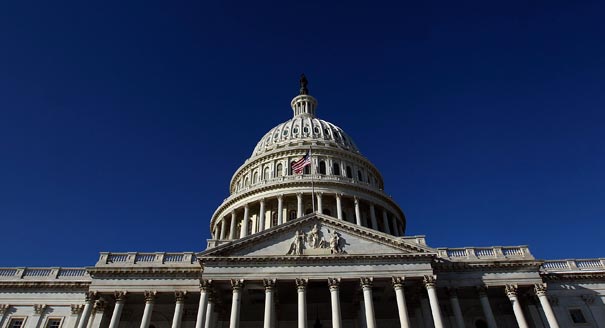
If America abandoned its visceral need for an enemy, it might actually be able to reset its economic priorities and start investing in the things that would make the country stronger, more prosperous, and safer again.
Source: Foreign Policy

Since the end of the Cold War, America has been on a relentless search for enemies. I don't mean a search in the sense of ferreting them out and defeating them. I mean that America seems to have a visceral need for them.
Many in the United States have a rampant, untreated case of enemy dependency. Politicians love enemies because bashing them helps stir up public sentiment and distract attention from problems at home. The defense industry loves enemies because enemies help them make money. Pundits and their publications love enemies because enemies sell papers and lead eyeballs to cable-news food fights.The Greeks, who once seemed to know a lot more about life than they do about fiscal management today, noted that for any drama to succeed it requires agon -- conflict. The same seems to hold true for politics and foreign policy. It's easier to run against a threat than it is to articulate a vision of where we should be headed and how to get there. Absent clear dangers, it's hard to persuade people to fund giant defense and intelligence establishments or to mobilize international coalitions. (Just add up how many international coalitions are primarily against things -- enemies, hunger, disease, climate change -- rather than for things.)
For the World War II generation, there were the Germans and the Japanese, vilified so much that even today they are the enemies against whom all others are measured. Then there were the Soviets, who were both dependably evil and happened to be a genuine threat. After the communist collapse, America tried to replace them but came up at first only with tin-pot bad guys like Manuel Noriega, Slobodan Milosevic, and "Baby Doc" Duvalier.
Then came the 9/11 attacks, and politicians simply crossed out the word "Soviet" in their stump speeches, replaced it with "terrorist" (despite the huge disparity in the nature and scope of the threats), and started scaremongering and spending like the good old days.
Now, as the United States winds down the wars that came of that, there seems to be a search for new bogeymen. In March, Republican presidential candidate Mitt Romney called Russia America's "No. 1 geopolitical foe," following up on his December complaint that Vladimir Putin is "a real threat to the stability and peace of the world." But in February he was warning against the risks posed by China's "prosperous tyranny." In March, it was nuclear North Korea, one of the "world's worst actors." Back in 2009, Romney wrote an op-ed calling Iran "the greatest immediate threat to the world since the fall of the Soviet Union, and before that, Nazi Germany," while in 2007 he called jihad "this century's nightmare."
Romney, of course, is not alone. Republican presidential contender Newt Gingrich similarly offered up the nearly hysterical assertion that Venezuelan President Hugo Chávez's "anti-American" alliances with Iran and within Latin America could present the biggest threat to the United States since the Soviet Union. (To be fair, it's worth noting that during the 2008 presidential campaign, Barack Obama also called Cuba and Venezuela "enemies.")
Of course, there are problems even with the more credible of these assertions. Putin may be anti-democratic, a troublemaker with a very misguided sense of how attractive his bare torso is, but his country is a shell of its Soviet self. Russia is in the midst of a demographic meltdown pretty much unprecedented since the Black Death, and the country is even sometimes cooperative with the United States on issues from nuclear weapons reduction to counterterrorism. China may be a rising power that often disagrees with the United States, but the two countries' economies are deeply interdependent. China has little history of global adventurism, and though it is a large country with a large economy, it is also still a very poor one focused on its own social problems. As for the Islamic fundamentalists, they fall into two categories: private actors who are dangerous but small (al Qaeda) and state actors who are dangerous but middleweight (Iran). They pose threats. They may view America as the enemy. But they are not big enough or organized enough to warrant organizing America's entire foreign policy around them as the country did during the so-called "Global War on Terror." The true damage they might inflict on the United States, while serious, is limited.
By far, the greatest threats to the United States right now are internal ones -- like that Big Mac. They don't come from terrorists. They come from political obstructionists and know-nothings who are blocking needed economic and political reforms, whether fixing a health-care system that poses a debt threat many times greater than the immense U.S. budget deficit or tackling the growing inequality in American society or overhauling the United States' money-corrupted, dysfunctional political process.
If America stopped searching for goblins under the bed, it might actually be able to reset its economic priorities and start investing in the things that would make the country stronger, more prosperous, and safer again, from infrastructure to energy security to better schools. What's more, Americans might find that a foreign policy that identified real risks but kept them in perspective and was more about deepening ties, finding common ground, and avoiding unnecessary conflict would work better than the tired us vs. them formulations of the recent past.

Former Visiting Scholar
David Rothkopf was a visiting scholar at the Carnegie Endowment as well as the former CEO and editor in chief of the FP Group.
Recent Work
David Rothkopf
David Rothkopf
Carnegie does not take institutional positions on public policy issues; the views represented herein are those of the author(s) and do not necessarily reflect the views of Carnegie, its staff, or its trustees.

The real test may come after the leaders leave the room.



Sheena Chestnut Greitens, Oriana Skylar Mastro, Yukon Huang, …

The Horn of Africa countries are among those facing a new security calculus.


Andrew Leber, Lesley Anne Warner

The European far right might fail to steer EU policy in the direction Russia wants, but they will create enough chaos inside Europe to benefit the Kremlin.

Dimitar Bechev

The nuclear relationship between China and the United States is increasingly shaped by widening perception gaps rather than deliberate strategic design.

Tong Zhao
Washington needs to recognize that influence in the Western Hemisphere comes from presence, delivery, and reliability. It also must recognize that while the United States remains the key external actor, it no longer operates in a permissive environment and cannot presume deference from regional players who have other options, namely China.
Juan S. Gonzalez