

Paper
Ibrahim Saif, Ahmed Ghoneim
{
  "authors": [
    "Ibrahim Saif"
  ],
  "type": "legacyinthemedia",
  "centerAffiliationAll": "",
  "centers": [
    "Carnegie Endowment for International Peace",
    "Malcolm H. Kerr Carnegie Middle East Center"
  ],
  "collections": [],
  "englishNewsletterAll": "",
  "nonEnglishNewsletterAll": "",
  "primaryCenter": "Malcolm H. Kerr Carnegie Middle East Center",
  "programAffiliation": "",
  "programs": [],
  "projects": [],
  "regions": [
    "Levant",
    "Syria"
  ],
  "topics": [
    "Economy"
  ]
}
Source: Getty
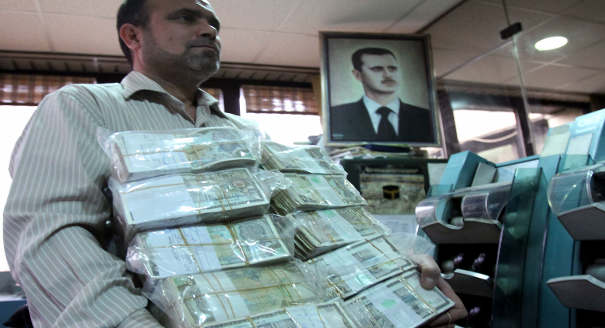
Signalling the regime’s waning control over the country’s affairs, the Syrian regime has decided to print new currency to pump liquidity back into the markets, though the move may offer only temporary relief.
Source: Al-Monitor

This especially applies to small countries like Syria, whose currency lacks commercial convertibility. The United States, European countries and Japan, for example, do not worry about their currencies, and much less about how much they print because those currencies can be converted into other hard currencies, or traded. Moreover, these currencies can be used as reference currencies for international contracts and financial transactions. None of these conditions apply to the Syrian Lira, which has lost nearly half of its real value over the past year. This has affected the prevailing inflation levels and prompted many to get rid of the Lira and convert it to foreign currencies that are more stable.
In this context, the question is: what has prompted the authorities to make such a move? Clearly, there is a liquidity shortage in terms of the revenue that the state is collecting from taxes, fees and service charges. The government is busy grappling with issues relating to security, and is no longer capable of collecting taxes or electricity and water bills. As a result, economic activity has witnessed a downturn and a drop in tourism revenues has reduced government revenues to a minimum – one local observer estimated that it has dropped by more than 50 percent. What's more, citizens are reluctant to pay their bills because of the difficult living conditions. Add to this the fact that the central state is no longer capable of exercising its control over some areas witnessing armed conflicts. Tax collection in some areas is no longer being channeled to the state treasury, but instead to new regional centers of power, by force.
This decline in revenue is taking place as more pressure is being placed on the government to increase its expenditure and preserve stability. However, the scarcity of liquidity has imposed undesired alternatives on the government, such as printing new quantities of paper currency, thereby depreciating the value of the Lira. Nonetheless, the lira has kept its balance with the banks so far able to meet the demand for foreign currency. How did this happen?
The monetary policy is reportedly out of the hands of the Central Bank of Syria because traditional tools are no longer able to rise to the challenge. There is a security cell working with monetary experts, which is depriving commercial banks of the freedom to deal with the demand for foreign currencies. Now, banks operating in Syria are forced to meet the foreign currency demand through security delegates who are working in the main banks in order to defend the Lira. For its part, the Central Bank is pumping up the rest of its foreign currency reserves to close the loopholes in the markets.
Now the question is: how long will this policy be sustained? Increasing the money supply by printing new currency infers that Syria will enter a spiral of inflation, rising prices and an unprecedented loss of confidence in the currency. In this context, we cannot forget the experience of former Iraqi President Saddam Hussein, who resorted to printing new paper currencies in the middle of the siege, thereby creating two editions in the market: the original Swiss edition and the Saddam edition. In the end, both editions collapsed despite the enormous cash reserves that Iraq had at the time. Collapse then was attributed to the lack of hope that things were headed toward a solution.
In the Syrian case, sources of foreign currency are sharply dropping, and official transfers of foreign currency are in decline. What's more, the amounts being transferred to Syria through Iran and Iraq, Syria's major trade partners, are not clear. However, it is obvious that the central government's ability to manage its monetary policy, fiscal policy and tax collection is sharply waning.
The printing of additional banknotes at a time when foreign currency revenues are decreasing indicates that Syrian authorities are beginning to lose control of their currency and their fiscal policies. It points to a level of precariousness in the authorities’ economic policies, and that they are running out of alternatives to reassure the Syrian public. The impending wave of inflation, which will result from the decision to print more currency, means that a new phase of economic deterioration lies ahead for Syria.
Ultimately, economic distress has begun imposing options that the government has long sought to avoid. However, the effects of the deteriorating security situation and increasing international pressure are starting to adversely influence important sectors. In the short run, printing money perceived by authorities as the easiest way to manage the deteriorating situation, but only temporarily. The challenge of defending and protecting the currency remains the most difficult one, failing to do so will reveal the defects of the banking and financial system. The concerns plaguing the public psyche are justified, especially since the situation is not heading toward any political settlement that can in turn help restore economic stability.
This article was originally published in Al-Monitor.

Former Senior Associate, Middle East Center
Saif is an economist specializing in the political economy of the Middle East. His research focuses on international trade and structural adjustment programs in developing countries, with emphasis on Jordan and the Middle East.
Recent Work
Ibrahim Saif, Ahmed Ghoneim
Ibrahim Saif, Muhammad Abu Rumman

The Plaza Accord was not an externally imposed punishment of Japan but part of a broader restructuring that Japanese economists and policymakers themselves recognized was necessary. Its effects were undermined, however, when Tokyo responded to the resulting slowdown with policies that exacerbated investment, credit expansion, and the very imbalances the adjustment was intended to resolve.

Michael Pettis

A summer of escalation in the Black Sea has hurt Ukraine economically and is exacerbating world food security. A truce is needed—as is a broader reframing of Europe’s Ukraine strategy.

Thomas de Waal
The Zaidi government’s objective to collect weapons is constrained by regional conflict, but it can take certain measures at home.
Ali Al-Mawlawi

The Bureau of Industry and Security needs to adjust its focus and practices to maintain its position as the U.S. government’s primary champion of international technological competition.

Geoffrey Irving

Depleted financial reserves and a shrinking tax base mean it is no longer possible to simultaneously deliver high defense spending, price stability, and economic growth.

Alexandra Prokopenko