

Article
Deborah Gordon, Stephen D. Ziman
{
  "authors": [
    "Deborah Gordon"
  ],
  "type": "legacyinthemedia",
  "centerAffiliationAll": "dc",
  "centers": [
    "Carnegie Endowment for International Peace"
  ],
  "collections": [],
  "englishNewsletterAll": "ctw",
  "nonEnglishNewsletterAll": "",
  "primaryCenter": "Carnegie Endowment for International Peace",
  "programAffiliation": "SCP",
  "programs": [
    "Sustainability, Climate, and Geopolitics"
  ],
  "projects": [
    "Carnegie Oil Initiative"
  ],
  "regions": [
    "North America",
    "United States"
  ],
  "topics": [
    "Climate Change"
  ]
}
Source: Getty
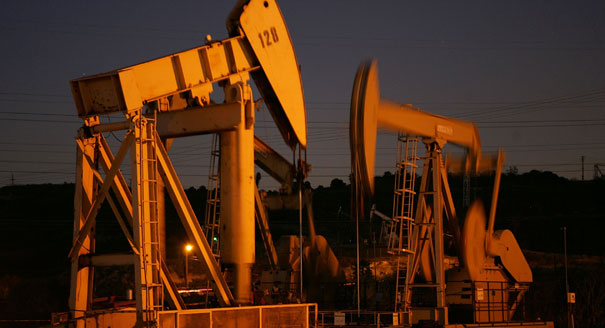
Unconventional oil development faces a range of economic, technical, environmental and political challenges.
Source: AGI Energia

At issue here is U.S. tight shale oil, which is located in different “continuous” geological sites (that is, not in conventional pooled deposits) in the central United States and in many other parts of the world. Some refer to these tight shale oils as “transitional” oils because of their conventional composition yet unconventional means of extraction that require more invasive, energy-intensive production techniques.
Lower global crude oil prices could slow the growth of tight-oil production. This slowdown could facilitate development of appropriate long-term local protections against hydraulic fracturing or fracking damage to water, land, and air, which accompany the production of shale oil.From an economic perspective, it is also important to underscore that shale oil and shale gas tend to coexist in continuous formations, which can create competition in the short term between these resources. Therefore, the development of oil shale is not only linked to the price of crude oil. The price of gas also plays a complex role.
To truly answer this question, we need to take the different types of unconventional oils into consideration. Each type demands a different method of transport and production.
Generally, I believe new technologies will be developed, some in response to economic signals and others in response to politics, environmental policies, and local ordinances. However, the attraction of investors will be moderated by the price of conventional crude oil, whose performance is expected to fluctuate, perhaps moving lower in the short term but trending upward over time.
Again, there will be different environmental challenges associated with different unconventional oils. Those who produce tight shale oil (or gas) will face a number of critical local, regional, and state issues arising from fracking. Shale oil, for instance, requires more energy to be extracted but does not require a different processing than conventional crude oil.
Bitumen (extra-heavy tar sands in Canada and Venezuela) takes a lot of energy to be extracted, contains high levels of imbedded carbon and heavy metals, and requires intensive treatment before it can be refined. Each phase of the cycle to produce petroleum products from bitumen raises new environmental challenges for industry. Some challenges, such as the extraction of large volumes of petroleum coke, have a global impact on climate.
The best way to address the climate impact caused by bitumen and other forms of unconventional oil is by putting a price on carbon. The best way to address problems that arise at the local level is to impose strict controls on air and water and strict rules governing solid waste, whether at national or regional level.
The United States will also have to deal with significant environmental impacts if there is an attempt to extract kerogen (oil shale) from the Rocky Mountains. These arid regions are particularly at risk from an environmental perspective. And the kerogen requires enormous amounts of energy to be treated and transformed into crude.
With some of the highest imbedded carbon of any unconventional oil, the exploitation of the bitumen (in Venezuela and Alberta) will be highly influenced by future climate policy, such as emissions charges. The petroleum coke separated from tar sands there must be reduced and stored carefully. These low-quality hydrocarbons have extremely high carbon emissions. If incinerated in Asia or elsewhere, they would greatly increase global greenhouse gas emissions and deteriorate local air quality, causing an increase in morbidity and mortality.
Extra-heavy oils (like tar sands) yield a heavier slate of petroleum products than the U.S. exports. This new reality of oil and petroleum products will require the United States to reassess the benefits of Canadian and Venezuelan bitumen imports compared to their costs in terms of extension of the transport network, upgrading of refining systems, large production of waste, and environmental impacts.
Europe does not seem to have the world's largest reserves of unconventional oils, but the continent is home to ample supplies of tight oil and tight gas reserves and smaller shares of bitumen and kerogen. Europe can learn from unconventional oil development efforts in America and, hopefully, take action to improve safety, both locally and globally. Europe will have to mitigate environmental impacts that are even closer to population centers compared to the situation in the United States. A significant portion of America’s unconventional oil is on more remote public lands.
Although Europe is not currently producing unconventional oils, the European Union will have to deal with rules governing the importation of these new oils and their petroleum products. At present, the diesel Europe imports from U.S. refineries that is produced from bitumen has carbon emissions upstream (due to the associated production of petroleum coke) that are not being fully accounted for in the EU’s Fuel Quality Directive. Climate policies will be needed that incorporate the full carbon impacts of unconventional oils and, in the case of bitumen, their full slate of co-products, especially petroleum coke.
This article was originally published in Italian in AGI Energia.

Former Director and Senior Fellow, Energy and Climate Program
Gordon was director of Carnegie’s Energy and Climate Program, where her research focuses on oil and climate change issues in North America and globally.
Recent Work
Deborah Gordon, Stephen D. Ziman
Deborah Gordon, Smriti Kumble, David Livingston
Carnegie does not take institutional positions on public policy issues; the views represented herein are those of the author(s) and do not necessarily reflect the views of Carnegie, its staff, or its trustees.

Canadian Prime Minister Mark Carney has twice inspired praise for standing up to U.S. President Donald Trump: at the 2026 World Economic Forum in Davos and on Canada-U.S. trade negotiations. Is Carney showing a third way better than the EU has in dealing with the Trump administration?

Rym Momtaz, ed.

Middle Eastern states should welcome an accelerated U.S. disengagement from their region.

Michael Young

In an interview, former ambassador Charles Freeman assesses the Trump administration’s war against Iran.
Michael Young

European states control several Overseas Countries and Territories around the world that carry strategic, economic, and environmental weight. As great powers challenge the rules-based order, defending them is a geopolitical imperative for Europe.

Marc Pierini

By focusing only on hard security, the Shield ignores the conditions that fuel cartel power.


Alejandro Martin Rodriguez, Kayly Ober