

Other
Michael D. Swaine
{
  "authors": [
    "Michael D. Swaine"
  ],
  "type": "legacyinthemedia",
  "centerAffiliationAll": "dc",
  "centers": [
    "Carnegie Endowment for International Peace",
    "Carnegie China",
    "Malcolm H. Kerr Carnegie Middle East Center"
  ],
  "collections": [
    "China’s Foreign Relations",
    "China and the Developing World"
  ],
  "englishNewsletterAll": "asia",
  "nonEnglishNewsletterAll": "",
  "primaryCenter": "Carnegie Endowment for International Peace",
  "programAffiliation": "AP",
  "programs": [
    "Asia"
  ],
  "projects": [],
  "regions": [
    "Middle East",
    "Syria",
    "East Asia",
    "China",
    "Levant"
  ],
  "topics": [
    "Security",
    "Military"
  ]
}
Source: Getty
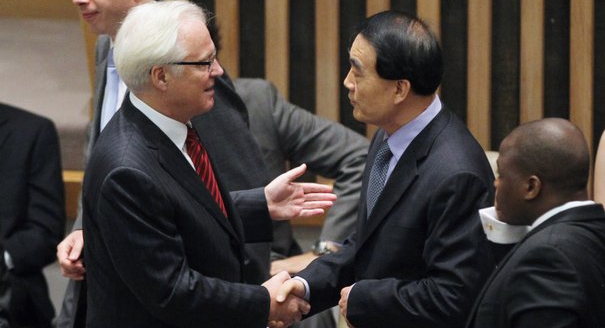
Chinese leadership gives no sign of accepting any type of foreign military intervention in Syria, calling into question the significance of China’s apparent earlier move toward accepting some infringements on national sovereignty by outside forces.
Source: China Leadership Monitor

This position has been reinforced by its stated overall opposition to the use of force in international affairs, the highly limited utility, from Beijing’s perspective, of external coercive pressures (such as sanctions) on sovereign governments to make them alter their behavior, and a belief in the relatively superior results attained by private dialogue and positive incentives. In addition, the Chinese leadership has no doubt resisted foreign interventions in the internal affairs of sovereign nations—especially when led by the United States and the West in general—out of a concern that such intervention is often motivated by a desire for regime change, and could establish a precedent that one day might be used against Beijing.
All of these factors have led Beijing to resist or at the least abstain from efforts by other states, and even international bodies, to coercively pressure or intervene militarily in civil wars or cases of internal unrest occurring in other (particularly developing) states.However, in the past few years, China’s supposedly principled and pragmatic stance on this issue has been under pressure due to growing international concern over a number of incidents wherein authoritarian governments have applied violence against their own populations (best exemplified by the Rwandan genocide of 1994 and the subsequent mass killings of civilians in the Darfur region of Sudan in 2003-2004), as well as the emergence of a wide range of social, economic, and security issues that span and erode national boundaries. For some analysts, such developments are contributing to the creation of so-called post-Westphalian norms, which emphasize “the right (and indeed the obligation) of the international community to infringe on the autonomy of the nation-state to protect or advance other considerations.”
The most notable example of such an effort in the area of humanitarian intervention is reflected in the so-called “responsibility to protect” (R2P) norm adopted at the UN World Summit meeting in 2005, and addressed in various UN resolutions and statements since then.
If such norms gain greater support, especially among major developing countries (and democracies) such as India, Brazil, and Indonesia, Beijing could encounter increasing pressure to support more interventionist policies. In fact, Beijing now recognizes that humanitarian crises or other local problems occurring in so-called areas of instability (from the Chinese perspective) or failed states (from a Western perspective) can pose serious political, diplomatic, and economic threats to other nations, including China. Additionally, the Chinese leadership agrees with many other nations that although it is important to diagnose the underlying, long-term problems that cause such local instability, this overall objective should not prevent short-term actions necessary to deal with emerging and immediate humanitarian and other threats.
As a result, Beijing has recently shown signs of accepting, or at least acquiescing in, internationally endorsed interventions in other countries, in some cases for reasons associated with the prevention of state-inflicted mass violence. A recent example of such changing attitudes was provided by Beijing’s willingness to permit UN-backed, NATO-led military intervention in Libya to prevent the killing of innocent civilians by the Qaddafi dictatorship.
That said, the subsequent evolution of the Libyan intervention into a NATO-backed effort to oust the Qaddafi regime, and more recent Western-led efforts to sanction and condemn the Syrian government for its attacks on protesting Syrian civilians, have led Beijing to more pointedly resist even widely backed foreign intervention efforts, for a variety of reasons. In contrast to the Libyan case, the Chinese leadership has repeatedly exercised its veto against UN resolutions on Syria, and gives no sign of accepting any type of foreign military intervention, even in support of humanitarian ends. This development has called into question the significance of China’s apparent earlier move toward accepting, if not endorsing, some infringements on national sovereignty by outside forces.
This issue of the CLM takes a closer look at Chinese views toward the ongoing Syrian turmoil and the larger context created by the earlier Libyan experience, to identify the elements of Beijing’s current stance on foreign intervention in human rights-related political conflict occurring within sovereign states, as well as possible differences in viewpoint and approach among Chinese observers.
As with my essay in CLM 38, three categories of sources are examined: authoritative, quasi-authoritative, and non-authoritative.

Former Senior Fellow, Asia Program
Swaine was a senior fellow at the Carnegie Endowment for International Peace and one of the most prominent American analysts in Chinese security studies.
Recent Work
Michael D. Swaine
Michael D. Swaine

It should address the shortcomings of previous crisis communication efforts and adapt to the demands of frontier AI.

Lucy Luo
The Zaidi government’s objective to collect weapons is constrained by regional conflict, but it can take certain measures at home.
Ali Al-Mawlawi

Are Germany’s economic, industrial, and political struggles becoming a liability for the EU’s ability to rise to the geopolitical moment?

Rym Momtaz, ed.

China’s police training infrastructure construction projects provide benefits to recipient countries, promote China’s image as a major global security provider, and are likely to reinforce alignment between Beijing’s security priorities and those of countries in the Global South.


Cameron Waltz, Sheena Chestnut Greitens, Kim Nguyen, …

AI capabilities are moving fast. Most institutions—including governments—can’t keep up.


Anton Leicht, Scott Singer