

Paper
Ibrahim Saif, Ahmed Ghoneim
{
  "authors": [
    "Ibrahim Saif"
  ],
  "type": "legacyinthemedia",
  "centerAffiliationAll": "",
  "centers": [
    "Carnegie Endowment for International Peace",
    "Malcolm H. Kerr Carnegie Middle East Center"
  ],
  "collections": [],
  "englishNewsletterAll": "",
  "nonEnglishNewsletterAll": "",
  "primaryCenter": "Malcolm H. Kerr Carnegie Middle East Center",
  "programAffiliation": "",
  "programs": [],
  "projects": [],
  "regions": [
    "Levant"
  ],
  "topics": [
    "Political Reform",
    "Economy"
  ]
}
Source: Getty
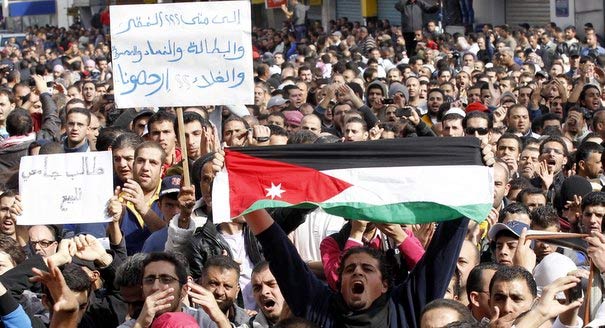
Jordan's budget deficit has reached an alarming level. As the government grapples with economic issues and enforcing subsidy reductions, protests have erupted across the country.
Source: Middle East Voices

But in mid-November, the country’s budget deficit reached alarming levels. According to the Jordanian Ministry of Finance, in the first nine months of 2012, the country’s loan-financed deficit stood at around $3.5 billion, roughly 16 percent of GDP. The government of Prime Minister Abdullah Nsour was forced to raise prices by reducing subsidies in order to preserve the stability of the economy and hence the Jordanian dinar. The price hike was pushed through despite the concerns of the security services about the threat of violent protest.
These fears were well-founded. Recent protests in Jordan have resembled reactions to previous experiments in subsidy reduction, all of which were eventually withdrawn under intense public pressure. The reaction to earlier reform attempts took Jordan by storm, with various regions of the country rocked by spontaneous protest. Two months ago, for instance, the interim government of Fayez al-Tarawneh attempted to make good on its pledge to raise fuel prices. Public backlash led Jordan’s King Abdullah II to intervene, and the government withdrew the price hike just one day after its announcement.Jordanians took to the streets even before the prime minister finished his announcement and justifications for increasing the prices. Political tension, corruption, and injustice all exacerbated the crisis, especially because subsidy reduction was not tied to a comprehensive economic policy or blueprint for serious political reform. Many Jordanians also complained about mismanaged public spending and the absence of government transparency.
But the problem is more severe this time as Jordan has fewer financial alternatives and offers of aid to fall back on. Promises of aid and facilitated loans from some Arab states have already fallen through. Worse, an agreement with the IMF constrains the government’s ability to maneuver, leaving little room for compromise.
The prime minister has vowed to push through the price increase and the lifting of subsidies, claiming that backing down would amount to a “political crime.”
The government’s decision to proceed with the price hike indicates that it has chosen to follow through with measures to remove economic distortions in order to secure a $2 billion loan from the IMF. The price hikes also represent a change in the domestic political order. The fact that the system is no longer sustainable indicates that the government is no longer able to maintain a paternalistic political system.
The government appears to have succeeded in passing the subsidy reforms and restoring stability while proving its ability to make difficult decisions in order to secure the country’s economic future. The downside is that they will soon be forced to make other tough choices, including raising electricity prices and removing other types of subsidies, which together cost Jordan about $1.8 billion annually. In light of ongoing political tensions and the legacy of the Arab Spring, it will be difficult to enact these subsidy reforms before legislative elections that are scheduled for January 2013.
Jordanians will closely scrutinize the government’s handling of public spending, seeking to limit the state’s extravagance and improve transparency regarding defense and security expenditures—which, while not subject to audit, now account for about 30 percent of the budget.
But there are promising developments, too. The king’s annulment of the Civil Retirement Law has been well received by the public. This unpopular law gave members of parliament lifetime pensions, and its removal has been viewed as a positive first step toward reforming public expenditure.
Jordan will continue to face economic challenges and must take steps to restore the momentum of economic growth, mobilize private sector resources, and attract foreign investments—all of which have served to benefit foreign currency reserves and job creation in the past. Accomplishing these goals will require drafting a new economic vision that can form the basis of lasting economic stability while still taking into account Jordan’s changing political climate. It calls for addressing the current decline in the quality of Jordan’s public administration by including more voices in the decisionmaking process and transitioning toward a merit-based system of government in which administrative positions are awarded based on an official’s qualifications, not his or her political malleability.
The government must involve all key political actors in policymaking in order to foster an environment of cooperation and responsibility rather than blame and accusations. All of these measures are necessary because, at the end of the day, overcoming Jordan’s current economic impasse is a collective responsibility.
This article was originally published in Middle East Voices.

Former Senior Associate, Middle East Center
Saif is an economist specializing in the political economy of the Middle East. His research focuses on international trade and structural adjustment programs in developing countries, with emphasis on Jordan and the Middle East.
Recent Work
Ibrahim Saif, Ahmed Ghoneim
Ibrahim Saif, Muhammad Abu Rumman
Carnegie does not take institutional positions on public policy issues; the views represented herein are those of the author(s) and do not necessarily reflect the views of Carnegie, its staff, or its trustees.
During our visit, we observed a democracy that has learned from its difficult past and is working toward an even more dynamic future.

Sarah Yerkes, Natalie Triche
Israel is encroaching on the country’s territory, while the Lebanese look askance at one another.

Issam Kayssi
The party’s domestic and regional roles have changed, so Lebanon should devise a disarmament strategy that encompasses this.

Michael Young
The cost of air defense has become an unregistered tax on revenue for businesses. While military rents are consolidated in the federal budget, the costs of defense are being spread across the balance sheets of companies and regional governments.

Alexandra Prokopenko
Cities across the United States facilitate investment in American communities. Yet, because global attention remains focused on U.S. trade policy, their distinctive and bold local approaches to international trade and investment promotion are often underappreciated.


Wyatt Frank, Marissa Jordan