

Paper
David Burwell
{
  "authors": [
    "David Burwell"
  ],
  "type": "legacyinthemedia",
  "centerAffiliationAll": "dc",
  "centers": [
    "Carnegie Endowment for International Peace"
  ],
  "collections": [],
  "englishNewsletterAll": "ctw",
  "nonEnglishNewsletterAll": "",
  "primaryCenter": "Carnegie Endowment for International Peace",
  "programAffiliation": "SCP",
  "programs": [
    "Sustainability, Climate, and Geopolitics"
  ],
  "projects": [],
  "regions": [
    "North America",
    "United States"
  ],
  "topics": [
    "Climate Change"
  ]
}
Source: Getty
Until U.S. tax and securities oversight laws level the playing field by rewarding energy companies for making bets on renewables and remove the incentives for going after ever more fossil fuels, drilling for oil in ever more dangerous places will continue.
Source: Huffington Post

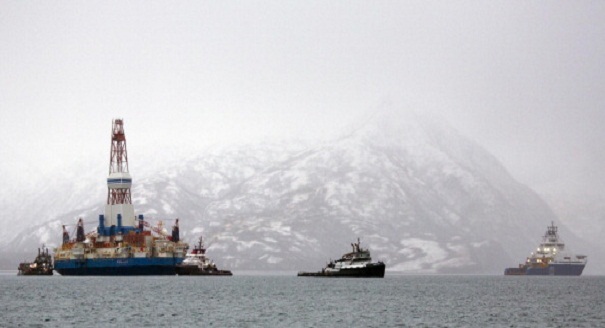
Intuitively, drilling for oil in the seas north of Alaska seems masochistic. For most of the year the ocean is dark, storms are intense, the weather horrible, and the temperatures -- well, Arctic. Working on or under the ice in frigid seas requires significant foresight and preparation, and it is dangerous. Back-up rigs are needed in case of a blow-out (to drill relief wells), as is a separate containment ship to reduce damage in the case of spills. The entire enterprise is an unending battle of technology versus Mother Nature. And, as we know, Mother Nature always bats last.
It is not as if the world is running out of oil. Total consumption is about 32 billion barrels of oil a year and known readily recoverable reserves are about 1.3 trillion barrels. The U.S. Geological Survey estimates that there are between seven and eight trillion barrels in the world and up to now about one trillion barrels have been extracted and consumed. Thanks to new fracking technology, the International Energy Agency now estimates that U.S. will be the largest liquid fuels producer in the world by the 2020s, and a net oil exporter by 2030 -- even without any new Arctic oil production.
Moreover, according to the United Nations 2012 Carbon Emissions Gap report, the world budget for additional C02 emissions consistent with staying below the 2 degree Celsius global warming limit is between 1000-1500 gigatons from 2000-2050. Emissions beyond that amount will almost inevitably trigger catastrophic ecological impacts. In just the first ten years of this century, global C02 emissions were about 420 gigatons from fossil fuels (coal, oil and gas). Known global reserves of these fuels contain at least another 2700 gigatons. Given these numbers, and the fact that the cost of producing oil in the Arctic, while still indeterminate pending actual oil discoveries, will almost certainly be over $70 per barrel of oil lifted, the wisdom of oil drilling in extreme locations must be questioned. In Iraq, the similar cost is estimated to be around $15 per barrel, reserves are huge, and many fields are still unexplored.
With all these challenges, and burgeoning new reserves opening up in sunnier climes, why are oil companies risking so much money and braving brutal conditions to drill in the Arctic? The answer may be surprising -- that is what we tell them to do. U.S. tax laws and securities regulations almost force oil companies to continually seek new reserves in extreme environments, while punishing them for diversifying into a wider spectrum of renewable, climate-friendly fuels.
This occurs in a number of ways. Direct subsidies exist as production tax credits for new wells drilled, intangible drilling cost deductions, reserve depletion allowances, royalty and severance fee waivers for drilling both on and off-shore, and generally lower royalty rates (when paid) compared to many other countries. While not determinative of capital asset allocation, these subsidies incentivize more and more drilling--wherever.
Regulation also plays its part. Under the Securities and Exchange Commission (SEC) rule 4-10 oil and gas companies must publicly disclose the value of their "economically producible" recoverable reserves at the end of every calendar year. This is a way of letting investors understand the full value of assets under management. If oil and gas companies can't achieve a 100 percent replacement rate every year, their stock price can suffer. Renewables don't count in this replacement allocation since the resources (sun, wind, ocean currents, geothermal) aren't privately owned, they can't be claimed as "economically producible." Nor do manufactured reserves such as biofuels. This discourages oil and gas companies from investing in such alternative fuels because they get no benefit in terms of investor confidence.
There are also tax benefits for investing in "depletable resources." Separately from the discriminatory SEC rules, the tax code affirmatively blocks company access to investment capital in renewable energy through its rules on master limited partnerships (MLPs). An MLP is a business structure where corporate tax is avoided while distributions are taxed as dividends, not ordinary income and shares are traded on stock exchanges. But there's a catch: MLPs are only allowed under the tax code for investments in "depletable" sources such as fossil fuels, not renewable fuels. The logic, though perverse, is the same as the SEC rule on "economically producible" -- they can't be owned privately so they can't be depreciated, taxed, or declared as a recoverable reserve. For purposes of the tax code and SEC disclosure rules, renewables don't exist.
Given this policy framework, who can blame oil and gas companies from finding and producing new oil and gas reserves, especially since their core competency is in doing just that? Until our tax and securities oversight laws level the playing field by rewarding energy companies for making bets on renewables and remove the incentives for going after ever more fossil fuels, drilling for oil in ever more dangerous places will continue.
This article was originally published in the Huffington Post.
Former Nonresident Senior Fellow, Energy and Climate Program
Burwell focused on the intersection between energy, transportation, and climate issues, as well as policies and practice reforms to reduce global dependence on fossil fuels.
Recent Work
David Burwell
David Burwell
Carnegie does not take institutional positions on public policy issues; the views represented herein are those of the author(s) and do not necessarily reflect the views of Carnegie, its staff, or its trustees.

The Russian leadership wants to avoid a dangerous precedent in which it is squeezed out of Iran by the United States and Israel—and left powerless to respond in any meaningful way.

Nikita Smagin
Afro-Iraqis experience political, economic, and social marginalization and discrimination, which exposes the poorest members of the community to the harsh realities of the region’s climate disaster.

Zeinab Shuker

Mitigating the repercussions of climate change in Kuwait is crucial for lessening economic disparities and achieving social justice.
Courtney Freer
In Ukraine, Gaza, and Iran, AI warfare has come to dominate, with barely any oversight or accountability. Europe must lead the charge on the responsible use of new military technologies.

Raluca Csernatoni

Cairo’s efforts send a message to the United States and the region that it still has a place at the diplomatic table.

Angie Omar