

Article
C. Raja Mohan, Darshana M. Baruah
{
  "authors": [
    "C. Raja Mohan"
  ],
  "type": "legacyinthemedia",
  "centerAffiliationAll": "dc",
  "centers": [
    "Carnegie Endowment for International Peace",
    "Carnegie India"
  ],
  "collections": [],
  "englishNewsletterAll": "ctw",
  "nonEnglishNewsletterAll": "",
  "primaryCenter": "Carnegie India",
  "programAffiliation": "SAP",
  "programs": [
    "South Asia"
  ],
  "projects": [],
  "regions": [
    "South Asia",
    "India",
    "East Asia",
    "Japan"
  ],
  "topics": [
    "Security",
    "Military"
  ]
}
Source: Getty
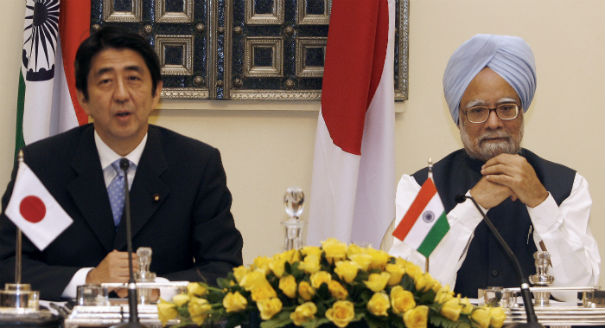
With Japan's new Prime Minister, Shinzo Abe, eager to ensure a stable balance of power in Asia, there could be room for a closer Indo-Japanese partnership in 2013.
Source: Indian Express

As tensions between Japan and China over disputed islands in the East China Sea escalate and diplomatic observers warn against the dangers of a shooting match between their armed forces in 2013, Abe has begun his new tenure with a strong focus on national security.
Speaking to a leading Japanese newspaper, Yomiuri Shimbun, immediately after he was sworn in last week, Abe emphasized the importance of strengthening the longstanding alliance with the United States and deepening the new partnerships with India, Indonesia and Australia.Japan already has formal declarations on security cooperation with both India and Australia and is hoping to build one with Indonesia. In his earlier brief tenure as PM, during 2006-07, Abe talked of cooperation among Asian democracies as part of a grand strategy to build “an arc of freedom of prosperity.”
The challenge from China has risen so rapidly in the last few years that Japan no longer has the luxury of limiting its partnerships to those countries that share the values of democracy and political pluralism.
Among the first leaders that Abe got in touch with over the telephone last week were Prime Minister Manmohan Singh, Indonesian President Susilo Bambang Yudhoyono, and Australian Prime Minister Julia Gillard.
More interesting were Abe’s calls to Russian President Vladimir Putin and Vietnamese Prime Minister Nguyen Tan Dung. Neither Russia nor Vietnam has been part of Abe’s earlier conception of Asia’s democratic arc.
But both are important neighbors of China and have a critical role in shaping the Asian balance of power. While Japan and Vietnam have developed strong economic links in recent years, Abe’s Russia initiative will be closely watched in Asian capitals.
The absence of good neighborly relations with Russia has long been a major weakness of Japan’s foreign policy since World War II.
Moscow and Tokyo never signed a formal peace treaty thanks to the dispute over four islands—Russia calls them the Kuriles and Japan, the Northern Territories—occupied by the Red Army at the end of the war.
Japan’s military alliance with the US made the two countries irreconcilable adversaries in the Cold War.
The Gorbachev era in the late 1980s had opened a brief window of opportunity for Tokyo to normalize relations with Moscow. Unlike the West Germans who seized the moment to buy Russian consent for German reunification, the Japanese were too slow to clinch a territorial settlement.
Abe has now spoken about the responsibility of the current generation of Japanese leaders to end the territorial dispute with Russia. Putin, who has a strong interest in elevating Russia’s standing in East Asia, should be equally interested in playing the Japan card.
Abe is expected to travel to Russia quite early in the new year and the two leaders have agreed to fast-track the negotiations on the peace treaty.
As Abe outlines the strategy to restore the Asian balance of power, his close ally and Deputy Prime Minister Taro Aso is heading to Myanmar, which has emerged as a critical theater in Asian geopolitics.
Aso, who is also the finance minister in the new Japanese cabinet, will meet President Thein Sein this week and discuss plans to write off nearly $6 billion of Myanmar’s debt to Japan and announce a large new aid package.
Aso will give a big political boost to the many Japanese corporations that have set up shop in Myanmar and review the progress in building the Special Economic Zone (SEZ) at the Thilawa deep sea port near Yangon. Aso could also be preparing the ground for an early visit to Myanmar by Abe.
The 2,400 hectare SEZ at Thilawa is being developed by a joint consortium of Japanese companies and Myanmarese entities. According to Reuters, Japan might agree to provide nearly $13 billion in the coming years to help build infrastructure around Thilawa.
In the first phase expected to completed by 2015, 450 hectares of the SEZ will be thrown open to Japanese and global manufacturers. Given India’s own economic and strategic interests, there is much room for joint Indo-Japanese initiatives in Myanmar.
This article appeared in the Indian Express on January 2, 2013.
Former Nonresident Senior Fellow, Carnegie India
A leading analyst of India’s foreign policy, Mohan is also an expert on South Asian security, great-power relations in Asia, and arms control.
Recent Work

C. Raja Mohan, Darshana M. Baruah


Alexander Gabuev, Paul Haenle, C. Raja Mohan, …
Domestic and international conflicts present myriad challenges for leaders, militaries, and civilians, including the effects of new technological capabilities on the conduct of war, the effectiveness of security strategies, and the intricacies of post-conflict peacemaking. Carnegie scholars provide timely analyses to address these and other related questions.
The war in Iran proves the United States is now a destabilizing actor for Europe and the Arab Gulf. From protect their economies and energy supplies to safeguarding their territorial integrity, both regions have much to gain from forming a new kind of partnership together.

Rym Momtaz
Strategy and force design are key to solving Kyiv’s persistent manning and readiness problems.

Viktor Kevliuk, Olesya Favorska, Andriy Zagorodnyuk
The current U.S. indifference to human rights means Astana no longer has any incentive to refuse extradition requests from its authoritarian neighbors—including Russia.

Temur Umarov
The conflict is threatening stability in Armenia and Azerbaijan.

Zaur Shiriyev
