

Q&A
Suzanne Maloney, Aaron David Miller, Karim Sadjadpour
{
  "authors": [
    "Karim Sadjadpour"
  ],
  "type": "legacyinthemedia",
  "centerAffiliationAll": "dc",
  "centers": [
    "Carnegie Endowment for International Peace",
    "Malcolm H. Kerr Carnegie Middle East Center"
  ],
  "collections": [],
  "englishNewsletterAll": "menaTransitions",
  "nonEnglishNewsletterAll": "",
  "primaryCenter": "Carnegie Endowment for International Peace",
  "programAffiliation": "MEP",
  "programs": [
    "Middle East"
  ],
  "projects": [],
  "regions": [
    "Middle East",
    "Iran",
    "Gulf"
  ],
  "topics": [
    "Political Reform"
  ]
}
Source: Getty
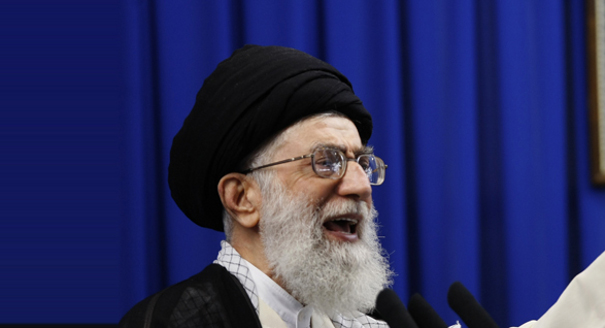
With major factional feuding taking place within Iranian domestic politics, the Ayatollah must find a way to help to select the next president of Iran and help manage Ahmadinejad's abdication.
Source: CNN
ZAKARIA: If you think the tension between President Obama and House Speaker Boehner is bad, let me introduce you to a similar relationship, the two top politicians in the land where the animosity is extreme and out in the open. The very public feud between Iran's president Mahmoud Ahmadinejad and the speaker of the parliament, Ali Larijani has gotten so bad that both men had to write letters apologizing for their bad behavior to the man with the real power in the land Ayatollah Khamenei who said the spat made him feel sad. There are implications for the rest of the world, which eagerly wants Iran to sit down at the nuclear negotiating table. To talk about all this, joining me Hooman Majd an Iranian American journalist and author and Karim Sadjadpour, a senior associate at the Carnegie Endowment for International Peace. So, what on earth is going on, Hooman? Why? This is a very public feud.
HOOMAN MAJD, IRANIAN JOURNALIST AND AUTHOR: Yeah, I think -- I think it's related somewhat to the presidential election coming up in June and Ahmadinejad's sort of desperate attempt to remain relevant after the election, unlike other presidents or the previous president, Khatami, who kind of faded into obscurity. I think he's determined to remain relevant. And ...
ZAKARIA: And does he have a certain kind of popular power and appeal that could ...
MAJD: I think he does have. I think he has some base. I mean the base is exaggerated by some people who are his supporters, but he does have a base among the certain segment of society and I think he's trying to appeal to a larger segment of society, including the middle class. And if you go up against the mullahs in Iran, if you go up against the ayatollahs, against the clerical regime, which is what he's doing effectively and has been doing for over a year, two years, actually, at this point, I think you gain some support among people who dislike the idea of a theocracy to begin with. ZAKARIA: How should we think about -- because here in America, people think of Ahmadinejad as the bad guy. But here you have this odd situation where Ahmadinejad is really openly fighting against the mullahs who seem to have much of the power.
KARIM SADJADPOUR, SENIOR ASSOCIATE, CARNEGIE ENDOWMENT FOR INTERNATIONAL PEACE: Fareed, I joked that Ahmadinejad comes from the Groucho Marx school of politics which says that these are my principles, and if you don't like them, I've got some other ones for you.
(LAUGHTER)
SADJADPOUR: So, Ahmadinejad, you know, began his term -- his first term of being the sort of the supreme leader, Ayatollah Khamenei, a bludgeon (ph) against Khamenei's internal opponents against the United States, but I think after seven or eight years of being in power, now Ahmadinejad is not ready to leave the scene. And I think a big challenge for the supreme leader in the coming months is not only helping to select the next president of Iran, but helping to -- you know, Ahmadinejad to managing Ahmadinejad's abdication for power.
ZAKARIA: Vice President Biden, you know, put out these remarks.
(BEGIN VIDEO CLIP)
JOE BIDEN. U.S. VICE PRESIDENT: We would be prepared to meet bilaterally with the Iranian leadership.
(END VIDEO CLIP)
ZAKARIA: Which had seen (ph) the long sending Iranian request, which is that there be direct talks from the United States on the range of issues and Biden said we're open to that possibility. And in response Ayatollah Khamenei shuts it down and says anyone who wants to go down that path referring to Ahmadinejad, because Ahmadinejad had seem excited by this prospect, is a traitor and, you know, they're trying to bring back American domination. What does all this mean?
MAJD: Well, I think you have to look at it from the Iranian side. I mean when Vice President Biden made that remark, I think it was a couple of days later that new sanctions were put in place. So, it was this continuing pressure on Iran and I think inside the administration and inside the regime, Iran, the view is that unless the pressure is let up, there is no reason to talk. And I think, I don't think he completely eliminated the possibility of ever talking, having direct talks with the U.S. And he's repeated this a few times and as other Iranian officials have repeated this, is that if you, have -- hold a gun, as he said, if you hold a gun to our heads, we are not going to negotiate. And I think that's probably true. Every time there's been a lot of pressure on Iran, Iran has backed off negotiating because they feel they don't want to be viewed to be in a weak position. And certainly, there's a lot of domestic politics involved here. The nuclear program is still relatively popular in Iran. They don't want to be seen to be backing off and giving in to American demands. They certainly don't want to be seen to be negotiating or making a deal because of the sanctions, because of this pressure, that the pressure worked. That America can make us do something that we don't really want to do.
ZAKARIA: But the timing, Karim, looks very bad because, you know, the Americans have put all this pressure on the Iranians from what Khamenei said, it certainly doesn't look likely that in the next month or two something is going to happen on the negotiating front.
SADJADPOUR: I'm equally pessimistic, Fareed. First, I think, it's worth pointing out that this Obama administration national security cabinet, between Obama himself, Biden, Secretary of State John Kerry, potential Secretary of Defense Chuck Hagel, I would argue as the most pro-Iran engagement cabinet U.S. national security cabinet since the 1979 revolution. So, these guys seriously do want to do a deal. And I think if Ayatollah Khamenei genuinely wants to try to build confidence with the United States, this is the best administration to do that. Now, I think the dilemma Khamenei has is that for 24 years since 1989 he has been supreme leader, he hasn't left the country since 1989. He sought to preserve the status quo by avoiding transformative decisions and he has now put himself increasingly with the back against the wall facing unprecedented international pressure, sanctions, et cetera, whereby if he wants to reduce this pressure, either he needs to do a nuclear deal to reduce the pressure or go for a nuclear weapon, the so-called Pakistan option, whereby if they get a bomb, they believe that then the outside world will be forced to deal with them. But these are both transformative options and both transformative choices for him. So, I think he's put himself in a very uncomfortable position.
ZAKARIA: And he's a conservative guy by nature. He doesn't really trust ...
SADJADPOUR: By nature. I think you know -- you're a revolutionary until you acquire power and then you become a conservative. And the Obama administration isn't interested in going to war. They're trying to get out of the war business, out of Afghanistan, out of Iraq. So, I don't see 2013 actually being a decisive year. because I think that the Obama administration is reluctant to attack, the Israelis want the Americans to do it and I think the Iranians will continue to move forward in a very incremental fashion so we can avoid worst-case scenario which is a military conflagration, but I also don't see a then diagram, in which Israeli national security, Iranian revolutionary ideology and U.S. domestic politics all intersect in one place.
ZAKARIA: Fascinating conversation. Thank you, both.

Senior Fellow, Middle East Program
Karim Sadjadpour is a senior fellow at the Carnegie Endowment for International Peace, where he focuses on Iran and U.S. foreign policy toward the Middle East.
Recent Work


Suzanne Maloney, Aaron David Miller, Karim Sadjadpour

Aaron David Miller, Karim Sadjadpour, Robin Wright
Carnegie does not take institutional positions on public policy issues; the views represented herein are those of the author(s) and do not necessarily reflect the views of Carnegie, its staff, or its trustees.

If the Russian-speaking community in Latvia cannot articulate their interests without being seen as disloyal, they could end up embracing a pro-Kremlin agenda.

Sergejs Potapkins

Russia’s ruling party would have benefited from Putin appearing as its distant patron, but as an active frontman imposing his views on the public, he has done nothing but harm both the party’s election campaign and the ruling system overall.

Andrey Pertsev

Understanding the climatic pain points is necessary for policymakers hoping to minimize the war’s negative environmental consequences.



Alejandro Martin Rodriguez, Joy Arkeh, Sarah Yerkes

Huawei pushed hard to enter the Egyptian data centers market, until the Americans made a better offer.

Angie Omar

The books, podcasts, and films that explain the world it made.

Andrew Leber