

Commentary
U.S. trading partners in Asia are closely watching the dispute for signs of how it may affect their own interests.
Barbara Weisel
{
  "authors": [
    "Gilles Dorronsoro",
    "Adam Baczko",
    "Arthur Quesnay"
  ],
  "type": "legacyinthemedia",
  "centerAffiliationAll": "dc",
  "centers": [
    "Carnegie Endowment for International Peace"
  ],
  "collections": [],
  "englishNewsletterAll": "ctw",
  "nonEnglishNewsletterAll": "",
  "primaryCenter": "Carnegie Endowment for International Peace",
  "programAffiliation": "SAP",
  "programs": [
    "South Asia"
  ],
  "projects": [],
  "regions": [
    "Middle East",
    "Syria"
  ],
  "topics": [
    "Political Reform",
    "Security",
    "Military",
    "Foreign Policy"
  ]
}
Source: Getty
The opposition in Syria needs a government more than it needs guns.
Source: International Herald Tribune
The international community has given up hope for a negotiated settlement in Syria. All talk has turned to whether rebels should be armed to hasten the fall of the Assad regime. This debate, however, is often framed as a lose-lose situation: Arms could fall into the wrong hands, but not providing them means the civil war could tip in Assad’s favor.
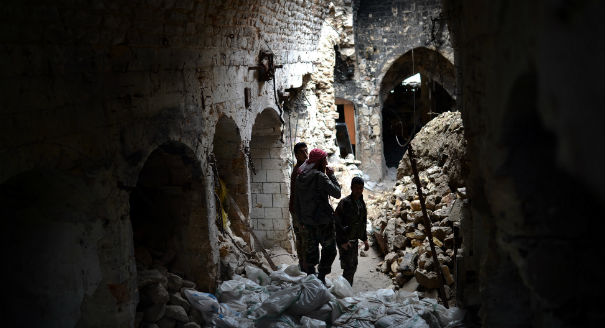
That’s a false choice. The United States and the international community must help rebel groups build a state within the area they hold or risk more radical elements hijacking the revolution and taking control of Syria.In our recent trips in northern Syria it was obvious that the continuation of the conflict favors radical groups and risks destabilizing the entire region. Western countries are providing very limited support to the opposition, and this disinterest is misunderstood by Syrians after the interventions in Libya and Mali.
In the meantime, Gulf countries are financing specific armed groups, further increasing fragmentation and radicalization within the insurgency. This situation favors groups like Jabhat al-Nusra—and Syria is just one step in its internationalist, jihadist strategy—and the regime, which tries to impose a sectarian narrative on the Syrian revolution to gain the support of minorities and the international community.
With the debate in the West focused on supplying or withholding arms to rebel groups, these important realities are being overlooked. The fear of inadvertently supporting an Islamist takeover is delaying efforts to reconstruct the state where insurgents are already in control.
This must change. Today the nascent insurgent institutions lack the resources to assert their authority. While there are courts and other civilian structures in the north that will hopefully serve as the core of a new Syrian state, these institutions remain fragile. Damascus is no longer paying the salaries of civil servants living in the liberated zones and there is no budget to sustain basic public services.
Without foreign funds to support these activities, more radical groups with foreign sponsors have a chance to step in. And Syrians are in desperate need of governance. It is a war-ravaged economy with millions of refugees and displaced persons, and we met many people this winter struggling to stay warm, find food and get healthy.
The opposition requires foreign aid. So instead of perpetuating the back and forth argument on directly arming rebel groups, the West should adopt a type of aid that doesn’t face the same technical or political hurdles at home. A political consensus on civilian aid is much more likely in Washington and European capitals. And the Syrian population is sufficiently trained to redistribute the funds and deliver services at the local level.
The advantages of using Western aid to establish governing institutions in liberated areas are clear.
First, inaction is fueling anti-Western hostility. The image of the West among the people of Syria, and Muslim populations more broadly, will be greatly improved if people see foreign aid supporting their daily lives. This will also help give a future Syrian government popular backing for establishing good relations with the United States and Europe.
Second, the installation of effective civil and political organizations will marginalize the more radical groups. Indeed, the rise and strength of Jabhat al-Nusra relies heavily on the current difficulties of the insurgency to administer the distribution of food and basic supplies. Bolstering national institutions now helps ensure that extremist groups don’t come out on top of the war.
And third, military progress in the coming months needs to go hand in hand with building a good governing organization that can minimize the disorder after Assad’s ouster. Establishing a legal system will both contain jihadis and curtail the impulse for reprisals against the Alawites and other minorities perceived to be on the side of current rulers.
Assad will ultimately fall, but the Syria that emerges from the ashes of a civil war is undecided. The international community has an opportunity to shape the future Syria and limit the long-term downsides of the struggle’s aftermath. To do so, the United States and its allies must give assistance to the opposition so it can build a government-in-waiting in insurgent-held areas before it’s too late.
This article was originally published in the International Herald Tribune.
Former Nonresident Scholar, South Asia Program
Dorronsoro’s research focuses on security and political development in Afghanistan. He was a professor of political science at the Sorbonne in Paris and the Institute of Political Studies of Rennes.
Adam Baczko
Arthur Quesnay
Carnegie does not take institutional positions on public policy issues; the views represented herein are those of the author(s) and do not necessarily reflect the views of Carnegie, its staff, or its trustees.

U.S. trading partners in Asia are closely watching the dispute for signs of how it may affect their own interests.

Barbara Weisel

The aftermath of the Ceuta crisis shows Europe has drawn the wrong lessons. Rather than doubling down on failed migration policies, the EU needs to address the underlying roots of such episodes.

Richard Youngs
By abandoning past U.S. pro-democracy policies and adopting several lines of pro-autocratic action, the Trump administration has fundamentally repositioned the United States vis-à-vis democracy in the world.

Thomas Carothers
Chinese strategists are once again debating whether American power is declining and whether U.S. hegemony is experiencing irreversible decay.
Wu Xinbo

In the tenth year of his presidency, President Mirziyoyev’s system is becoming even more personalized than that of his predecessor Karimov.

Galiya Ibragimova