

Commentary
Sarah Chayes
{
  "authors": [
    "Sarah Chayes"
  ],
  "type": "legacyinthemedia",
  "centerAffiliationAll": "dc",
  "centers": [
    "Carnegie Endowment for International Peace"
  ],
  "collections": [],
  "englishNewsletterAll": "democracy",
  "nonEnglishNewsletterAll": "",
  "primaryCenter": "Carnegie Endowment for International Peace",
  "programAffiliation": "DCG",
  "programs": [
    "Democracy, Conflict, and Governance"
  ],
  "projects": [],
  "regions": [
    "North America",
    "United States"
  ],
  "topics": [
    "Political Reform",
    "Security",
    "Civil Society"
  ]
}
Source: Getty
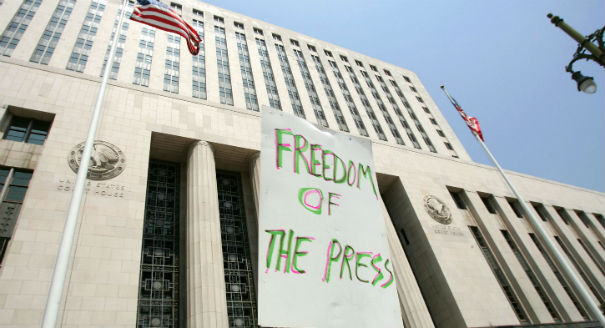
Journalists can be too cavalier in asking their sources for classified information, but the government should take a hard look at what it chooses to classify.
Source: Washington Post
“Are you kidding me?”
I was always stunned to hear reporters ask me — as they did half a dozen times when I worked at the Pentagon — to show them some classified document or other. They’d just pop the question blithely, unfazed, without an apparent thought for the implications. My incredulous retort would usually reap an only half-sheepish answer: “Well, I had to ask.”
Countless national security officials have had some version of this conversation – including the State Department security adviser that Fox News correspondent James Rosen allegedly plumbed for information on North Korea. Rosen wrote in an e-mail that he’d “love to see some internal State Department analyses.”
I’ve served on both sides of the line, as an NPR reporter and a Defense Department official, and it’s from that split perspective that I’ve been observing the furor over the seizure of journalists’ telephone and e-mail records in Justice Department investigations of national security leaks. Especially troubling to some reporters and pundits is a search warrant application suggesting that Rosen was “an aider and abettor and/or co-conspirator” with his source. Commentators have decried the Justice Department for criminalizing journalism itself.The value to democracy of a courageous and unfettered press poking into back corners that agencies would rather keep hidden is incontrovertible. But I find myself wondering why journalists shouldn’t shoulder some responsibility for transgressions they often goad their sources to commit.
Every government employee who obtains a security clearance receives a briefing on the rules about accessing and using classified information, and, as part of his or her terms of employment, must sign a piece of paper acknowledging the potential consequences of violating the law. Many officials, including me, have been subjected to a polygraph exam — an exceedingly unpleasant experience for anyone with a conscience or a literal mind. National security staffers’ careers can be wrecked over how they handle documents stamped SECRET.
Reporters, on the other hand, have little to lose when trawling for leaks. No American journalist has been prosecuted for publishing classified information. And the media could gain even greater protections under a shield law or new procedures now being hammered out with the Justice Department.
I’ve heard from reporters and senior government figures alike that the Obama administration’s leak investigations are having a chilling effect on officials who normally interact with journalists. That’s unfortunate, because regular conversations about the business of government, as well as the injection of alternative perspectives by way of the questions reporters ask, or their reflections on what they hear, are critical to a healthy state.
But the stakes might be clearer if sources knew that reporters had skin in the game, too: if they understood that journalists weren’t asking questions idly — in hopes of a passing scoop, or even happy to be made use of in some messaging campaign — but because the information is so critical to the public interest that they are willing to risk repercussions for finding and airing it.
Comparatively unfettered though the press may be in the United States, its courage is frequently lacking. Washington relationships cemented by orchestrated leaks and background innuendo can verge on the sycophantic. Then again, government disingenuousness has also been on display in the current imbroglio.
Far too much information is protected by unwarranted classification. It’s hard to take a system seriously that places so many gigabytes of material that are not critical to national security under the same umbrella as the few nuggets that are. I’ve seen a New Yorker article included among prep documents for a National Security Council meeting stamped SECRET//NOFORN (meaning that only cleared U.S. citizens were allowed to read it). I’ve had a colleague contradict a sunny e-mail he sent me on the unclassified system with a SECRET snarl. Such misuse makes a mockery of rules that the leak investigations seek to enforce.
At least as troubling is the double standard that has seemed to apply in the recent investigations. The six criminal prosecutions under the Obama administration have all targeted working-level government employees. Meanwhile, senior officials leak — or authorize leaks — with impunity.
In September 2010, a flurry of coverage in major U.S. newspapers reported a supposed government decision on how corruption in Afghanistan would be handled. Perusing the articles with growing wonder, I looked down at a memo on my desk. Not only were passages quoted from it classified, the document was also watermarked DRAFT. No decision had been made yet because debate on the draft had not even reached the level of Cabinet secretaries. It was a classic Washington case of offensive leaking. For months, I was convinced that the perpetrator was the late Richard Holbrooke, then special representative to Afghanistan and Pakistan. But I kept asking reporters. Finally I traced the leak to a senior White House official, whose career has progressed untroubled.
Last year, Washington Post columnist David Ignatius was given an exclusive preview of 17 redacted documents that had been retrieved from Osama bin Laden’s compound in Abbottabad, Pakistan. Ignatius wrote that the documents had been declassified but had not yet been made available to the public. More than six weeks later, those 17 documents — and only those 17, out of some 1.5 million scooped up at Abbottabad — were released. How does such selectivity square with a coherent declassification policy?
Perhaps the most remarkable example of disclosure of classified information in plain sight was the detail offered up to the media in the wake of the raid that killed bin Laden — capped off by briefings from then-White House chief counterterrorism adviser John Brennan. The superfluous specificity left a number of officials who had helped plan the raid aghast, including a longtime Washington insider, then-Defense Secretary Robert Gates.
The law, including regulations protecting national security secrets, should be taken seriously, and decisions to break it for reasons of conscience should not be taken lightly. But by the same token, the law should not be stretched for purposes far beyond its original, legitimate intent. And most important, it should be applied equally to all who vow to uphold it.
Former Senior Fellow, Democracy, Conflict, and Governance Program
Sarah Chayes is internationally recognized for her innovative thinking on corruption and its implications. Her work explores how severe corruption can help prompt such crises as terrorism, revolutions and their violent aftermaths, and environmental degradation.
Recent Work
Sarah Chayes
Carnegie does not take institutional positions on public policy issues; the views represented herein are those of the author(s) and do not necessarily reflect the views of Carnegie, its staff, or its trustees.

It should address the shortcomings of previous crisis communication efforts and adapt to the demands of frontier AI.

Lucy Luo

If the Russian-speaking community in Latvia cannot articulate their interests without being seen as disloyal, they could end up embracing a pro-Kremlin agenda.

Sergejs Potapkins
Washington’s decision to support some UN functions while letting others wither is pulling the organization apart at the seams.

Stewart Patrick, Theodore Zaritsky

While there are notable demographic, economic, and geographic divides over AI, there is also substantial alignment between Republicans and Democrats.


Ian Klaus, Mark Baldassare, Rachel George, …

Are Germany’s economic, industrial, and political struggles becoming a liability for the EU’s ability to rise to the geopolitical moment?

Rym Momtaz, ed.