• Research
  • Emissary
  • About
  • Experts
Carnegie Global logoCarnegie lettermark logo
Democracy
  • Donate
{
  "authors": [
    "Maria Lipman"
  ],
  "type": "commentary",
  "centerAffiliationAll": "",
  "centers": [
    "Carnegie Endowment for International Peace",
    "Carnegie Russia Eurasia Center"
  ],
  "collections": [],
  "englishNewsletterAll": "",
  "nonEnglishNewsletterAll": "",
  "primaryCenter": "Carnegie Russia Eurasia Center",
  "programAffiliation": "",
  "programs": [],
  "projects": [],
  "regions": [],
  "topics": []
}

Source: Getty

Commentary
Carnegie Russia Eurasia Center

The Problem Is Broader Than the Declining Authority of G8

That the final communiqué was signed by all the G8 members can hardly delude anyone: the disagreements between Russia and the other Seven look deeper than ever.

Link Copied
By Maria Lipman
Published on Jun 20, 2013

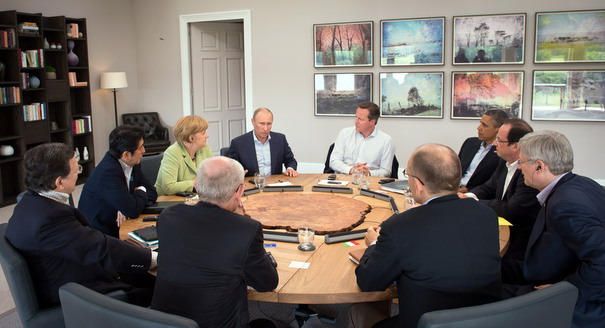
The final statement of the G8 Summit held in Northern Ireland this week avoided divisive issues, such as the U.S. plan to deliver military aid to the Syrian opposition. The G8 called for an urgent peace conference on Syria to be held in Geneva, but the prospect of such a conference is vague, given that the Syrian opposition stands firm on President Assad’s resignation as a precondition for peace talks. Meanwhile, the G8 communiqué does not as much as mention Assad’s name. The G8 document sounds empty, and can barely be seen as offering a solution to the Syrian conflict.

That the final communiqué was signed by all the G8 members can hardly delude anyone: the disagreements between Russia and the other Seven look deeper than ever. The Canadian Prime Minister Stephen Harper stated the obvious when he said on Monday that “this is G7 plus one.”

Ironically it was in Canada that Russia, over a decade ago, was confirmed as a full-fledged G8 member and granted a permission to host the G8 Summit in 2006. The statement issued in 2002 at the G8 Summit in Kananaskis today sounds utterly unthinkable: “This decision reflects the remarkable economic and democratic transformation that has occurred in Russia in recent years and in particular under the leadership of President Putin.”

That wording implied that the G8 membership was granted (after years of partial membership) as a reward for Russia’s progress and encouraged its president to stay the course. This emphasized Russia’s difference from its fellow G8ers who had joined the club in mid-1970s: The first six nations got together in 1975 in what was conceived as a forum for the world’s major industrialized democracies; the following year they were joined by Canada—unlike Russia, with no trial period.

Russia has not lived up to the expectations that were laid on her back in 2002. Russia’s dissimilarities from its G8 fellow members are fairly strong and include, to mention just a few, its increasingly authoritarian political regime, its geopolitical vision, as well as its status as an emerging market (it is a member of BRICS, while the other seven belong to the OECD). With increasing assertiveness Russian officialdom claims that Russia does not share Western values.

This rift within the G8 seriously reduces the Group’s relevance in tackling global issues. But in fact, the G8 relevance has been on decline even regardless of Russia’s dissent. The judgment and recommendations of the seven “major industrial democracies” may have mattered back in the 1970s, but over the past years their authority or their capacity to offer solutions to world problems has been repeatedly called in doubt. The rise of emerging markets, China first and foremost, but also India and Brazil, has led to the foundation of the G20—an obvious challenge to the G8 stature.

In fact, the problem with supranational authority is broader than the declining influence of the G8. After the end of the cold war, as the major confrontation of the two poles receded into history, the concept of the “international community” has become problematic. In a world that gets increasingly fragmented—call it multipolar—the ability of international actors to make a difference is strongly limited, especially when it comes to dealing with armed conflicts or inhuman regimes.

 
Maria Lipman
Former Scholar in Residence, Society and Regions Program, Editor in Chief, Pro et Contra, Moscow Center
Maria Lipman

Carnegie does not take institutional positions on public policy issues; the views represented herein are those of the author(s) and do not necessarily reflect the views of Carnegie, its staff, or its trustees.

More Work from Carnegie Endowment for International Peace

  • Kushner and Putin shaking hands, with Witkoff standing next to them
    Commentary
    Emissary
    What If Trump Gets His Russia-Ukraine Deal?

    It’s dangerous to dismiss Washington’s shambolic diplomacy out of hand.

      Eric Ciaramella

  • Abstract of global AI
    Article
    South-South AI Collaboration: Advancing Practical Pathways

    The India AI Impact Summit offers a timely opportunity to experiment with and formalize new models of cooperation.

      Lakshmee Sharma, Jane Munga

  • Commentary
    Strategic Europe
    Taking the Pulse: Can the EU Attract Foreign Investment and Reduce Dependencies?

    EU member states clash over how to boost the union’s competitiveness: Some want to favor European industries in public procurement, while others worry this could deter foreign investment. So, can the EU simultaneously attract global capital and reduce dependencies?

      • Rym Momtaz

      Rym Momtaz, ed.

  • Article
    What Can the EU Do About Trump 2.0?

    Europe’s policy of subservience to the Trump administration has failed. For Washington to take the EU seriously, its leaders now need to combine engagement with robust pushback.

      Stefan Lehne

  • Commentary
    Strategic Europe
    To Survive, the EU Must Split

    Leaning into a multispeed Europe that includes the UK is the way Europeans don’t get relegated to suffering what they must, while the mighty United States and China do what they want.

      • Rym Momtaz

      Rym Momtaz

Get more news and analysis from
Carnegie Endowment for International Peace
Carnegie global logo, stacked
1779 Massachusetts Avenue NWWashington, DC, 20036-2103Phone: 202 483 7600Fax: 202 483 1840
  • Research
  • Emissary
  • About
  • Experts
  • Donate
  • Programs
  • Events
  • Blogs
  • Podcasts
  • Contact
  • Annual Reports
  • Careers
  • Privacy
  • For Media
  • Government Resources
Get more news and analysis from
Carnegie Endowment for International Peace
© 2026 Carnegie Endowment for International Peace. All rights reserved.