

Article
Japan’s revision of its three strategic documents reflects an intention to keep the United States engaged in the region while Japan fills any vacuums of U.S. power to preserve the Indo-Pacific order.
Ryo Sahashi
{
  "authors": [
    "Yukon Huang",
    "Canyon Bosler"
  ],
  "type": "legacyinthemedia",
  "centerAffiliationAll": "dc",
  "centers": [
    "Carnegie Endowment for International Peace",
    "Carnegie China"
  ],
  "collections": [],
  "englishNewsletterAll": "asia",
  "nonEnglishNewsletterAll": "",
  "primaryCenter": "Carnegie China",
  "programAffiliation": "AP",
  "programs": [
    "Asia"
  ],
  "projects": [],
  "regions": [
    "East Asia",
    "China"
  ],
  "topics": [
    "Economy"
  ]
}
Source: Getty
The standard package of market-based financial reforms will not work until China’s banks are subjected to increased competition.
Source: Wall Street Journal
The news leading up to China's Third Plenum next month seems to suggest that the country is heading toward a financial cliff. The common perception is that China's mismanaged banks are saddled with unprecedented debt driven by irresponsible local borrowing and incomprehensible shadow banking products. Over-capacity in manufacturing suggests that high investment rates cannot produce the returns needed to service these new debts.
But these anxieties are overblown. If a crisis were imminent, you would expect to see signs of stress in the banking data. Instead, the Big Four banks continue to bring in stellar profits, consistently beating expectations. Industrial & Commercial Bank of China and China Construction Bank still top the list of the world's most valuable banks. Sure, nonperforming loans "surged" by $2.1 billion last quarter. But that absolute rise ignores the fact that they account for just 0.96% of assets.
The real issue is that the banks remain insulated from competition in a financial system dominated by the state, which plays conflicting roles as borrower, creditor and regulator. The Big Four state-owned commercial banks control nearly half of the banking system. City and local banks beholden to local governments account for an additional 20% of assets. Between weak non-bank intermediaries, underdeveloped bond and equity markets and extensive capital controls, the major state banks face minimal competition for Chinese citizens' deposits or firms' business.
The main competitors to state bank deposits are speculative investment in real estate or unregulated lending through wealth management products. Both are dangerous to the financial system as a whole. The first stokes the real estate bubble while the latter introduces new risks through opaque channels. The rise of shadow banking has been driven by the locally controlled banks, which are responding to pressures to boost local coffers by funding often unproductive infrastructure and property development.Another factor restraining competition is the government's implicit guarantee of all bank deposits. Since the current system makes deposits "riskless," banks only compete through the interest rate, resulting in all banks paying the ceiling rate. The same guarantee has resulted in debt difficulties for local infrastructure-investment entities, which have gone on borrowing binges. Shifting over to an explicit, but limited, deposit insurance scheme would generate competition to improve quality, gradually strengthening the banking system.
The lack of competition in the banking system will not be solved by standard solutions. Liberalizing interest rates or educating managers to be cognizant of risks will do little to address this lack of competition and pervasive political pressures. In fact, such solutions are undermined by the condition they are meant to fix—oligopolistic markets encourage political rent seeking. They are not prone to efficient price discovery or disciplining poorly managed institutions. Competition is a prerequisite for market-based reforms to work.
Introducing change to a state-dominated system is difficult, but not unprecedented. Consider the reform of large corporations in the 1980s, which challenged state-owned enterprises (SOEs) in two ways. First, they made the SOEs more export-oriented, which subjected them to foreign competition. Second, they encouraged rivalries between firms from different provinces. A similar approach can make banking more competitive: namely, opening the capital account, breaking up the big four banks and weakening the links between the city banks and demands of local officials.
Reformers have long called for China to open its capital account, with the conventional prescription being to liberalize inflows before outflows. But capital inflows will only increase the liquidity that has driven the credit boom and asset bubbles. In contrast, liberalizing outflows would channel excess liquidity abroad. This would divert funds from fueling the housing bubble or shadow banking, while also pressuring banks to compete for deposits.
A more radical approach to increase competition would be to break each of the Big Four banks into three or four regional banks. The resulting smaller institutions could compete to develop a national presence. Doing so would require them to survive by becoming more commercially oriented. Some might even be inclined to welcome foreign partners.
This approach worked well when the monolithic national airline was broken up in the late 1990s into many regional airlines. Market pressures led to consolidation, global alliances and improved performance.
One roadblock to reform is China's relatively low tax revenues compared to other middle-income countries. This forces the government to rely on the banks for a large portion of public expenditures. So long as the government remains unable to fund its obligations through the fiscal system, it is unlikely to be willing to restructure the Big Four banks. Strengthening the fiscal system is therefore a prerequisite to ending the state's use of the commercial banks for non-commercial purposes.
Absent more competition, the explosion of debt and the rapid growth of shadow banking may pose a significant threat to China's financial stability. Just as Deng Xiaoping revitalized a moribund manufacturing industry by subjecting state-owned enterprises to market forces, the current Chinese leadership must discipline the state-owned banks by increasing competition. Only then will the banks clean up their act.
This article was originally published in the Wall Street Journal.

Senior Fellow, Asia Program
Huang is a senior fellow in the Carnegie Asia Program where his research focuses on China’s economy and its regional and global impact.
Canyon Bosler
Former Junior Fellow, Asia Program

Japan’s revision of its three strategic documents reflects an intention to keep the United States engaged in the region while Japan fills any vacuums of U.S. power to preserve the Indo-Pacific order.

Ryo Sahashi

Chinese biotech companies have been on the receiving end of U.S. economic coercion. Yet their responses have differed significantly because firm and state interests are not uniformly aligned. For Washington, treating all Chinese tech firms the same, irrespective of their actual interests, risks pushing them farther into Beijing’s corner.

Xue Gong

Over the past decade, China has moved from marginal player to major producer of all things batteries. The United States, Europe, and others are aiming to balance the market.

Milo McBride
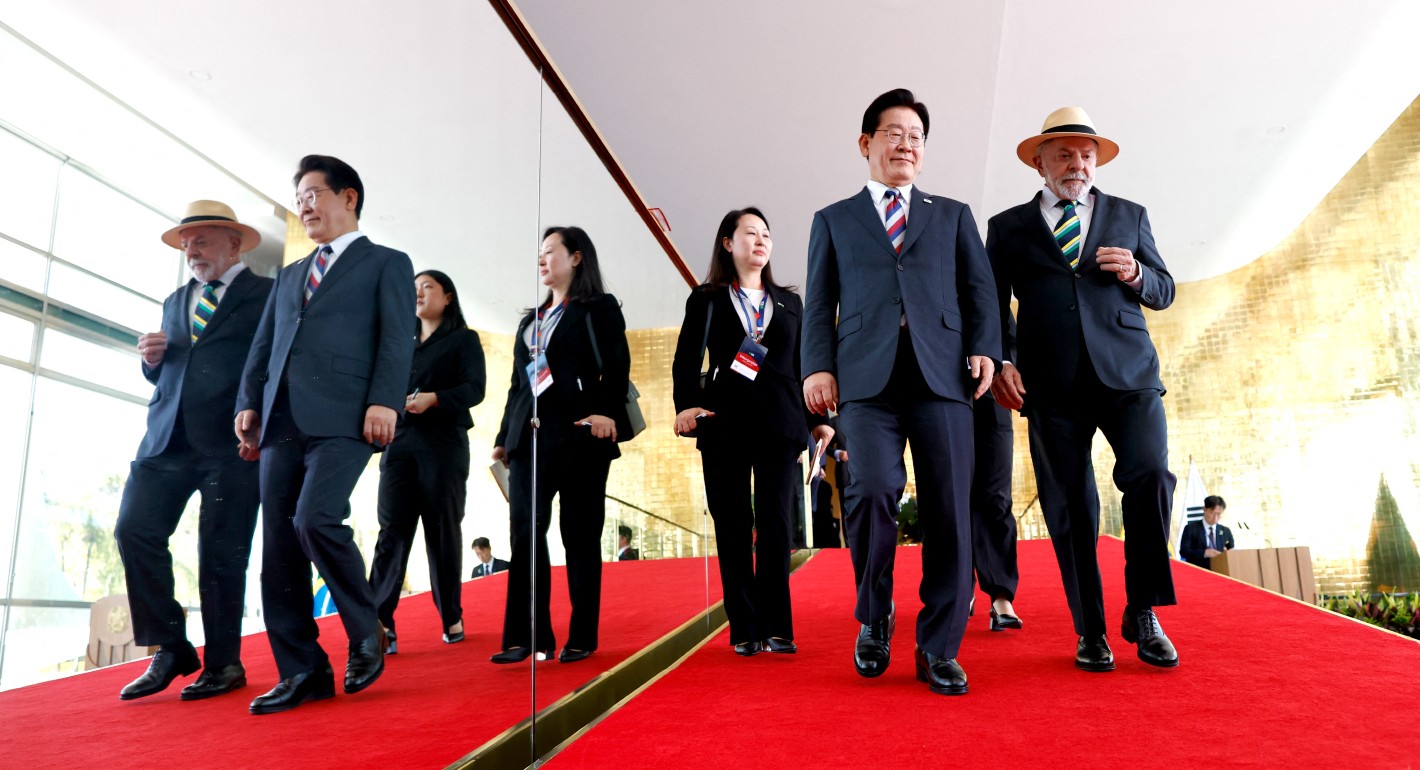
Lee’s tour shows how Seoul is reorganizing its diplomacy away from Pyongyang and toward industrial networks and the geography of the compute economy.

Darcie Draudt-Véjares

Most migrants may have left Ceuta, but the effects may linger.


Alejandro Martin Rodriguez, Sarah Yerkes