

Commentary
Dmitri Trenin
{
  "authors": [
    "Dmitri Trenin"
  ],
  "type": "commentary",
  "centerAffiliationAll": "",
  "centers": [
    "Carnegie Endowment for International Peace",
    "Carnegie Russia Eurasia Center"
  ],
  "collections": [],
  "englishNewsletterAll": "",
  "nonEnglishNewsletterAll": "",
  "primaryCenter": "Carnegie Russia Eurasia Center",
  "programAffiliation": "",
  "programs": [],
  "projects": [
    "Eurasia in Transition"
  ],
  "regions": [
    "East Asia",
    "Central Asia"
  ],
  "topics": []
}
Source: Getty
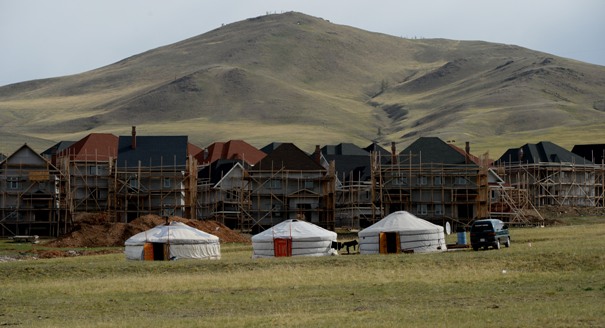
Next to maintaining a strict balance between two former overlords, Beijing and Moscow, Ulan Bator seeks to balance its both physical neighbors with a third—virtual—one.
Mongolia seldom features in the news. A vast country with a puny population sandwiched between China and Russia, it has managed since 1990 to build a parliamentary system of government which results in periodic alternation in power of the two main parties. Occasionally, political tensions can rise and streets of Ulan Bator, the capital, become filled with people pressing their demands. However, the political system has been able so far to absorb such shocks and move on.
During most of the 20th century, Mongolia, due to its close links to Moscow, was said to be a country in Eastern Europe, not East Asia, where it is geographically positioned. Today, its leaders and elites leave no doubt that they are looking east, toward the Pacific basin, which they see as the center of the global economy and 21st century politics. The former Soviet republics of Central Asia, such as Kyrgyzstan, are now learning from Mongolia’s parliamentary system.
Besides making parliament work in the birthplace of Genghis Khan, the Mongols have given the world a foreign policy concept of a “third neighbor.” Next to maintaining a strict balance between two former overlords, Beijing and Moscow, Ulan Bator seeks to balance its both physical neighbors with a third—virtual—one. This third neighbor is never identified by name but is described as “advanced democratic countries,” which stands, in the first place, for the United States, Japan, and South Korea.
Mongolia’s achievements and aspirations were recognized by a U.S. presidential visit. Finally, a few years ago, Moscow, after a 20-year-long break, started paying attention, including at the top level. The Mongols, however, became concerned last month as Xi Jinping, China’s new leader, toured Central Asia. With Beijing reviving the Great Silk Road, Ulan Bator saw itself as being sidelined. So much more reason, the Mongols have decided, to work with the Chinese, the Japanese, the Koreans, and the Russians toward closer economic integration in the Far East.
Mongolia keeps to its own code of political conduct. The main reason it is staying away from the Shanghai Cooperation Organization is that it does not want even to hint at a political affiliation, not to speak of a security alignment. Given its strategic position, it needs not only to be friends with its both giant neighbors, but also have powerful friends in a third place to avoid domination by China or Russia. Yet, Ulan Bator is not shunning anyone. It offers itself, for example, as a venue for contacts related to North Korea. Mongolian officials are frequent visitors to Pyongyang, and the head of the North Korean state security service has traveled to Ulan Bator. To retain their friendships with third parties, the Mongols want to make themselves useful.
Former Director, Carnegie Moscow Center
Trenin was director of the Carnegie Moscow Center from 2008 to early 2022.
Recent Work
Dmitri Trenin
Dmitri Trenin
Carnegie does not take institutional positions on public policy issues; the views represented herein are those of the author(s) and do not necessarily reflect the views of Carnegie, its staff, or its trustees.

The nuclear relationship between China and the United States is increasingly shaped by widening perception gaps rather than deliberate strategic design.

Tong Zhao
U.S. trading partners in Asia are closely watching the dispute for signs of how it may affect their own interests.
Barbara Weisel

In the tenth year of his presidency, President Mirziyoyev’s system is becoming even more personalized than that of his predecessor Karimov.

Galiya Ibragimova

With the growth in points of friction between the great powers, organizations like the SCO will continue to play a role in the strategic adaptation of the smaller powers caught between them.

Temur Umarov
Xi, Putin, and other regional leaders are back-slapping in Bishkek, but the SCO has yet to answer the most serious questions about continental Asia's economic future.

Evan A. Feigenbaum