

In The Media
John Judis
{
  "authors": [
    "John Judis"
  ],
  "type": "legacyinthemedia",
  "centerAffiliationAll": "",
  "centers": [
    "Carnegie Endowment for International Peace"
  ],
  "collections": [],
  "englishNewsletterAll": "",
  "nonEnglishNewsletterAll": "",
  "primaryCenter": "Carnegie Endowment for International Peace",
  "programAffiliation": "",
  "programs": [],
  "projects": [],
  "regions": [
    "North America",
    "United States"
  ],
  "topics": []
}
Source: Getty
The quest for objectivity was an attempt to carve out an area of public information and judgment that the public (who may not be familiar with the Egyptian street or the details of a trade agreement) can rely on.
Source: New Republic
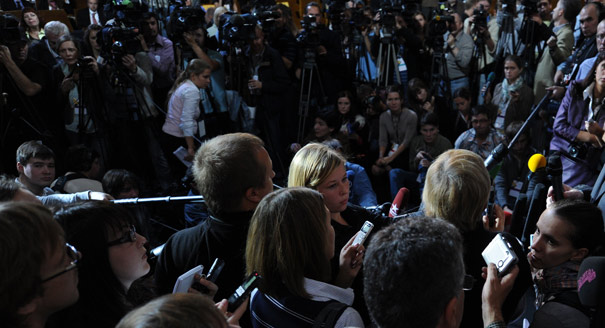
A debate has been raging for 50 years or more over whether journalists should try to be “objective” in reporting events or describing controversies. It flared up recently in an exchange in The New York Times between former editor Bill Keller and uber-journalist Glenn Greenwald. And even thousands of miles away, I haven’t been able to avoid it.
At a conference on the media this week sponsored by the United States Studies Centre of Sydney University, I was asked several times whether I thought journalists should strive to be “objective.” I have a simple answer to this question: yes. And that’s because I reject the assumptions that many people now make in asking this question.
The fashionable answer today is that there is no such thing as objectivity. Greenwald, for instance, writes, “Human beings are not objectivity-driven machines. We all intrinsically perceive and process the world through subjective prisms.” Keller also rejects objectivity as a model. “I avoid the word ‘objective,’ which suggests a mythical perfect state of truth,” he writes. Instead, Keller prefers impartiality as a model.There is an old philosophical fallacy at work here that goes back to the works of the 18th century Irish philosopher George Berkeley. The discussants are transporting terms that have understandable meanings into a metaphysical realm where they do not. If you say that there is no such thing as objectivity because we “process the world through subjective prisms,” you can only have known this if you were able to compare objective reality with what you perceive through your subjective prism, but you can’t know this because by your own formulation objective reality is unknowable. This is not just a puzzle or a paradox, but an indication that the assertion itself is nonsense.
If you leave the realm of metaphysics and use the term “objective” the way that, outside of classrooms, it is usually taken, then it makes perfect sense to talk about some judgments or perceptions or descriptions being more or less objective than others. That’s a tipoff that “objective” does mean something. A judgment that is more objective is one that is less shaped by one’s prejudices, hopes, fears, and wishes, and vice versa for less objective. And every journalist has examples at hand. They come particularly easy to people who cover politics.
When I used to do “man-in-the-street” interviews to judge who was ahead in a race, I often had to recognize afterwards that I had asked questions and picked out people to interview who would confirm my hopes that the Democrat was going to win. It happens all the time, but it’s also not inevitable. You learn to question your assumptions; you write second and third drafts; you listen to a taped interview again; editors ask questions; and so do fact-checkers. And sometimes, as a result, you are able to write things that are accurate—and in this sense, objective—even if they don’t accord with your hopes and wishes. Will they be “perfectly objective”? This is a metaphysical dead horse comparable to asking whether a circle drawn on paper to do a geometry problem is “perfectly round.”
What about Keller’s insistence that impartiality is a better standard than objectivity? As Greenwald suggests, this kind of standard can lead to misleading journalism. Being impartial most often means not taking sides in an argument between opposed opinions. That’s fine when there is strong evidence on both sides, and when the reader is not really interested in what the reporter or researcher thinks. But there are cases where accepted scientific findings are at stake, or where the reporters, or researcher is in a position to know that one side of the argument is false. In that case, a reporter can do a disservice by suggesting that the arguments for or against, say, human-caused climate change or Barack Obama being born in the United States are of equal weight. There is a difference, in other words, between being objective and being impartial.
What about Greenwald’s defense of “activist” journalism? Greenwald writes, “All journalism is a form of activism. Every journalistic choice necessarily embraces highly subjective assumptions—cultural, political or nationalistic—and serves the interests of one faction or another.” Greenwald wants journalists to disclose their “subjective assumptions and political values” in reporting on the news—the assumption being that the reader will then be able to judge better the accuracy of the story.
To evaluate Greenwald’s position, you have to distinguish between normative judgments about what ought to be done and analytical judgments about what is likely to happen, or about what, given accepted ends, is a viable means of achieving them. Almost all journalism—unless it consists of publishing transcripts or stock quotations—involves making analytical judgments. But the question is whether all journalism implicitly or explicitly involves advocacy, and if or when it does, whether the author’s positions should be disclosed.
I would say something different here from Greenwald. Yes, journalists (or policy experts) usually have a rooting interest in what they write about, but it need not shape what they write. That’s the whole point about objectivity—and the role of editors and second drafts. On a psychological level, too, a journalist might want to see Al Gore win the election, but he or she might also want to maintain his reputation as a journalist whose reporting can be trusted by Republicans as well as Democrats. One hope might override the other. That’s what professionalism is about.
As for whether writers or television reporters should disclose their political values, I think that depends on whether we are talking about a reporter working for a large newspaper or network or a quasi-independent operator like myself or Greenwald. With a newspaper like The New York Times, the credibility of its coverage rests ultimately on the publication’s reputation for objectivity rather than on the reputation of individual authors. It would be tedious and misleading for, say, political reporters to begin each of their election accounts by saying who they would vote for.
Political writers known for their byline more than for the publication they work for have to build trust largely by their own efforts. In these cases, it is sometimes superfluous to disclose what one advocates, because one’s politics are generally known. Most people who read me know that I would be happy if a third or more of American workers belonged to unions, but if they think that everything I write about unions will be designed to buttress this conviction, I will have failed as a journalist and will be seen merely as an “activist” or “lobbyist” for a cause. So I have to be willing to write that the labor movement is in trouble. I even make a point occasionally of saying in an article, “I would like to see X happen, but I’m afraid that Y is more likely.” That is supposed to demonstrate my own objectivity.
In case it’s not obvious, I am defending here—with reservations about Keller’s use of impartiality—the kind of journalism The New York Times or National Public Radio practice. It is not a defense of Fox News, which has polluted the waters of American journalism by eschewing objectivity. Standards of objectivity became prevalent, historian Michael Schudson has written, in response to the rise of public relations during the 1920s and to the development as journalism as a profession. By imposing this standard, journalists were trying to distinguish their work from those of lobbyists or PR people.
Much the same standards also apply to early policy organizations—now often called think tanks—and to the work of presidential or congressional commissions and of independent agencies. Their work is supposed to be objective—that is, not determined by faction, party, or interest. Brookings’ work is supposed to be different from the work of groups like Center for American Progress or Heritage Foundation that are linked to political causes or parties or to that of groups like the American Enterprise Institute that is driven by its business funders.
The quest for objectivity was an attempt to carve out an area of public information and judgment that the public (who may not be familiar with the Egyptian street or the details of a trade agreement) can rely on. And it’s well worth preserving at a time when it is under attack from both left and right.
Former Visiting Scholar
As a visiting scholar at Carnegie, Judis wrote The Folly of Empire: What George W. Bush Could Learn from Theodore Roosevelt and Woodrow Wilson.
Recent Work
John Judis
John Judis
Carnegie does not take institutional positions on public policy issues; the views represented herein are those of the author(s) and do not necessarily reflect the views of Carnegie, its staff, or its trustees.

The EU can impose sanctions but struggles to enforce them without the United States. With Washington increasingly disinterested in backing European interests, the bloc must now fend for itself.


Nicu Popescu, Tiago Antunes

Rubio’s recent visit brought welcome attention, but more capital requires governance changes that may be a hard sell for regional governments.

Jennifer B. Murtazashvili

America’s foreign-policy objectives have grown more demanding while Americans have demanded greater focus on their own affairs.

Stephen Wertheim

Despite public disputes over trade and immigration, the strategic partnership’s foundations remain sturdy.

Sameer Lalwani

It signals a new era of tech diffusion and warfare.

Steve Feldstein