

Commentary
Uri Dadush
{
  "authors": [
    "Uri Dadush"
  ],
  "type": "legacyinthemedia",
  "centerAffiliationAll": "",
  "centers": [
    "Carnegie Endowment for International Peace",
    "Carnegie Europe"
  ],
  "collections": [],
  "englishNewsletterAll": "",
  "nonEnglishNewsletterAll": "",
  "primaryCenter": "Carnegie Endowment for International Peace",
  "programAffiliation": "",
  "programs": [],
  "projects": [],
  "regions": [
    "Western Europe",
    "Europe"
  ],
  "topics": [
    "Democracy",
    "Foreign Policy",
    "EU",
    "Migration"
  ]
}
Source: Getty
Immigrants come to Europe to work, and Europeans need them. It is time for France and other EU countries to bring their immigration policies more in line with their ideals.
Source: Libération
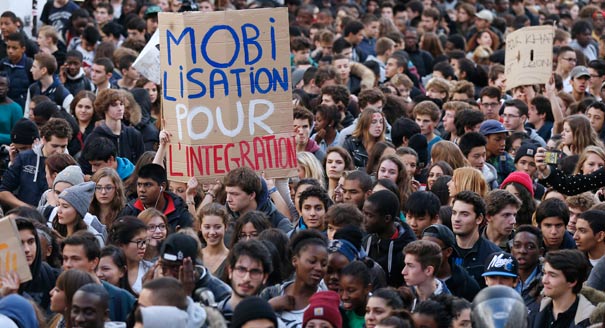
The contradictions are as sharp as a surgeon’s scalpel. One day, we celebrate the survival of the remarkable Malala Yousafzai, the 15-year-old girl who was shot in the face by the Taliban for defying them by going to school. The next day, we arrest the 15-year-old Roma girl Leonarda Dibrani while she is on a school outing and deport her to Kosovo. Her crime? To have come to France—my country, the land of fraternity—with her parents, immigrants who were seeking, but who were refused, asylum. Then our students, outraged, stage protests. Finally, the president of the republic issues a judgment truly emblematic of our collective neurosis: the girl can return, but not her parents.
One day, we erect impassable barriers for Africans desperate to immigrate to Europe, even those seeking asylum from the ravages of war and persecution; the next, when hundreds drown within sight of our shores, Italians declare a day of mourning. Only a few weeks ago, the courageous Pope Francis visited Lampedusa on his first trip to signal his solidarity with the oppressed of the world. Meanwhile, our diplomats are unceasing in their efforts to keep Africans out, negotiating obscure deals with regimes that can use direct methods unimpeded by television cameras. Above all, methods that cannot be ascribed to us.
One day, we give Qatar an enormous accolade, the privilege of hosting the World Cup—the greatest event of our most popular sport, one where the whole world—black and white, poor and rich—comes together. The next day, we “discover” that their stadiums are being built by modern-day slaves—immigrant workers from India and Nepal who have no rights, not even the right to leave without their employer’s consent, or to demand the pay due to them, living and toiling in despicable conditions. Blinded by oil and gas money, we choose to ignore mountains of evidence that, in the Gulf countries, worker abuse is as prevalent as the desert wind.These contradictions are not isolated events, only the most newsworthy incidents of established behaviors that blight the lives of millions. And they are not accidental; the contradictions are the symptoms of a profound and dangerous disorientation. Europeans are confused. To make ends meet in the era of economic globalization, we must trade intensively, compete for foreign investment, and rely on foreigners, including cheap labor from Africa or Central America. Yet we still owe our allegiance to ancient tribes, ones where xenophobia—the atavistic fear of foreigners—and racism are deeply entrenched. These sentiments are hardly unusual in our private discourse. More perniciously, barely camouflaged, they guide our policies.
And so it is that we have come to live in societies where the exploitation of immigrants and their arbitrary treatment, as in the case of Leonarda Dibrani, have become routine and occur in the shadow of magnificent constitutions full of human rights and the noblest ideals. In increasingly globalized societies, this cohabitation of opposites in the heart of Europe breeds cynicism, hypocrisy, and illegality, and erodes the moral authority of our institutions.
Perhaps the time has come to listen to the student protesters in France and to bring our policies a little more in line with our ideals. Let us recognize that immigrants are not criminals: they come here to work and we need them. Let us legalize those that are already here, and provide legal avenues for the new ones we need to come. Let us also insist on their rights: we want them to be treated like any other worker and to receive the same decent minimum wage. Let us also impose heavy fines on employers who hire undocumented migrants or who fail to treat migrants like anyone else.
No, if the measures I advocate are applied, they will not lead to a flood of new migrants. Peasants from the countryside in Morocco will not be eager to pay Parisian rents unless they think they can find a well-paid job. And no, migrants will not take the jobs of natives. Hundreds of studies have examined this question and the vast majority conclude that immigration creates opportunities and only very limited direct competition for natives. Legally employed immigrants pay taxes and are not a burden on the state.
Why, if the solution is so clear and simple, have these steps not already been taken? In part, because it is difficult, if not impossible, to execute these changes successfully without coordination among EU partners. But also because it is politically much easier to criminalize illegal immigrants than to pursue their employers. And because criminalization of migrants lowers their cost, since the threat of deportation keeps immigrants quiescent in the face of wage and workplace discrimination.
To understand how we arrived at our dismal immigration policies, ask yourself: Who is more influential, the sheikh or the construction worker from Nepal? The Parisian restaurant owner or the waiter from Tunisia? You, or your housekeeper from Bangladesh?
This article was originally published in Libération in French.

Former Senior Associate, International Economics Program
Dadush was a senior associate at the Carnegie Endowment for International Peace. He focuses on trends in the global economy and is currently tracking developments in the eurozone crisis.
Recent Work
Uri Dadush
Uri Dadush
Carnegie does not take institutional positions on public policy issues; the views represented herein are those of the author(s) and do not necessarily reflect the views of Carnegie, its staff, or its trustees.

Before the next wave of EU enlargement takes place, the union needs to grapple with thorny questions of how power is distributed among its members.


Emil Sondaj Hansen, Ditte Brasso Sørensen

The real test may come after the leaders leave the room.



Sheena Chestnut Greitens, Oriana Skylar Mastro, Yukon Huang, …

The Horn of Africa countries are among those facing a new security calculus.


Andrew Leber, Lesley Anne Warner

The European far right might fail to steer EU policy in the direction Russia wants, but they will create enough chaos inside Europe to benefit the Kremlin.

Dimitar Bechev

The new U.S.–Denmark–Greenland agreement will help Washington exert political, economic, and financial dominance under the guise of security. Yet, it acknowledged Copenhagen’s and Nuuk’s sovereignty on the island.

Marc Pierini