

Commentary
For every ruble allocated to social policy, health, and education in 2027, double that amount is earmarked for the army, the police, and the security services.
Alexandra Prokopenko
{
  "authors": [
    "Akio Kawato"
  ],
  "type": "commentary",
  "centerAffiliationAll": "",
  "centers": [
    "Carnegie Endowment for International Peace",
    "Carnegie Russia Eurasia Center"
  ],
  "collections": [],
  "englishNewsletterAll": "",
  "nonEnglishNewsletterAll": "",
  "primaryCenter": "Carnegie Russia Eurasia Center",
  "programAffiliation": "",
  "programs": [],
  "projects": [],
  "regions": [
    "East Asia",
    "China",
    "Japan",
    "Russia"
  ],
  "topics": [
    "Political Reform",
    "Economy"
  ]
}
Source: Getty
The simple axiom is: as far as you have a sufficient economic growth, you can be generous to the immigrants, but if the economy goes wrong, you should limit the inflow of foreign workers. The Russian economy is now ill, with a growth rate at slightly above one percent. And the more frustrated the Russians become, the more acute the ethnic problem becomes.
Alexander Pushkin once wrote in his poem, “My uncle is a most worthy man. But when he seriously fell ill, he forced us to hold him in honor. For others this is a mere clinical case, but…”
The Russian economy is now ill, with a growth rate at slightly above one percent. And the more frustrated the Russians become, the more acute the ethnic problem becomes. If the immigrants cause so many problems, Russia had better limit the inflow of immigrants just as the United States and the EU are trying to do.
But the right of immigration to Russia is one of the few means to keep her influence in the former Soviet republics, the Russians themselves would not want to work in construction sites, and the supply of fruits is monopolized by the Caucasus people anyway.
When economy grows, immigration works positively; it enlarges the size of the economy, whereas the immigrants try to adapt themselves to the local norms and mores in an effort to keep their jobs. The best example is the United States. The French thinker Jacques Attali says (“Une brève histoire de l'avenir”) that in 1880-1914 one fifth of the European population and one third of the world savings came over to the United States, and that this pushed up America to a superpower.
But when economy stagnates, immigrants generate social and cultural problems; if they do not have a proper job, they would prefer to stay with their own countrymen without trying to assimilate themselves into the local society. A typical example is today’s EU, in which non-Europeans constitute more than ten percent of the population. European indigenous people complain that immigrants take jobs and that they do not respect the local values and customs. The ensuing xenophobia brings to the fore ultra-nationalist or even fascist movement in Europe.
Japan is somewhere in-between. Contrary to the general understanding, Japan does have her own ethnic problems. About four hundred thousand ethnic Koreans remain in Japan since the pre-war days, and besides around two million foreigners permanently live in Japan (one third of them are the Chinese). Chinese waitresses are common in small Chinese noodle shops, Chinese clerks serve you in convenience stores, and you can find Chinese managers in numerous Japanese companies. (Many of them speak fluent Japanese, English, and of course Chinese. They are highly motivated and intelligent.)
However, thank God, we do not witness many ethnic confrontations. It is not only because we cannot distinguish Chinese and Koreans from Japanese, but also because most Japanese, Chinese, and Koreans are busy in making ends meet in their life in Japan (and they succeed in doing so).
There is no simple solution to the immigration issue. One has to keep balance between costs and benefits which immigration entails. And the equilibrium always fluctuates, depending upon the economy, politics, and society. The simple axiom is: as far as you have a sufficient economic growth, you can be generous to the immigrants, but if the economy goes wrong, you should limit the inflow of foreign workers.
But if Russia ever prohibits foreign workers, then she may have to cede to China the position as an Eldorado for foreign immigrant workers. Remember that in September the Chinese leader Xi Jinping proposed a visa-free traffic among the member countries of the Shanghai Cooperation Organization.
If Pushkin lived today, what kind of advice would he give? Or would he be again silenced in another duel, this time perhaps with a Chinese?
Akio Kawato
Writer
Akio Kawato is a former Japanese diplomat and blogger.

For every ruble allocated to social policy, health, and education in 2027, double that amount is earmarked for the army, the police, and the security services.

Alexandra Prokopenko

The acknowledgment has sparked fears of a new arms race with China and Russia.

Chris O’Meara

The European Commissioner for Trade is headed to China. But after President Xi’s bridge-building visit to Washington, can a more isolated EU overcome Beijing’s stranglehold on critical raw materials? Who will blink first?

Rym Momtaz, ed.
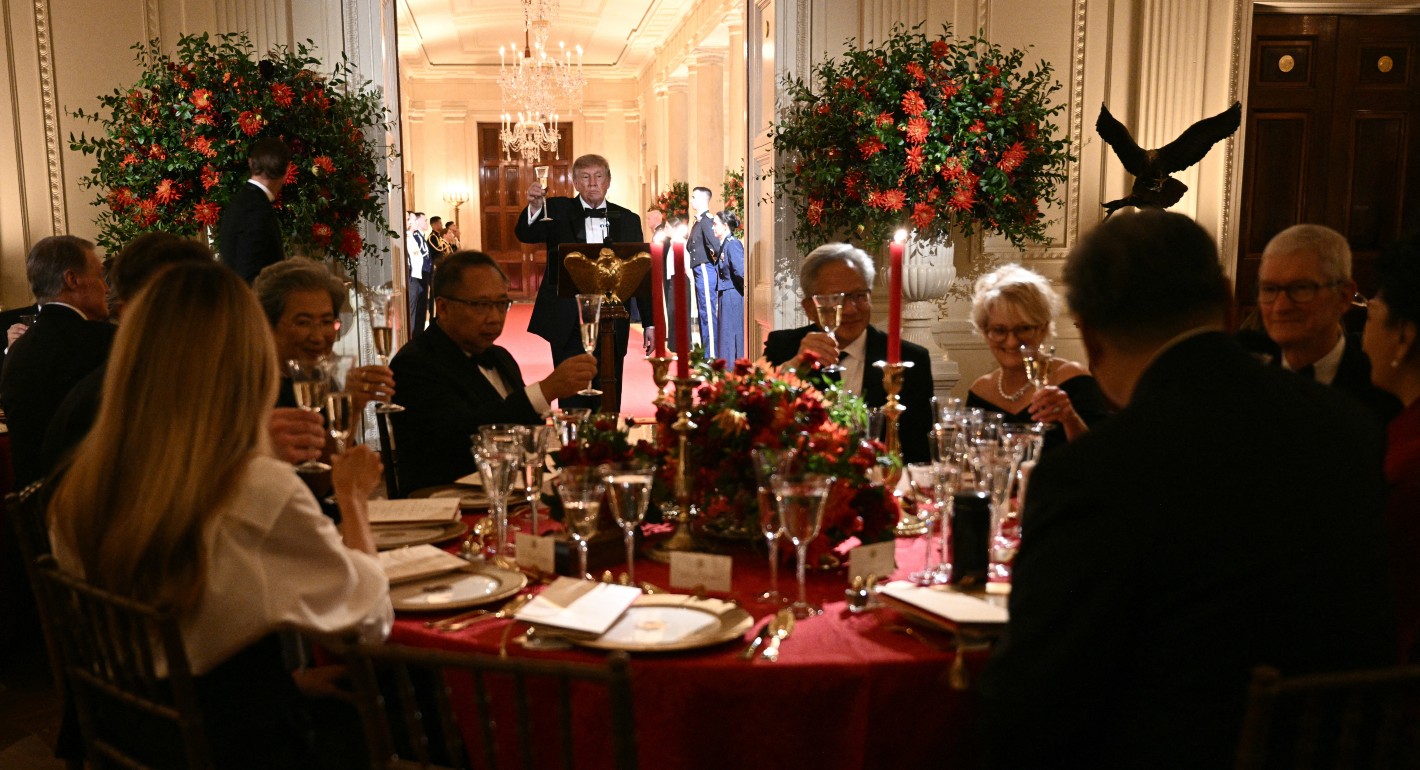
The summit may be remembered as a fatal blunder, when Washington, Beijing, and the AI industry collectively chose ceremony over action.

Jeffrey Prescott

Cargo traffic through Russia’s Northern Sea Route has increased because of the disruption caused by the conflict in the Middle East, the Ukraine war, and U.S.-China tensions.

Mikhail Korostikov