

Commentary
Before the next wave of EU enlargement takes place, the union needs to grapple with thorny questions of how power is distributed among its members.
Emil Sondaj Hansen, Ditte Brasso Sørensen
{
  "authors": [
    "Kateryna Pishchikova",
    "Richard Youngs"
  ],
  "type": "commentary",
  "centerAffiliationAll": "dc",
  "centers": [
    "Carnegie Endowment for International Peace",
    "Carnegie Europe",
    "Carnegie Russia Eurasia Center"
  ],
  "collections": [],
  "englishNewsletterAll": "democracy",
  "nonEnglishNewsletterAll": "",
  "primaryCenter": "Carnegie Europe",
  "programAffiliation": "DCG",
  "programs": [
    "Democracy, Conflict, and Governance"
  ],
  "projects": [],
  "regions": [
    "Eastern Europe",
    "Ukraine",
    "Western Europe"
  ],
  "topics": [
    "Political Reform",
    "Democracy",
    "Civil Society",
    "Foreign Policy"
  ]
}
Source: Getty
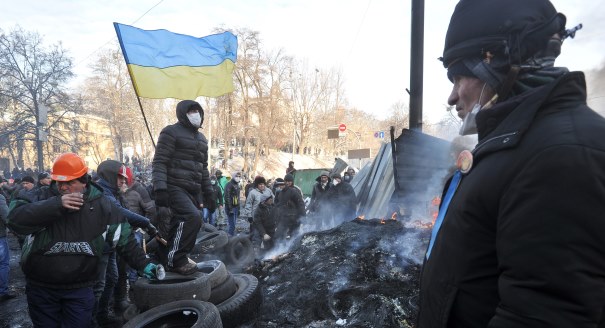
The European Union has proven powerless to prevent a tragic spiral of lethal violence in Kyiv. In addition, its image amongst protestors has suffered. Now the key challenge for the EU is to begin shaping the conditions that will facilitate deeper democratic reform in Ukraine.
The European Union (EU) has not merely proven powerless to prevent a tragic spiral of lethal violence in Kyiv. In addition, its image amongst protestors has suffered in recent weeks. Many Ukrainian democrats have switched to a refrain of, as one Maidan placard put it, “EU: thank you for your deep concern, now do something!”
This is in stark contrast with the stirring evening of December 10 when hundreds of thousands cheered High Representative Catherine Ashton in one of the biggest ever pro-European demonstrations. Protestors will be looking for Ashton’s visit this week to deliver more tangible EU support.
Many have called for the EU to impose targeted sanctions on members of the regime. After all, if the Union does not use punitive measures when pro-EU democrats are lying dead in the streets, why does the EU have sanctions clauses at all? The differences that have been on display between member states over sanctions will hardly inspire confidence in the EU from Ukraine's courageous and embattled protestors.
Measures targeted at the financial assets of regime members are surely justified. And if bold and well targeted, they are likely to make a difference. At the same time, however, other cases suggest that such sanctions are unlikely to have a game-changing impact by themselves. Sanctions have had a limited impact not only in Belarus—the example most often evoked as a comparison with today’s turmoil in Ukraine—but in most other cases where they have also been used. And their potential is modest not only because the fast-evolving events in Kyiv are now determined overwhelmingly by domestic factors. It is also because sanctions generally have some effect when nested in a broader range of instruments.
Self-evidently, events are moving fast and can shift unpredictably from one day to the next. At the time of writing, many hope that the government’s resignation and the revocation of repressive anti-protest laws will open the way for more productive dialogue between President Viktor Yanukovych and the opposition.
EU diplomats have focused primarily on the need for “political dialogue,” and there are many in the Union ready to seize on such negotiated compromises as a way out of the conflict. And encouraging dialogue and flexibility in positions is indeed crucial. However, the EU should not be overly supportive of deals that merely offer opposition leaders government posts without underlying institutional reform. Such patched-up deals are unlikely to stabilize the situation or placate the Maidan. In reaction to the recent concessions by President Yanukovych, many activists have stressed that the protests are not about replacing a few political figureheads but about a systemic political change.
The EU should learn the lesson from having previously put too much emphasis on the signature of its Association Agreement with Ukraine almost as an end in itself. If the opposition does accept some kind of accord, the EU must this time not take its eye off the importance of such structural liberalization.
In this vein, the key challenge for the EU is to begin shaping the conditions that will facilitate deeper democratic reform. Recently the EU introduced policy guidelines stating that sanctions should always be offset by an increase in positive support to reformers. It must now follow through on this sensible, balanced approach in Ukraine.
The EU will need to match such support to a better analysis of the factors driving and impeding democratic deepening. It needs to move beyond generic civil society support and target its initiatives more purposively at the most constraining obstacles to democratization.
These include:
Monitoring elections—whenever they take place—will not be enough. The EU must engage early on to prevent measures that effectively load the dice in favor of the regime well before polling day. In 2004, external support for vote tabulation initiatives played a vital role and should be stepped up early on.
An old, much-repeated yet still unavoidable point: it is by dramatically upgrading its offer of partnership that the EU could make a difference in influencing the vast majority of the population that is neither out in Maidan nor enthusiastic about the regime. Member states will pay a price for ritually repeating that this is not feasible.
One broader connection is vital too: divisions between member states over what to do in Ukraine are a mirror image of differences over Russia. Effective action toward Ukraine cannot be disconnected from the need for the Union to design a more united and holistic strategy toward Russia.
The EU's enthusiasm for enhanced engagement in Ukraine is low—and understandably so. When President Yanukovych decided not to sign the Association Agreement in November, many member states thought the move was a disappointment but no great tragedy. Some European governments almost seemed relieved: the EU could comfortably step back into passive mode, hold out the prospect of the agreement with the same conditions attached, and wait for Ukraine to get its house in order.
The events of the last week must now shake member states out of such indifference.

Kateryna Pishchikova
ISPI
Kateryna Pishchikova is an associate research fellow at the Istituto per gli Studi di Politica Internazionale (ISPI) and an associate professor of political science and international relations at the eCampus University in Italy.

Senior Fellow, Democracy, Conflict, and Governance Program
Richard Youngs is a senior fellow in the Democracy, Conflict, and Governance Program, based at Carnegie Europe. He works on EU foreign policy and on issues of international democracy.
Carnegie does not take institutional positions on public policy issues; the views represented herein are those of the author(s) and do not necessarily reflect the views of Carnegie, its staff, or its trustees.

Before the next wave of EU enlargement takes place, the union needs to grapple with thorny questions of how power is distributed among its members.


Emil Sondaj Hansen, Ditte Brasso Sørensen

The real test may come after the leaders leave the room.



Sheena Chestnut Greitens, Oriana Skylar Mastro, Yukon Huang, …

The Horn of Africa countries are among those facing a new security calculus.


Andrew Leber, Lesley Anne Warner

The European far right might fail to steer EU policy in the direction Russia wants, but they will create enough chaos inside Europe to benefit the Kremlin.

Dimitar Bechev

The new U.S.–Denmark–Greenland agreement will help Washington exert political, economic, and financial dominance under the guise of security. Yet, it acknowledged Copenhagen’s and Nuuk’s sovereignty on the island.

Marc Pierini