

In The Media
David Rothkopf
{
  "authors": [
    "David Rothkopf"
  ],
  "type": "legacyinthemedia",
  "centerAffiliationAll": "",
  "centers": [
    "Carnegie Endowment for International Peace"
  ],
  "collections": [],
  "englishNewsletterAll": "",
  "nonEnglishNewsletterAll": "",
  "primaryCenter": "Carnegie Endowment for International Peace",
  "programAffiliation": "",
  "programs": [],
  "projects": [],
  "regions": [
    "North America",
    "United States"
  ],
  "topics": [
    "Security"
  ]
}
Source: Getty
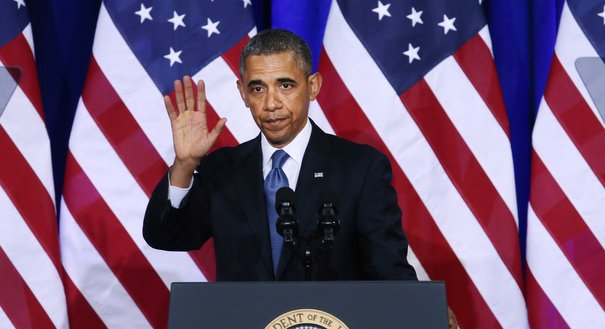
Leaders are supposed to have principles, standards, and processes by which critical security decisions are developed that enable them to protect U.S. interests by keeping those decisions on the down low, rather than opening them up to public polling.
Source: Foreign Policy
Only in Washington can an acronym be perceived as an insult. For this reason apparently, the White House yesterday announced that the artists once known as the National Security Council (NSC) staff but rechristened in 2009 by President Barack Obama as the National Security Staff (NSS) would henceforth be referred to again as the National Security Council (NSC) staff. Apparently, in the eyes of NSC staffers, the NSS lacked the cache of the direct and clear association to the National Security Council itself. So, in a gesture of sensitivity to their needs, National Security Advisor Susan Rice (NSASR) prevailed on the president to change the name back. Mission accomplished.
Now, since I've written one book on the NSC and have another one due out in September (hint), you might expect that I would have a strong opinion about one or the other of these names, the Classic Coke and New Coke of the foreign-policy acronym bureaucracy. But I don't. Far too much time is spent by each administration christening and rechristening the names for memos and committees and reworking their org chart -- we hardly need to devote more to commenting on it.Having said that, I do have a suggestion that the NSC may wish to consider using as its symbol (if it considers next going the way of the artist formerly known as "Prince"): the weathervane.
Take the recent reports that the White House is deliberating as to whether or not they should kill an American citizen who is allegedly collaborating with bad guys in Pakistan. Which -- behind closed doors -- is, of course, just the kind of thing they should be doing, especially given the recent debate over the morality and legality of such strikes. Further, such internal discussions on their own do not, of course, suggest that the Obama administration is flailing, or that its top policymakers are most comfortable pointing in the direction the political wind is blowing. But the fact that they chose to leak this story -- and given its distribution to top papers simultaneously, complete with off-the-record White House comments, it is absolutely clear that is what happened -- is another matter.
It's difficult not to conclude from this weird turn of events that the White House is not sure what it thinks and wants to test public reaction before it takes a decision, or -- as has happened in the past -- punts. That's how the Syria debacle unfolded in August. A deliberate, public call to action led to a decision which led to second guessing which led to leaks about the "very deliberate" process of second guessing, which led to the president punting the decision to Congress. And that, of course, led to the message being sent to the world that America had no clear idea what it wanted to do in that unfortunate, war-ravaged country. Or recall the way the candidacy of Larry Summers to be Fed chief was leaked to the press to test the waters before a decision was made. Or that in the days before the president made his remarks on the NSA scandal, elements of his response were leaked and tested with the media. Testing the waters isn't a sin, but that this has become something approaching standard operating procedure -- in instances when decisions were hard or might be controversial -- is.
The administration says that it takes these decisions (whether these enemy combatants are threats to the United States) seriously, and that it won't hesitate to act. Well, either this person is a threat to the United States or he isn't. And this certainly seems like hesitating to act.
Further, if the White House is planning a secret mission to violate the sovereignty of another country and blast someone who happened to be colluding with terrorists there are some pretty good conventional, operational, and diplomatic reasons why such a thing should remain secret. Once again, for an administration that has been selectively aggressive on targeting and prosecuting leakers (see the case just this past week of a State Department leaker sentenced to prison time for his misstep), it is amazing how often they violate basic operational security standards to achieve a political purpose. (Like rapidly declassifying info on the Osama bin Laden raid or secret back-channel negotiations with the Iranians to assure that the president got full credit for his successes.)
Leaders are supposed to have principles, standards, and processes by which critical security decisions are developed that enable them to protect U.S. interests by keeping those decisions on the down low. Most Americans not only expect this, it's one of the reasons they hired the leaders in the first place. The idea that each one is opened up to crude public polling and debate in the Washington echo chamber is grotesque, politically craven, and undermines the likelihood our missions will be successful. It is not how leaders or professional security organizations behave. It is the way of the pol.
For these reasons, acronyms be damned, as long as the NSC is using a weathervane to produce public policy decisions that should be its symbol ... and a caution to all who think values, reason, or suitable standards of professional judgment are dependably our means for determining America's security policies worldwide.

Former Visiting Scholar
David Rothkopf was a visiting scholar at the Carnegie Endowment as well as the former CEO and editor in chief of the FP Group.
Recent Work
David Rothkopf
David Rothkopf
Carnegie does not take institutional positions on public policy issues; the views represented herein are those of the author(s) and do not necessarily reflect the views of Carnegie, its staff, or its trustees.
The summit may be remembered as a fatal blunder, when Washington, Beijing, and the AI industry collectively chose ceremony over action.

Jeffrey Prescott

European NATO countries are wrestling with the possibility of U.S. disengagement from the alliance. With the continent’s security increasingly uncertain, governments must restore the credibility of their collective defense.



Hans-Dieter Lucas, Adam Thomson, Pierre Vimont
Soft power on its own is insufficient to meet U.S. national security needs, but hard power also has its limits. Soft power allows for more effective and efficient use of hard power than hard power alone, as it encourages cooperation and compliance which deters the need for hard power.

Sarah Yerkes

A deep dive into the policy ecosystems behind battery development in China, South Korea, Japan, the European Union (including some of its member states), the United States, Canada, and India.



Milo McBride, Herbert Crowther, Darcie Draudt-Véjares, …

In an interview, Ian Lustick and Eli Clifton discuss their new book on why a prominent ally has so much influence in America.

Michael Young