Source: The New York Times
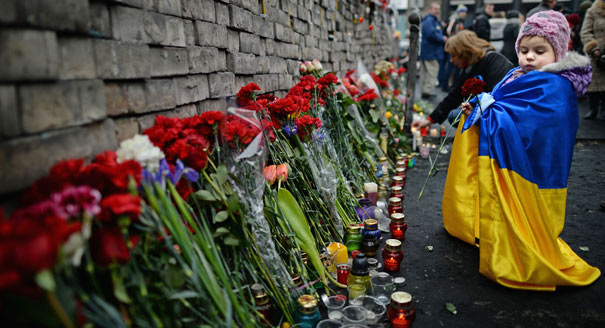
Thanks in part to the coordinated efforts of Germany, Poland, France and the United States, irrevocable change has finally come to Ukraine, with President Viktor F. Yanukovych’s flight from Kiev and Parliament’s vote to call for new elections in May.
But the powers still have urgent work to do. Ukraine could either descend into chaos or right itself on a path toward a new democratic stability. The European powers and the United States must offer the country all possible support to move toward the latter.
The first and most urgent step for Western leaders is to send unequivocal messages to Moscow that any support by Russia for the southern and eastern regions of Ukraine to break away from the rest of the country would be met harshly, and result in a general reconsideration of relations with Russia on all levels.
In parallel, they must make sure that their own resources, and those of the European Union institutions in Brussels, are available to political leaders in Kiev to assist them in their transition to a new regime.
Moreover, Ukraine’s crisis isn’t just political: The country faces economic default without support. It had been relying on Russia for that help, and now Europeans and Americans must quickly work with the International Monetary Fund to provide a financial lifeline to Kiev and to prepare longer-term economic-assistance programs; they must also be ready to give direct emergency aid by themselves, if needed.
Simply by announcing a readiness to commit to these steps, they would be providing enormous help to the forces committed to change in Ukraine.
Besides getting through the first days and weeks, there are two great political risks the West must help Ukraine to address. One is the inevitable attempt to undermine an emerging order. The protest movement that began last November, centered in Kiev’s Independence Square, has won. But it is quite possible that the forces that supported the former regime, especially in the east and south of the country, are going to contest the new order.
And it is questionable whether the Kremlin will accept a loss of influence in Ukraine. Mr. Putin had high hopes of making Ukraine a key ally in his planned Eurasian Union. He may have decided that Mr. Yanukovych was too unreliable an ally, but that does not mean he will accept a revolution against him. (Mr. Yanukovych, who reportedly fled to the eastern city of Kharkiv, near the border with Russia, said he had been forced to leave the capital because of an illegal “coup d’état.”)
The second risk is that the new regime will look like the one installed after the Orange Revolution in 2004: years of painful stalemate, political institutions blocking each other, permanent infighting and no clear separation between political and economic power.
It is primarily up to the Ukrainian people to put their still-young country on a new path. Many have demonstrated incredible courage over the last weeks. But a post-Yanukovych Ukraine will still be a fragile state with weak institutions.
Since it declared independence from the collapsing Soviet Union in 1991, Ukraine has lived uncomfortably between the European Union and Russia. Despite some progress, it failed to build stable and trustworthy institutions. That’s why so much of the country has put its hopes in the European Union; Ukrainians saw that their neighbors who had joined it — Hungary, Poland, Romania, Slovakia — were doing very well. All the bloc offered last year was an “association,” which does not include the promise of membership, and a free-trade agreement.
Because the offer was so weak, the door was open for Mr. Putin to sabotage it and for Mr. Yanukovych to reject it. Now the European Union needs to come back with a better offer — not just association, but membership.
Doing so would unleash a new dynamic. It would embolden a new leadership in Kiev and give them enough authority to push through painful but necessary economic and government reforms. A process of transformation would kick off. Urgently needed foreign investment would rush in. It would signal to the entire country that a better future is possible.
The key to this approach lies in Berlin. In the 1990s, it was Chancellor Helmut Kohl, Angela Merkel’s mentor, who pushed through the enlargement of the European Union to include former members of the Soviet bloc as a way to stabilize Germany’s Eastern neighborhood.
His successor, and Ms. Merkel’s predecessor, Gerhard Schröder, continued on that path. But Ms. Merkel, in office since 2005, has been reluctant to follow in their steps so far. Wary of Russian opposition and unwilling to press a more active foreign policy, Berlin in recent years has been reluctant to provide leadership in eastern Europe.
Ms. Merkel must now show courage and strategic competence. If Eastern Europe becomes unstable, Germany will be affected too — and deeply so. Only Berlin has the necessary weight and connections to bring all key players on board to make significant change possible.
Seen by many as the European Union’s leading power, Germany can bring France on board, a necessary condition for getting the bloc fully behind a new approach to Ukraine. Moreover, Berlin, with its strong economic ties with Moscow, is able to keep the West’s relations with Moscow on track. And Berlin pulls enough weight in Washington to put together a common trans-Atlantic strategy.
In the last weeks and days in Ukraine we saw how fast things can deteriorate in Eastern Europe. Germany and the European Union must significantly step up their engagement and be ready to take more risks. If Berlin does not take the lead, nobody else will.
This article was originally published in The New York Times.