Commentary
Montenegro and Albania are frontrunners for EU enlargement in the Western Balkans, but they can’t just sit back and wait. To meet their 2030 accession ambitions, they must make a strong positive case.
Dimitar Bechev, Iliriana Gjoni
{
  "authors": [
    "Rajiv Kumar"
  ],
  "type": "legacyinthemedia",
  "centerAffiliationAll": "dc",
  "centers": [
    "Carnegie Endowment for International Peace"
  ],
  "collections": [],
  "englishNewsletterAll": "ctw",
  "nonEnglishNewsletterAll": "",
  "primaryCenter": "Carnegie Endowment for International Peace",
  "programAffiliation": "SAP",
  "programs": [
    "South Asia"
  ],
  "projects": [
    "India Decides 2014"
  ],
  "regions": [
    "South Asia",
    "India"
  ],
  "topics": [
    "Political Reform",
    "Economy"
  ]
}
Source: Getty
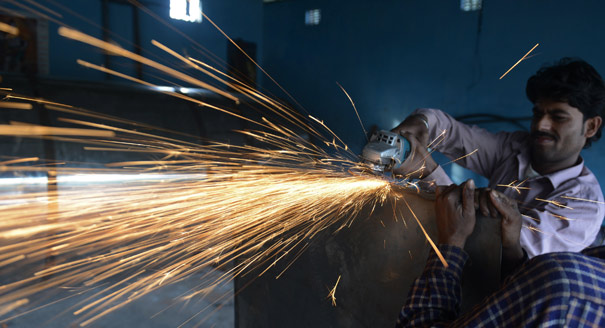
To revive Indian manufacturing, industry and the government must implement a reform agenda together—to increase competition, reduce dualism, make the regulatory process more transparent, and cut the compliance burden.
Source: Mint
Manufacturing is in trouble in India. The sector’s share of gross domestic product (GDP) reached 16% in 2006-07, then stagnated and has declined since 2010-11, to little more than 15%, a sliver when compared with the shares in Thailand (36%), South Korea (31%), and China (30%). Employment in absolute terms has fallen in the formal manufacturing sector from 55 million in 2004-05 (12.2% of India’s overall workforce) to 50 million in 2010 (10.5%). The sector’s growth rate has been declining for four years, actually falling into negative territory in the first quarters of 2012 and 2013.
India’s development model is largely at fault. In the absence of a well-conceived policy response by the next government, manufacturing will soon be gripped by an even more profound crisis.
The sector is marked by a deep dualism—gaps between the formal and informal economies—in virtually every sub-sector. The dualism affects wages, productivity, technological capabilities and working conditions. This, in turn, creates capacity fragmentation, a relative absence of economies of scale and scope that renders the sector globally uncompetitive.
A disturbing feature in the past decade has been the slow but steady exit of established manufacturers, a reflection of an increasingly difficult operating environment. Many have switched to importing their products from China and elsewhere. The recently passed Land Acquisition, Rehabilitation, and Resettlement (LARR) Act, which sharply raised rural land prices and mandated a time-consuming acquisition procedure, will likely accelerate the process of de-industrialization in India.
Given that India needs to find jobs for at least one million new workers every month for the next 15 years, the prospect of a shrinking manufacturing sector should be cause for extreme concern.
Because discussions about the problems facing manufacturing tend to begin and end with a long finger pointed at the government, it might be useful to start elsewhere: with constraints that flow from industry’s self-induced weakness and inertia.
Indian industry continues to face an acute skills shortage. It laments this problem but does not even attempt to emulate the efforts of firms in the information-technology and other service sectors, which have opened large-scale in-house training programmes. It has also been unable or unwilling to adopt effective forms of collective action to demand government accountability or to find solutions for shared problems. And it has made no attempt at self-regulation to curb corrupt practices.
On another front, small and medium enterprises (SMEs) often do not receive payments on time from their larger buyers, a far cry from the nurturing that such companies enjoy in Japan and South Korea. Finally, because Indian industry is in large parts cartelized, there is much resistance to price competition, a short-sighted stance works against achieving global competitiveness. All of these weaknesses should be addressed by the industry itself if it hopes to improve its competitiveness and credibility.
That said, the challenges posed, directly or indirectly, by government policies are formidable. Consider the following.
Difficult business environment: India ranked 132 out of the 185 countries in the World Bank’s Doing Business survey in 2013. According to the official data, nearly 70 clearances are required annually for businesses to operate. The greatest cost falls on SMEs, where the proprietor has to bear the entire burden. Such an environment, combined with retroactive changes in tax demands, creates much uncertainty, anathema for investment. Another challenge is the lack of adequate protection against extortion and protection rackets.
Labour deployment rigidity: Indian manufacturing has suffered in the past from the twin constraints of militant and competitive trade unionism and a plethora of labour legislation. In recent years, unionism has ostensibly weakened. Nevertheless, it is still present in major industrial centres, and its infrequent but violent demonstration discourages foreign investors and induces others to keep employment to a minimum. India has nearly 50 laws at the central or state level that affect labour conditions. Consequently, hardly any enterprise can claim to be in total compliance.
Infrastructure deficit: The peak power deficit in India is estimated at 7% to 8%, and industry is not insulated from the resultant power cuts that sweep the country. Most large manufacturing units have had to create full backup capacity, raising capital costs. Indian companies across the board bear a significantly higher price for infrastructure services and utilities than their global competitors.
Regulatory delays and lack of transparency: Over time, a rather complex regulatory structure has been established to deal with land acquisition, land use and the environment. The process has become increasingly time-consuming, opaque and unpredictable, especially during the past 10 years under the rule of the United Progressive Alliance. According to one survey, 1,240 central and state regulations apply to the industrial sector.
Onerous commercial bank credit: More than two-thirds of surveyed SMEs preferred not to utilize commercial bank credit because of long processing times and stiff collateral requirements. Instead, they turned to the informal markets, paying higher rates but with less onerous conditions. This defeats the avowed aim of the government’s selective credit control policy, which requires banks to earmark 10% of their credit to SMEs.
Industry can implement a series of steps that are in its direct control. Private companies are just beginning to tackle the skills shortages by entering into a partnership with the government on managing about 110 industrial training institutes. They would do well to collaborate with vocational skill providers in growing capacities, designing curricula, and offering assured placements.
They should also empower their chambers and associations to take collective action to demand the timely delivery of high-quality public services. Because collective action requires credibility, they will first have to improve their record of self-regulation.
Large businesses must adopt a nurturing attitude toward their suppliers, which invariably belong to the MSME category of micro, small and medium enterprises. To become global players, they should substantially increase spending on research and development.
Finally, it is time to disband the thousands of sector and sub-sector associations whose ostensible raison d’être of negotiating fiscal concessions and securing government licenses is increasingly irrelevant in the post-liberalization period.
There are two schools of opinion on the government’s policy reform priorities for manufacturing. The first believes that structural conditions do not permit the growth of mass manufacturing in India. By putting a statutory floor under the price of both labour and land, the principal factors in production, the political process has effectively raised their cost. Moreover, the complicated resettlement and rehabilitation (R&R) provisions enshrined in the land acquisition law make land procurement highly cumbersome. This school also argues that the new generation of workers, being more educated and IT-savvy than earlier ones, will not accept low-productivity shopfloor jobs.
Given these conditions, this school holds that India should give up trying to enter mass manufacturing and instead support so-called sunrise industries—sectors that use frontline technologies, require highly skilled labour, and are design-and technology-intensive. Government policy would focus on creating and sustaining a learning environment for businesses. India could emulate Japan and South Korea, where private firms, government science and technology agencies and technology institutes come together to produce large-scale product and process innovations, which are then commercialized by dynamic entrepreneurs.
This is a seductive model, but a number of factors make it somewhat unfeasible, including the low R&D orientation of Indian industry and the low penetration of broadband connectivity and Internet access.
The alternative approach for policy reforms—which represents the more desirable way forward—is not to accept the high cost of labour and land as a given. Instead, it assumes that the large majority of new workers will continue to be semi-skilled and willing to accept productive jobs in the formal manufacturing sector (though not in the unorganized sector). Thus, this option requires government policy to be directed toward more conventional intervention.
Land costs: These costs can be kept at acceptable levels by using the land already acquired by industrial development corporations in various states; increasing the ratio of floor area to space; releasing the vast stock of land owned by government and public sector entities; and amending the land acquisition law to remove the R&R requirement for the private purchase of land.
Labour conditions: It is pointless to argue for the removal of Article 35A in Chapter V of the Industrial Disputes Act and give employers permission to hire and fire at will and without due process. This is a non-starter in the present Indian context. Instead, other ways have to be found for the desired level of flexibility in labour deployment. The proposal in the new manufacturing policy, for example, for the creation of a resource pool to retrain retrenched workers and to give them unemployment security for a minimum period while they are re-trained is well worth considering. Another change would reduce the welter of labour laws to four or five comprehensive statutes.
Business environment: Among the measures that could improve the environment almost immediately include introducing a combined application form for obtaining clearances, cutting the time needed for starting and exiting a business, licensing some private-sector banks to cater to the needs of the MSMEs.
To revive manufacturing, industry and the government (central and states) must implement a reform agenda together—to increase competition, reduce dualism, make the regulatory process more transparent and cut the compliance burden.
The two approaches described above are not necessarily in conflict. Expanding islands of innovation can coexist with a manufacturing sector that is reining in its informal side. But reforms must be urgently implemented. If India is to achieve its strategic and development objectives, its manufacturing base can’t be shrinking.
Rajiv Kumar is presently a senior fellow at the Centre for Policy Research and a senior fellow with the Wadhwani Foundation, New Delhi.
This is adapted from a chapter in the upcoming book Getting India Back on Track edited by Bibek Debroy, Ashley J. Tellis and Reece Trevor. It will be published in June by the Carnegie Endowment for International Peace and Random House India.
Rajiv Kumar
Carnegie does not take institutional positions on public policy issues; the views represented herein are those of the author(s) and do not necessarily reflect the views of Carnegie, its staff, or its trustees.

Montenegro and Albania are frontrunners for EU enlargement in the Western Balkans, but they can’t just sit back and wait. To meet their 2030 accession ambitions, they must make a strong positive case.


Dimitar Bechev, Iliriana Gjoni

This piece argues that the present Indian strategy, based on opportunistic diversification and utilization of limited strategic reserves, remains inadequate when confronting supply disruptions. It evaluates India’s options in the short, medium, and long terms.

Vrinda Sahai

As the war between the United States, Israel, and Iran continues, Carnegie scholars contribute cutting-edge analysis on the events of the war and their wide-reaching implications. From the impact on Iran and its immediate neighbors to the responses from Gulf states to fuel and fertilizer shortages caused by the effective shutdown of the Strait of Hormuz, the war is reshaping Middle East alliances and creating shockwaves around the world. Carnegie experts analyze it all.
The return of war as the organizing factor in Middle Eastern politics has predictable consequences: governments are prioritizing regime stability and becoming averse to political and social reform.


Sarah Yerkes, Amr Hamzawy

There is no better time for the countries of Southeast Asia to reconsider their energy security than during this latest crisis.

Gita Wirjawan