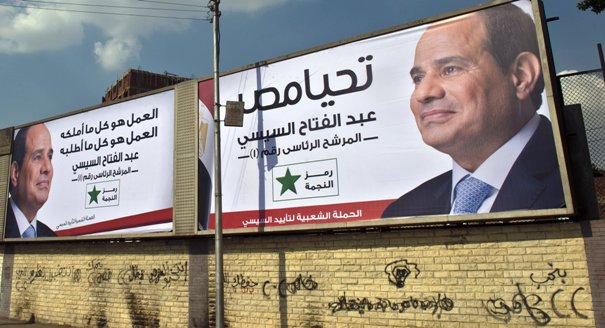
The Egyptian presidential elections are scheduled to take place on May 26-27. The elections are predictable in every respect. First, it is clear that they will indeed take place. The public is tired of revolutionary upheavals; people do not want new power shifts, opting for peace and quiet. Second, it is obvious that Egypt’s former defense minister, the 59-year-old Field Marshal Abdel Fattah Saeed Hussein Al-Sisi, will win the elections. Even as the Egyptian Spring was in full swing, one had a feeling that sooner or later the people would seek a fatherly figure capable of putting things in order and getting the country out of its crisis.
He will be the one to win the May elections and will do it in the first round of voting, which is the third certainty. His only opponent, Hamdeen Sabahi, is likely to get a third of the total vote. He previously collected 31,600 voters’ signatures, while Al-Sisi managed to get 188,900. The Muslim Brotherhood, which is the main opposition force, urges the people to boycott the elections. However, the Islamists are not strong enough to sabotage them. Thus, the upcoming elections will bring no surprises.
Having come full circle, Egyptian society is returning to the system it sees as the most familiar and “reliable,” that is, to authoritarianism. Today, this authoritarianism appears to be soft, but it will harden at the post-revolutionary stage, as the country experiences a deep systemic crisis and instability. In fact, this is quite natural.
In this light, I will try to draw some parallels between the current situation in Egypt and the 1950’s, the time when the military first came to power and then stayed at the top for good (barring the one-year break for Morsi’s rule). The analogy is particularly intriguing since Al-Sisi is actively exploiting Nasser’s legacy; he is supported by relatives of the former leader, and his campaign even features a photograph in which the six-year-old Al-Sisi is standing alongside the great Nasser.
The 1952 Egypt was also facing a systemic crisis as the country’s King Farouk lost popular support, just like Hosni Mubarak subsequently did. The celebrated July revolution was nearly bloodless. The Free Officers Movement took control of the country, and Gamal Abdel Nasser became its president in 1954. In a matter of months, he acquired the requisite charisma to become the undisputed national leader.
At that point, Nasser had turned 36, his reputation unsullied by working for the old political regime. In contrast, Al-Sisi is almost 60 and climbed to the top of career ladder under the old pre-revolutionary establishment. Nasser’s youth was one of the important reasons for his popularity. He set out to build a materially different “socialist” state. For his part, Al-Sisi cannot put forward a miracle model for Egypt’s development, nor does he have to. He needs to correct the situation and move the reforms along, thus sacrificing his popularity, which is lower than Nasser’s popularity was. Nasser had no serious opposition: he had a relatively easy time ruthlessly quashing the Muslim Brotherhood. But for Al-Sisi, the Brotherhood remains a formidable opposition. Every mistake he makes—and mistakes are inevitable—will play into the hands of religious radicals, who will never abandon their struggle for power having gained it once.
Starting in 1956, Nasser had quickly become the pan-Arab leader. As Israel’s main adversary, Egypt was at the forefront of the Arab-Israeli conflict. A bit later, Nasser became one of the leaders of the Non-Aligned Movement. His international clout served to boost his popularity inside the country. This cannot happen to Al-Sisi.
Finally, Nasser enjoyed a steady stream of political and economic support on the part of the Soviet Union from the very beginning of his rule. As for President Al-Sisi, he will have to work hard to secure full-fledged outside support, and its providers—the United States and the oil-producing countries—will make it subject to certain conditions, which will not always be acceptable to Egypt. In this respect, Russia may become Egypt’s selfless partner, but its capacity is increasingly limited, especially considering its spending during the Ukrainian crisis.
After his certain May elections’ victory, Al-Sisi will be confronted with a host of serious problems. Some segments of the population will be hard hit by socioeconomic reforms, which will exacerbate the situation in the country. The Muslim Brotherhood will seize on the opportunity to take advantage of the situation. The president will have to make some foreign policy changes with Egypt’s key role in the Arab world in doubt. Abdel Fattah Saeed Hussein Al-Sisi has less credibility than Gamal Abdel Nasser once did. Besides, he has less time than Nasser to deliver on the promises he made to the people. Whether the new president will be able to develop into a full-fledged national leader will become clear in the next few months.