

Commentary
Maria Lipman
{
  "authors": [
    "Maria Lipman"
  ],
  "type": "legacyinthemedia",
  "centerAffiliationAll": "",
  "centers": [
    "Carnegie Endowment for International Peace",
    "Carnegie Russia Eurasia Center"
  ],
  "collections": [],
  "englishNewsletterAll": "",
  "nonEnglishNewsletterAll": "",
  "primaryCenter": "Carnegie Russia Eurasia Center",
  "programAffiliation": "",
  "programs": [],
  "projects": [],
  "regions": [
    "Russia"
  ],
  "topics": [
    "Foreign Policy"
  ]
}
Source: Getty
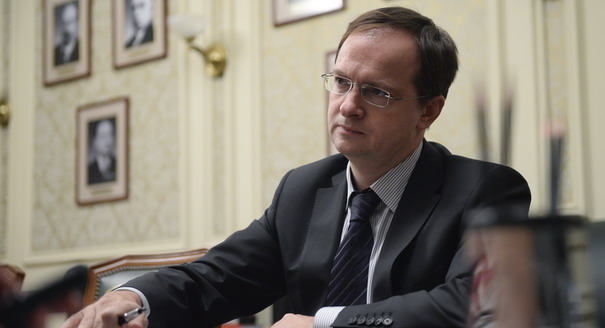
Russian Culture Minister Vladimir Medinsky’s primary motive is to curry favor with Vladimir Putin. As Putin has shifted gears to a more conservative, anti-Western, and isolationist outlook, scores of his aggressive loyalists have followed the new trend.
Source: New Republic
In April, the Russian Ministry of Culture issued a document that declared “Russia is not Europe,” and argued that Europe was morally inferior, even reprehensible. In May, the culture minister, Vladimir Medinsky, was to visit Venice to accept an honorary fellowship from the University Ca’ Foscari. He never made it to Italy, though. Professors and students protested the university’s choice and, at the last moment, the ceremony was canceled. But Medinsky got his honor nonetheless: An emissary from the Italian university travelled to Moscow last week, and the award ceremony was held on the premises of the ministry of culture.
Medinsky is a typical figure in Russian officialdom. His primary motive is to curry favor with the man at the top, President Vladimir Putin. As Putin has shifted gears to a more conservative, anti-western and isolationist outlook, scores of his aggressive loyalists have slavishly followed the new trend.
The ministry’s document, laying out ideas for Russia’s official culture policy, was published in the leading pro-Kremlin daily, Izvestia. It is interspersed with quotes from Putin's articles and speeches, just as Soviet government programs drew on Marx and Lenin. Since Putin had earlier condemned European multiculturalism and dismissed the policy of tolerance as “neutered and barren,” so the cultural policy blueprint includes “a rejection of the principles of tolerance and multiculturalism.” Following Putin's lead, the document emphasizes Russian “traditional values” and cautions against any kind of art that may be at variance with those values. Contemporary art is deemed especially suspicious: “No experiments with form,” the documents warns, “can justify the substance that contradicts the values traditional for our society.”The cultural policy document was but one of the reasons why Ca' Foscari professors were outraged by the decision to honor Medinsky. They were also responding to Medinsky's recent dismissal of the Russian program curator at the Venice Biennale, Grigory Revzin, just two months before the opening. While the cultural ministry said it fired Revzin, one of Russia’s most prominent art critics and public intellectuals, because he was too busy writing media commentary, there is little doubt that the actual reason was his public criticism of Russia’s policy in Ukraine.
Medinsky also eagerly picked up the Kremlin’s anti-gay stances: Earlier this year, he joined others in denying that Russia’s famous composer Pyotr Chaikovsky was gay despite numerous archival documents, including Chaikovsky’s personal letters, that leave no doubt that he was.
Before he was appointed minister of culture in 2012, Medinsky published a series of books debunking “myths” about Russia—a text that attempted to refute any negative fact or opinion, including widely accepted truths, such as the poor condition of Russia’s roads.
Medinsky is so keen to demonstrate Russia’s superiority to other nations that he has even said that Russia’s perseverance in the face of all twentieth-century catastrophes, indicates that “our people have an extra chromosome.”
A letter signed by 226 Italian academics and intellectuals outlined their objections to Medinsky's honorary fellowship. “Universities should support free research, and not a culture that serves a political regime,” the letter said. A similar letter signed by their Russian colleagues stated, “Awarding an honorary degree of a European university to one of the most infamous figures of Russian contemporary cultural policy … will damage the reputation of that educational institution.”
Why was Medinsky chosen in the first place? The Russian letter hints that the decision may be influenced by the generosity of the Russian government, which supported the creation three years ago of the university’s center for the study of Russian culture. “No mercantile considerations can … justify a betrayal of genuine academic values,” the letter states.
The Russian government support may be a more likely reason than Medinsky’s dubious scholarship. Medinsky holds three academic degrees, two in political science and a more recent one in history. One of his focuses has been foreign travelers’ writing about Russia. In his history dissertation Medinsky claims that hundreds of years ago Europeans—just like western media figures today—pursued a political agenda aimed at damaging Russia. "It is fully obvious,” he wrote about the sixteenth-century English diplomat Giles Fletcher, that his writing “was evil slander of the Russian state, its rulers and people.”
Medinsky’s work has been met with scathing criticism by Russian historians, who claim that he did not complete original research and that his work is high-school level, at best. One critic has said that “only a very weird person” would be preoccupied by a search for falsifications that had somehow hurt the Russian czars centuries ago. Another historian called Medinsky a “mirror of the contemporary Russian degradation.”
Moreover, Dissernet (an informal group of academics and journalists that has exposed over 100 instances of dissertation plagiarism, mostly by government officials), has repeatedly pointed out that Medinsky’s work involved academic fraud: a bogus bibliography (six books and three articles entered in the list are not found in any library or collection); 20 pages in his 1999 dissertation "borrowed" verbatim from two other works; and a bizarre overlapping of his third dissertation with that of his advisor. Mikhail Lotman, an Italian scholar of Russian origin, wrote in a public letter that awarding an honorary fellowship to Medinsky is like “awarding Mr. Berlusconi for his contribution to the education of female minors.”
But allegations of fraud notwithstanding, Silvia Burini, the Ca’ Foscari Vice-Rector and the CSAR director, was undeterred as she visited Moscow to award Medinsky his gown. In her interviews with Russian media, Burini dismissed her colleagues’ indignation. “We have a group of people who would protest against anything,” she said. Medinsky’s cultural achievements are “as important as his academic ones” she told a Russian news agency.
As he received his award from Burini, Medinsky, contrary to his ministry’s policy statement, said that Russia and Italy “share common values.” And his controversial honor suggests they may also share unsavory practices. But there is one basic difference: the power of public opinion. Silvia Burini has resigned from her position as Vice-Rector. In Russia, Medinsky, the loyalist, is sure to keep his job.
Former Scholar in Residence, Society and Regions Program, Editor in Chief, Pro et Contra, Moscow Center
Lipman was the editor in chief of the Pro et Contra journal, published by the Carnegie Moscow Center. She was also the expert of the Carnegie Moscow Center’s Society and Regions Program.
Recent Work
Maria Lipman
Maria Lipman
Carnegie does not take institutional positions on public policy issues; the views represented herein are those of the author(s) and do not necessarily reflect the views of Carnegie, its staff, or its trustees.
The impacts of the Faye-Sonko rupture could go well beyond the country’s borders.

Lesley Anne Warner
The reinvention of democracy support needs to be carried forward without the clear leadership of one dominant player.


Richard Youngs, Thomas Carothers
Hungary under Viktor Orbán deployed right-wing populism as a foreign policy strategy, embedding the country in a web of illiberal transnational networks whose legacy will endure even after his April 2026 electoral defeat.
Zsuzsanna Végh
By fueling the arguments of both supporters and opponents of Armenian Prime Minister Nikol Pashinyan, Azerbaijan wants to ensure he is re-elected with a weaker mandate.

Bashir Kitachaev

A much-discussed disagreement over internet restrictions in Russia was never an existential threat for Putin: It was about elite groups protecting their interests.

Alexandra Prokopenko