

Commentary
Dmitri Trenin
{
  "authors": [
    "Dmitri Trenin"
  ],
  "type": "commentary",
  "centerAffiliationAll": "",
  "centers": [
    "Carnegie Endowment for International Peace",
    "Carnegie Russia Eurasia Center"
  ],
  "collections": [],
  "englishNewsletterAll": "",
  "nonEnglishNewsletterAll": "",
  "primaryCenter": "Carnegie Russia Eurasia Center",
  "programAffiliation": "",
  "programs": [],
  "projects": [],
  "regions": [
    "North America",
    "United States",
    "East Asia",
    "China",
    "Japan",
    "Russia"
  ],
  "topics": [
    "Foreign Policy"
  ]
}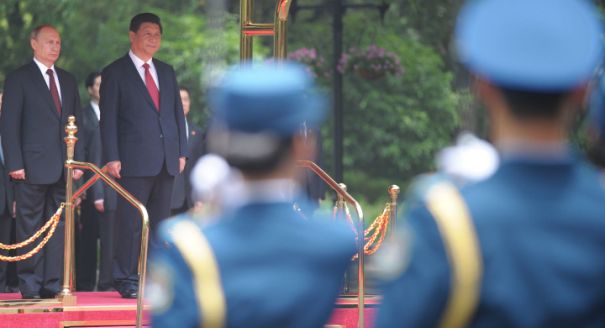
Source: Getty
In mid-2014, the United States' relations with China and Russia are substantially worse than those two countries' bilateral relations. The unique position that the United States has held since the 1990s as the dominant power in Eurasia is now history.
From Ukraine to the South and East China Seas, the international system experiences new turbulence, even as it searches a new balance. Ostensibly, the United States and Russia are in a conflict over Ukraine. In reality, they are in a conflict over the fundamentals of the post-Cold War settlement. Russia, pushing back against expanding Western influence, is labeled revisionist and "resurgent." China is not yet in a conflict with the United States, but the Sino-U.S. relationship, too, is experiencing increasing strains. As its power grows, China advances its interests in the maritime zones east and south of its shores, for which it is termed "assertive." Worried, China's smaller neighbors in Asia, like Russia's in Europe, are flocking to seek U.S. protection, thus re-invigorating Cold War-era alliances and creating new informal ones.
In mid-2014, for the first time in four decades, the United States' relations with China and Russia are substantially worse than those two countries' bilateral relations. The lopsided triangle now being formed and probably ignored in Washington, where Russia is heavily discounted as a factor, has Beijing in a more advantageous position than ever before. This position would allow China access to more resources, and would make its strategic rear in the north even more secure as it deals with the issues south and east of its shores. The result is that the unique position that the United States has held since the 1990s as the dominant power in Eurasia is now history. Symbolically, the Pentagon's quiet departure last month from the Manas air base in Kyrgyzstan closes the book on that era.
Former Director, Carnegie Moscow Center
Trenin was director of the Carnegie Moscow Center from 2008 to early 2022.
Recent Work
Dmitri Trenin
Dmitri Trenin
Carnegie does not take institutional positions on public policy issues; the views represented herein are those of the author(s) and do not necessarily reflect the views of Carnegie, its staff, or its trustees.

Russia’s AI-driven propaganda campaigns operate in a fragmented, chaotic, and often illogical manner. That’s not necessarily a problem for the Kremlin, though: It’s much easier to mimic genuine public debate that way.

Ilya Klishin

Ahead of a tough winter for Ukraine, Donald Trump’s swing back toward Russia bodes ill. But instead of panicking, Kyiv’s European allies are focusing on action.

Rym Momtaz

Without a ceasefire with Ukraine on attacking each other’s energy infrastructure—to which the Kremlin is unlikely to agree—the diesel agreement between Putin and Trump is largely for show, rather than representing a genuine increase in the volumes of Russian diesel on the global market.

Sergey Vakulenko

Despite its flop at the box office, the film raises important questions for the climate community to answer.

Leonardo Martinez-Diaz

Funding Ukraine remains a priority for European leaders. As Russia’s war of aggression heads into another winter, two feasible options to mobilize support for Kyiv should be fast-tracked.


Vladyslav Rashkovan, Gregory P. Wilson