

Research
- +5
Alper Coşkun, Fatih Ceylan, Tacan İldem, …
{
  "authors": [
    "Sinan Ülgen"
  ],
  "type": "legacyinthemedia",
  "centerAffiliationAll": "dc",
  "centers": [
    "Carnegie Endowment for International Peace",
    "Carnegie Europe",
    "Malcolm H. Kerr Carnegie Middle East Center"
  ],
  "collections": [
    "Turkey’s Transformation"
  ],
  "englishNewsletterAll": "menaTransitions",
  "nonEnglishNewsletterAll": "",
  "primaryCenter": "Carnegie Europe",
  "programAffiliation": "MEP",
  "programs": [
    "Middle East",
    "Europe"
  ],
  "projects": [],
  "regions": [
    "Middle East",
    "Europe",
    "Türkiye",
    "Iran"
  ],
  "topics": [
    "Political Reform",
    "Democracy",
    "Global Governance"
  ]
}
Source: Getty
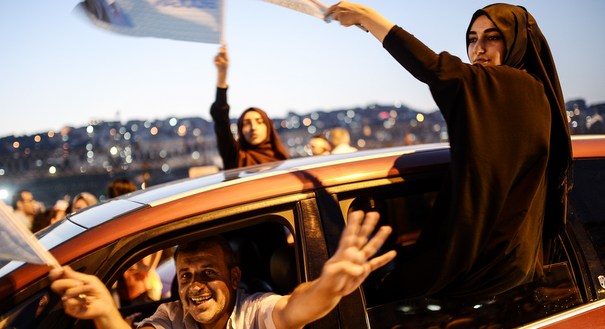
Recep Tayyip Erdogan’s transition to the Turkish presidency is a turning point in the nation’s politics; the question is what path he will lead the country down now.
Source: Financial Times
In Turkey’s first ever presidential race, Recep Tayyip Erdogan, prime minister since 2003, has been elected with 52 per cent of the vote. His transition to the presidency is a turning point in the nation’s politics; the question is what path he will lead the country down now.
With a record as the country’s most senior politician, Mr Erdogan became a transformative figure in its political history. Not only did he win nine elections in a row, with a gradually rising share of the popular vote; he also oversaw a period of economic change, with per capita incomes increasing by 40 per cent in real terms.
He normalised civil-military relations and eliminated the army’s undue political influence. It was also during his leadership that Turkey began EU accession negotiations. But the secret to his enduring success is above all his ability to build a deep emotional connection with the country’s socially conservative heartland.
Yet despite these considerable achievements, Mr Erdogan will leave a qualified legacy. His recent record has been less admirable. Instead of using the strong support he enjoyed at home to transform Turkey into a genuine liberal democracy, he used it to justify his non-consensual leadership style, deepening existing social, cultural and religious schisms. He opted to increase his own power to the detriment of the country’s institutions. The personalisation of governance and the weakening of the rule of law combined with a low tolerance of dissent tarnished his own and the nation’s democratic credentials.
Now Mr Erdogan is moving to the presidency, how will Turkey be changed? The short answer is: not much for a year – and then it depends.
In his early days, President Erdogan is set to mimic Prime Minister Erdogan. He has made no secret of his ambition to introduce an executive presidency to replace the current parliamentary system. Having failed, in the last year of his tenure, to change the constitution so as to devolve more power to the presidency, his fallback position will be to operate as the country’s de facto executive president. His conservative AK party, with its Islamist roots, will remain at the helm of the government so he will use his moral authority as well as his formal and informal influence over the party to continue to steer Turkey’s politics. He will rely, for instance, on some never-used provisions of the constitution, such as the one introduced by the military junta in 1983 that allows the president to chair cabinet meetings.
But this set-up is only temporary. A more permanent configuration will emerge after the 2015 parliamentary elections. Mr Erdogan’s ultimate objective is for his Justice and Development (AK) party to win a constitutional majority at these critical polls.
Then a presidential system can be introduced and he can become the omnipotent executive president. As a result, in his first year as president, he will focus much more on domestic politics with the aim of sustaining and even increasing the AK party’s popularity. He will have to accomplish a delicate balancing act to overcome the current constitutional restrictions on the bipartisanship of the presidency. The constitution, for instance, requires the president-elect to resign from his party to ensure impartiality.
The downside is that the current climate of polarisation is therefore very likely to continue unabated for at least a year. The upside is that Mr Erdogan will have to remain engaged in the Kurdish peace process, one of his important initiatives as prime minister, in order to enjoy the backing of Kurdish voters next year. A permanent settlement of this decades-old problem would eliminate the most pressing threat to political stability in Turkey, at a time when the security situation in the region is worsening.
Mr Erdogan’s main challenge in this regard will not be the frail and ineffective parliamentary opposition but rather the future leadership of his own party. To continue to be involved in daily politics, he will need a loyal and malleable prime minister as its next head. But choosing a weak leader will hurt the party’s popularity at the ballot box and could result in a coalition government, obliterating Mr Erdogan’s ambitions for a powerful presidency. Furthermore, unpopular leadership can lead to dissent within the party ranks. Yet choosing a more astute and respected politician, such as Abdullah Gul, the outgoing president – who is in no mood to end his political career and has alluded to political differences with Mr Erdogan – would gradually rob the new president of his political influence.
As much as these elections are important, next year’s parliamentary elections will be more instrumental in determining the future path of Turkey and the sustainability of Mr Erdogan’s political power. Yet the outcome of these elections will be influenced by Mr Erdogan’s first decision as Turkey’s president, namely the choosing of the next prime minister.

Senior Fellow, Carnegie Europe
Sinan Ülgen is a senior fellow at Carnegie Europe in Brussels, where his research focuses on Turkish foreign policy, transatlantic relations, international trade, economic security, and digital policy.
Recent Work

Alper Coşkun, Fatih Ceylan, Tacan İldem, …
Carnegie does not take institutional positions on public policy issues; the views represented herein are those of the author(s) and do not necessarily reflect the views of Carnegie, its staff, or its trustees.
Despite myriad challenges and occasional stumbles, the new Hungarian government is moving ahead with energy and conviction to uproot years of illiberalism and corruption and rebuild Hungarian democracy.

Thomas Carothers

European Commission President Ursula von der Leyen is about to give her annual address on the state of the EU. Here’s what she won’t—but should—say.

Rym Momtaz
Understanding the climatic pain points is necessary for policymakers hoping to minimize the war’s negative environmental consequences.


Alejandro Martin Rodriguez, Joy Arkeh, Sarah Yerkes

Huawei pushed hard to enter the Egyptian data centers market, until the Americans made a better offer.

Angie Omar

Radical-right parties are expected to do well in upcoming elections in four of the EU's biggest member states. If successful, they could prevent the union from addressing key challenges ahead.

Stefan Lehne