

Commentary
It should address the shortcomings of previous crisis communication efforts and adapt to the demands of frontier AI.
Lucy Luo
{
  "authors": [],
  "type": "pressRelease",
  "centerAffiliationAll": "",
  "centers": [
    "Carnegie Endowment for International Peace",
    "Carnegie Europe"
  ],
  "collections": [
    "Transatlantic Cooperation"
  ],
  "englishNewsletterAll": "",
  "nonEnglishNewsletterAll": "",
  "primaryCenter": "Carnegie Endowment for International Peace",
  "programAffiliation": "",
  "programs": [],
  "projects": [],
  "regions": [
    "Europe",
    "North America"
  ],
  "topics": [
    "Foreign Policy",
    "Security"
  ]
}
Source: Getty
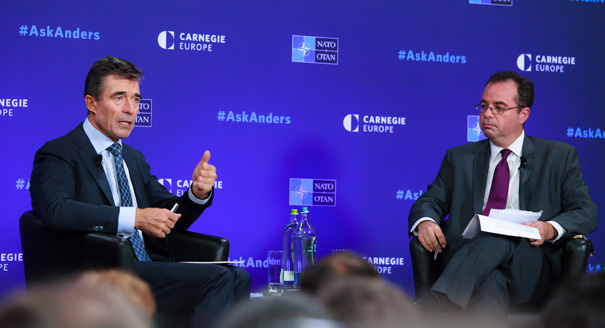
NATO Secretary General Anders Fogh Rasmussen discussed Russia, the Middle East, and the transatlantic bond at an event hosted by Carnegie Europe.
BRUSSELS—NATO Secretary General Anders Fogh Rasmussen said today that the West is witnessing “challenges on a scale we have not seen for over two decades, and they will endure for years to come.”
Speaking at a Carnegie Europe event to mark the end of his mandate as NATO chief, Rasmussen said that “these past five years have been the busiest and most challenging—for NATO and for me personally.”
On Russia, Rasmussen asserted that NATO has “tried long and hard to build a partnership in a way that respects Russia’s security concerns and is based on international rules and norms.”
“Regrettably,” he said, “Russia considers NATO, and the West more broadly, as an adversary.” He added that “from Moldova to Georgia, and now in Ukraine, Russia has used economic pressure and military actions to produce instability, to manufacture conflicts, and to diminish the interdependence of its neighbors.”
The Islamic State “poses even more of a danger [to NATO allies] as it risks exporting terrorists to our countries,” Rasmussen warned. “It also controls energy assets, and it is pouring oil on the fire of sectarianism already burning across the Middle East and North Africa.”
He explained that a military response is necessary to degrade and defeat the terrorist organization.
In closing, Rasmussen said that the West is “on the frontline of a new battle between tolerance and fanaticism, between democracy and totalitarianism, between open and closed societies.” “Any lasting solution to a crisis will always be political and so diplomacy remains vital,” he said. “But to give ourselves the best chance of success, we must be prepared to back up diplomatic soft power with military hard power, when necessary.”
A transcript, video, and audio from the event are available on the Carnegie Europe website.
Press Contact: Christine Lynch | +32 2 209 29 93 | clynch@ceip.org
Carnegie Europe is the Brussels-based center of the Carnegie Endowment for International Peace. Through publications, articles, seminars, and private consultations, Carnegie Europe aims to foster new thinking on the daunting international challenges shaping Europe’s role in the world.
Carnegie does not take institutional positions on public policy issues; the views represented herein are those of the author(s) and do not necessarily reflect the views of Carnegie, its staff, or its trustees.

It should address the shortcomings of previous crisis communication efforts and adapt to the demands of frontier AI.

Lucy Luo

If the Russian-speaking community in Latvia cannot articulate their interests without being seen as disloyal, they could end up embracing a pro-Kremlin agenda.

Sergejs Potapkins

Washington’s decision to support some UN functions while letting others wither is pulling the organization apart at the seams.

Stewart Patrick, Theodore Zaritsky

Are Germany’s economic, industrial, and political struggles becoming a liability for the EU’s ability to rise to the geopolitical moment?

Rym Momtaz, ed.

China’s police training infrastructure construction projects provide benefits to recipient countries, promote China’s image as a major global security provider, and are likely to reinforce alignment between Beijing’s security priorities and those of countries in the Global South.

Cameron Waltz, Sheena Chestnut Greitens, Kim Nguyen, …