

Article
C. Raja Mohan, Darshana M. Baruah
{
  "authors": [
    "C. Raja Mohan"
  ],
  "type": "legacyinthemedia",
  "centerAffiliationAll": "dc",
  "centers": [
    "Carnegie Endowment for International Peace",
    "Carnegie India"
  ],
  "collections": [],
  "englishNewsletterAll": "ctw",
  "nonEnglishNewsletterAll": "",
  "primaryCenter": "Carnegie India",
  "programAffiliation": "SAP",
  "programs": [
    "South Asia"
  ],
  "projects": [],
  "regions": [
    "South Asia",
    "India",
    "Oceania",
    "Southeast Asia"
  ],
  "topics": [
    "Foreign Policy"
  ]
}
Source: Getty
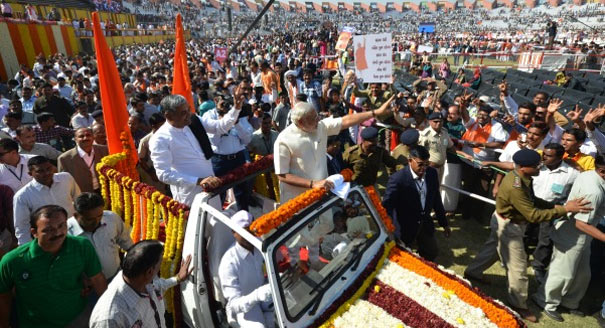
Through his visit across the eastern seas, Modi affirmed that India under the NDA government has entered a new era of economic development, industrialization, and trade.
Source: Indian Express
By changing the name of India’s Asia policy from “Look East” to “Act East”, Prime Minister Narendra Modi was signalling that he would be more proactive and purposeful than his predecessors in the region. To be sure, New Delhi has made much progress in reconnecting with Asia since the early 1990s. Yet the gap between potential and reality has steadily grown. So has the gulf between rising regional expectations of an Indian role in Asia and the political will in Delhi to measure up.
Modi wowed his Asian interlocutors in Myanmar, Australia and Fiji with his promises to inject new energy into India’s engagement with Asia in the economic, political and security domains. Through his visit across the eastern seas, Modi affirmed that India under the NDA government has entered a new era of economic development, industrialisation and trade. The PM showcased the “Make in India” policy and his efforts to reduce the difficulties in doing business in the country. He invited business leaders and the diaspora to come and invest in India and promised the region’s political leaders that his government is ready to wrap up pending free-trade agreements with Asean and Australia.
In the meeting with Asean leaders in Myanmar, Modi reaffirmed India’s commitment to deepening physical connectivity with the region. He announced his intent to create a “special purpose vehicle” to implement the connectivity projects expeditiously. Modi also expanded the scale and scope of India’s development assistance to the lesser-developed Asean states and the Pacific Islands.That the strategic engagement of the region has acquired a new salience under the Act East policy was underlined by the new agreement for security cooperation with Australia. The UPA government had set voluntary limits to India’s defence diplomacy in the East by deferring to presumed Chinese sensitivities, even before Beijing had expressed them. Whether it is the intensification of defence cooperation with Vietnam or initiating cooperation with Fiji, Modi’s Delhi is willing to do what it thinks is right for India without second-guessing Beijing’s reaction.
Engaging the diaspora in Australia and Fiji was also one of the main purposes of Modi’s extended travel to the region. As part of a new effort to build lasting bonds with the overseas Indian community, Modi has promised the liberalisation of India’s visa policies. Above all, Modi’s Act East policy has widened the canvas by putting Australia at the centre of India’s eastern strategy and the south Pacific back on India’s political radar. Through his visit, Modi demonstrated an acute awareness of the new maritime dynamic shaping Asian geopolitics and was explicit in affirming India’s concerns about the current conflicts in the South China Sea.
All this is pretty impressive. But in the scripted settings that formal diplomacy offers, it is quite easy to forget the enduring problems in India’s approach to Asia. The expansive warmth for India in Asia is matched by enduring scepticism about Delhi’s ability to convert words into deeds. East Asia is impressed by Modi talking the talk, but it would like to see Delhi walk the walk. There is no way that Modi can convince everyone at this stage that India has decisively changed course on the economic front. His strategy of focusing on small steps rather than big-bang reforms means progress will be incremental, rather than dramatic. If the change is genuine and becomes visible, Asia will not need much persuasion to expand its economic partnership with India.
Modi certainly regained some credibility by negotiating a deal with the United States on trade facilitation and food security. But it is no secret that getting the commerce ministry to clinch the negotiations with Washington was like extracting a molar. Modi, too, sounded cautious, using phrases like “balanced trade”, which reflect the conservatism in Delhi rather than an appreciation of Asia’s rapid pace of economic integration under simultaneous pressure from China and the US. If Modi does not want India to be an outlier in Asia’s trade development, he did not make a convincing case.
Modi’s promise to fast track connectivity projects is welcome, but Asia is not holding its breath. It would like to see how quickly the special purpose vehicle materialises and whether it can change the realities on the ground. At a time when China has come up with ambitious proposals like the Maritime Silk Road, there was little new or bold on offer from Modi on connectivity.
While the expansion of India’s development assistance is a step forward, Delhi has a long way to go in making the conception and delivery of aid more effective. Inter-ministerial coordination in Delhi remains difficult. The UPA government had backed off from fundamental reforms in how India delivers aid and so far, there has been no word on this from Modi.
Delhi’s greater commitment to security cooperation was an important rhetorical step forward, though it is by no means clear if the ministry of defence is really prepared for a significant intensification of India’s military partnerships in Asia. Even under Modi, Delhi’s default impulses remain insular rather than collaborative. That the PM did not sign off on trilateral security cooperation with Australia and Japan underlined South Block’s hesitation on trilateral and plurilateral partnerships, which are so critical for securing India’s interests in Asia.
Despite Modi’s instincts and intentions, Delhi has much to do before its Act East policy gains credibility in Asia — from the creation of a more business-friendly environment to faster implementation of trans-border projects; from visa liberalisation to expanding defence cooperation. The East has its arms open and is ready to embrace Modi, but the PM’s hands remain tied by Delhi’s political and bureaucratic inertia.
This article was originally published in the Indian Express.
Former Nonresident Senior Fellow, Carnegie India
A leading analyst of India’s foreign policy, Mohan is also an expert on South Asian security, great-power relations in Asia, and arms control.
Recent Work

C. Raja Mohan, Darshana M. Baruah


Alexander Gabuev, Paul Haenle, C. Raja Mohan, …
Carnegie does not take institutional positions on public policy issues; the views represented herein are those of the author(s) and do not necessarily reflect the views of Carnegie, its staff, or its trustees.

Despite a new textbook, an influx of Russian teachers and managers, and an end to the teaching of Ukrainian, the Kremlin is unlikely to have “reprogrammed” locals.

Konstantin Skorkin

The acknowledgment has sparked fears of a new arms race with China and Russia.

Chris O’Meara
Smaller powers cannot go it alone, but Canadian history shows that integration with the United States will not always be benign.
Paul Samson

The European Commissioner for Trade is headed to China. But after President Xi’s bridge-building visit to Washington, can a more isolated EU overcome Beijing’s stranglehold on critical raw materials? Who will blink first?

Rym Momtaz, ed.

The summit may be remembered as a fatal blunder, when Washington, Beijing, and the AI industry collectively chose ceremony over action.

Jeffrey Prescott