

In The Media
David Rothkopf
{
  "authors": [
    "David Rothkopf"
  ],
  "type": "legacyinthemedia",
  "centerAffiliationAll": "",
  "centers": [
    "Carnegie Endowment for International Peace"
  ],
  "collections": [],
  "englishNewsletterAll": "",
  "nonEnglishNewsletterAll": "",
  "primaryCenter": "Carnegie Endowment for International Peace",
  "programAffiliation": "",
  "programs": [],
  "projects": [],
  "regions": [
    "North America",
    "United States"
  ],
  "topics": [
    "Political Reform",
    "Foreign Policy"
  ]
}
Source: Getty
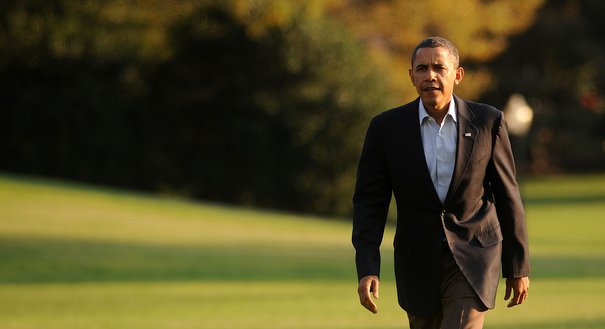
Obama stands alone, apart from his party and the world, in the wake of Tuesday’s elections.
Source: Foreign Policy
In the wake of Tuesday's elections, U.S. President Barack Obama cuts a lonely figure. In fact, he may end his term of office as the most isolated president since Richard Nixon. If that is the case, it will largely be a plight of his own making.
The isolation starts with the fact that from the beginning, for the president and his campaign team, it was never about the Democratic Party. It was never about the rest of their team in the administration. It was never about a network of international relationships. It was always about one man who was the product, the messenger, the mission, and the raison d'être all wrapped into one. And for the next two years, it seems highly likely that any brave post-election faces they try to put on this to the contrary, Obama will reap the results of his political and policy narcissism in a way that will not only be difficult for him personally but will be bad for America and its role in the world.
Tuesday's crushing defeats of the Democratic Party in Senate, House, and gubernatorial elections across America were not just the latest instance of a midterm historical pattern repeated. They equaled in total seats shifted to the opposition party some of the worst defeats for a sitting president's party ever seen in such elections. And while they were in part a repudiation of the dysfunctional status quo in Washington, they were also at their heart undeniably a repudiation of the president.While some will say this had little to do with Obama's largely unhappy foreign-policy record, they too easily discount the degree to which his international errors (and the consequent damage done to America's standing) impacted in a core way the public perception of Obama.Setting aside individual debates about individual policy choices, the public wants America and its leaders to appear strong. Whether in Crimea or Syria, Iraq or Afghanistan, in bickering with allies or being manipulated by rivals, Obama has projected anything but such an image. His perceived weakness and ineffectiveness overseas undoubtedly played into the results Tuesday. And it is therefore a reason why the next two years are likely to see an America that is like its president, increasingly ineffective internationally -- as the world waits for his successor and hopes for a change in the character of U.S. leadership.
While two-term presidents like Bush 43, Clinton, and Reagan all finished stronger on foreign policy than they started, that does not seem likely to be the case for Obama -- despite the fact that all three of his predecessors were, like Obama, weakened by domestic politics and other factors as they completed the last quarter of their presidencies. In part, this is due to the fact that Democratic losses Tuesday were so sweeping. In part, it is due to the fact that Obama (and his inner circle) are seen within his own party as the cause of those losses. Not only was Obama's record to blame but, once again, as in 2012 and 2010, his perceived lack of energetic efforts to support his own party's candidates has bred animosity. One such illustration is the comments made to the Washington Post by outgoing Senate Majority Leader Harry Reid's chief of staff David Krone, in which he said, "I don't think that the political team at the White House truly was up to speed and up to par doing what needed to get done" and "The president's approval rating is barely 40 percent. What else more is there to say?"
With views like that not only afoot but being made public, it suggests it is likely to be difficult for the president to muster any sort of support in domestic political matters, even from the people who ought to be most likely to provide it. His best hope lies in advancing issues where the GOP agenda and his views may align, such as the Trans-Pacific Partnership trade deal, corporate tax reform, or infrastructure projects.
But on a wide variety of other issues, including winning support for many of his more controversial foreign-policy initiatives (and avoiding obstacles to others, like the pending Iran nuclear deal), this will be a president at odds with both houses of Congress and one who is unable to muster support. This in turn will send a message to allies and rivals alike around the world that the president will not necessarily be able to keep any promises that he or his team might make. He will not be seen, therefore, as credible when he asserts plans or proposes initiatives that require congressional funding or approval.
His past behavior and its consequences will likely compound the problem of his severe domestic weakening. This is not a president like Bush or Clinton or Reagan who has a network of foreign leaders who are genuine friends, who trust him, and with whom he has built meaningful ties. Aloof from his own party and cabinet appointees at home, his relations with international leaders have always been cool and in some cases (like those important relationships as with Erdogan in Turkey or Netanyahu in Israel) have deteriorated profoundly. (And let's be candid: It doesn't help much when you have staffers calling key allies "chickenshit," either.) For such a man, pulling together international coalitions that can achieve meaningful results will be very difficult even with his tenacious and energetic secretary of state working overtime trying to do so. Sometimes it takes a president's touch. But this president who ran for the nation's top job in 2008 on a policy of engagement is likely to be known to history as a practitioner of serial disengagement, sometimes as a result of deliberate policy decisions, sometimes as a result of an unwillingness to do the work necessary to manage and maintain vital relationships.
Add to the above the fact that things aren't going very well for a whole host of Obama's most important international efforts -- with growing strains in Russia (keep an eye on Georgia, the Baltics, and Russia's teetering economy thanks to plunging oil prices), in Syria and Iraq (where we still lack anything like a coherent strategy or the military commitment to get the jobs we have undertaken done), in Libya (now in flames), in Israel-Palestine (tensions rising), in Afghanistan (where no one believes recent political gains will be long-lived and where the Taliban is on the move), or elsewhere.
Take all these factors into consideration and the outlook for the president looks very much like the famous photo from Back to the Future in which before our eyes we can see his image fading to nothing. In that movie, the only way to reverse the process was to restore history back to its original order. For Obama, the only way to do it would be to turn that formula on its head and actually undo his own history of isolating himself from those upon which all presidents must depend for international success -- from political allies at home, from the members of his own team who need to be truly empowered to manage so many issues at once, and from his counterparts around the world. Otherwise, over the next two years we may view the world as a shifting tableau involving many familiar actors and a blank space where once there was a president of the United States.

Former Visiting Scholar
David Rothkopf was a visiting scholar at the Carnegie Endowment as well as the former CEO and editor in chief of the FP Group.
Recent Work
David Rothkopf
David Rothkopf
Carnegie does not take institutional positions on public policy issues; the views represented herein are those of the author(s) and do not necessarily reflect the views of Carnegie, its staff, or its trustees.

Japan’s long-term security policy is driven by concerns about China, and there is little appetite for (or interest in) pursuing a confrontation with Moscow.

James D.J. Brown

Russia is testing the waters of NATO’s mutual defense clause. What do strikes in Romanian territorial waters mean for the alliance’s posture toward Moscow?

Dimitar Bechev
Why Pakistan, Saudi Arabia, and Turkey are joining forces on regional security.


Alper Coşkun, Amr Hamzawy

Despite public disputes over trade and immigration, the strategic partnership’s foundations remain sturdy.

Sameer Lalwani
It signals a new era of tech diffusion and warfare.

Steve Feldstein