

Research
- +10
Rosa Balfour, Frances Z. Brown, Yasmine Farouk, …
{
  "authors": [
    "Moisés Naím"
  ],
  "type": "legacyinthemedia",
  "centerAffiliationAll": "",
  "centers": [
    "Carnegie Endowment for International Peace"
  ],
  "collections": [],
  "englishNewsletterAll": "",
  "nonEnglishNewsletterAll": "",
  "primaryCenter": "Carnegie Endowment for International Peace",
  "programAffiliation": "",
  "programs": [],
  "projects": [],
  "regions": [
    "North America",
    "United States"
  ],
  "topics": [
    "Political Reform",
    "Democracy"
  ]
}
Source: Getty
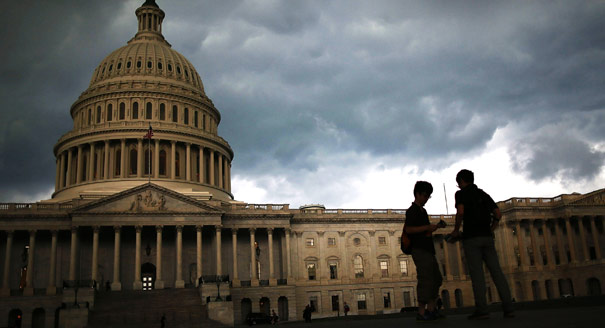
In the coming years, U.S. politics will serve as a laboratory for testing the idea that governments and politicians can get away with ignoring the most deeply felt demands of their voters.
Source: Atlantic
American voters are furious with their government and their politicians. That is the central message of the recent midterm elections. In explaining the electoral results, many analysts have stressed the anxiety about the future that led voters to reject their current leaders, especially the president, whose popularity has sunk. This summer, when pessimism was peaking, more than three-quarters of American adults felt their children would be worse off than they are.
But how does the rest of the world compare? Shortly before Election Day, the Pew Research Center issued a report on how people around the world feel about the future. Overall, their attitudes seem to depend a lot on the stage of their country’s economic development.
Consider the following statement: “Most people are better off in a free market economy, even though some people are rich and some are poor.” Do you agree or disagree? If you’re Vietnamese, and you agree with this assertion, the vast majority of your country is on your side. To be precise, 95 percent of people recently surveyed in Vietnam feel this way. The great irony is that together with China, Cuba, Laos and North Korea, Vietnam is one of five countries still governed by a party whose official doctrine is communism. And in which country is popular opposition to the market economy greatest? Spain, followed by Japan.This was one of the questions that the Pew recently posed to a sample of nearly 50,000 adults (18 years and older) in 44 countries. Pew grouped the respondent countries into three categories: advanced economies (Europe, Japan, South Korea, the United States, etc.), emerging markets (Argentina, Brazil, China, Colombia, India, Mexico, Nigeria, Pakistan, Russia, South Africa) and developing economies (Bangladesh, Ghana, Kenya, Nicaragua).
Perhaps not surprisingly, Germany, South Korea, and the United States are the advanced countries with the most robust support for the market economy. Among emerging markets, Jordan and Argentina are most opposed to the free market. And among developing economies, which are the poorest in Pew’s sample, the market economy is least popular in Uganda and El Salvador, while Bangladesh, Ghana, and Nicaragua (another country with a socialist government) report the strongest support.
In general, the world is inclined to favor the free market (66 percent of all those surveyed by Pew do), but its greatest supporters are in the poorest countries (80 percent in Bangladesh, 75 percent in Ghana, and 74 percent in Kenya). Among emerging economies, 76 percent of Chinese respondents think people do better in a market economy, and that number remains high in India (72 percent), socialist Venezuela (67 percent), and Brazil (60 percent).
Support for the Free-Market System in 44 Countries

Spring 2014 Global Attitudes Survey/Pew Research Center
Pew’s survey delivers other interesting results. Asia, for example, is the most optimistic region when it comes to how people view the economic prospects of their children. Europeans and Americans, meanwhile, are quite grim about the future. Pessimism abounds in France, where 86 percent of those surveyed believe that children will be worse off financially than their parents, and the numbers of those who worry about the outlook for younger generations is also high in Japan (79 percent) and Italy (67 percent). In contrast, the expectation that future generations will be better off is widespread in Vietnam (94 percent), China (85 percent), Chile (77 percent), and Bangladesh (71 percent).
But how, according to the survey’s respondents, does one get ahead in life? Participants were asked to rank the importance of several factors of success from zero (“not important”) to 10 (“very important”). Sixty percent of respondents say that “getting a better education” is very important. Among those surveyed in the most advanced economies, Spaniards place the greatest value on education as a factor of success, with 71 percent saying that it is very important. Not so in France, where the value of education was given its lowest marks among all surveyed countries with only 24 percent characterizing education as a critical factor. Ironically, by international standards the quality of education in France is higher than in countries where a much greater percentage felt a good education was a very important precursor to success (86 percent of Venezuelans, for example).
Half of the survey’s respondents believe that “hard work” is very important for success, while 37 percent say the same about “knowing the right people,” 33 percent about being “lucky,” and 20 percent about belonging “to a wealthy family.” Seventeen percent of those polled view being male as critical to success, and just 5 percent feel the same way about giving bribes. The countries where the greatest percentage of people believe that family money is very important for getting ahead in life are Tunisia (46 percent) and Nigeria (45 percent). These are also two of the countries where respondents ranked bribery among the most important determinants of success.
What's Most Important for "Getting Ahead" in Life?

Spring 2014 Global Attitudes Survey/Pew Research Center
As for the advantage of “being male” in pursuing personal success, it’s worth noting that in 32 of the 44 countries surveyed, men who hold this view far outnumber women. The proportion of women who believe this is significantly smaller. The gap between men and women on this question is as surprising as the discord between the policies a government adopts and the type of economy its population prefers. What’s clear here is that both men and governments hold views that clash with those of majorities in their countries. Could it be that that they also overestimate their own importance?
In the coming years, U.S. politics will serve as a laboratory for testing the idea that governments and politicians can get away with ignoring the most deeply felt demands of their voters. American voters have sent their leaders a clear message in this midterm election: “End the gridlock.” Barack Obama and Mitch McConnell, the next Senate majority leader, claim that they have heard the message and will work to reach the compromises that have eluded Democrats and Republicans in the last six years. Like many other observers, I am skeptical that this will happen. In this respect, if gridlock continues to stifle the functioning of America’s democracy, U.S. voters will live in a political system that is as oblivious to their demands and expectations as the 95 percent of Vietnamese who favor a free market but have to live in a communist country.

Distinguished Fellow
Moisés Naím is a distinguished fellow at the Carnegie Endowment for International Peace, a best-selling author, and an internationally syndicated columnist.
Recent Work



Rosa Balfour, Frances Z. Brown, Yasmine Farouk, …
Moisés Naím
Carnegie does not take institutional positions on public policy issues; the views represented herein are those of the author(s) and do not necessarily reflect the views of Carnegie, its staff, or its trustees.

In an interview, Ian Lustick and Eli Clifton discuss their new book on why a prominent ally has so much influence in America.

Michael Young

Sergei Kiriyenko used Russia’s parliamentary vote to further hone his strategy of corporate mobilization that is designed to maximize votes for United Russia.

Andrey Pertsev

Trump has promised Belarus a massive potash deal. But Minsk is seeking something greater: restored Western transit and greater room for maneuver from Russia.

Balázs Jarábik

Before the next wave of EU enlargement takes place, the union needs to grapple with thorny questions of how power is distributed among its members.


Emil Sondaj Hansen, Ditte Brasso Sørensen

The real test may come after the leaders leave the room.



Sheena Chestnut Greitens, Oriana Skylar Mastro, Yukon Huang, …