

Commentary
The EU can impose sanctions but struggles to enforce them without the United States. With Washington increasingly disinterested in backing European interests, the bloc must now fend for itself.
Nicu Popescu, Tiago Antunes
{
  "authors": [
    "Ulrich Speck"
  ],
  "type": "legacyinthemedia",
  "centerAffiliationAll": "dc",
  "centers": [
    "Carnegie Endowment for International Peace",
    "Carnegie Europe"
  ],
  "collections": [
    "Europe’s Eastern Neighborhood"
  ],
  "englishNewsletterAll": "ctw",
  "nonEnglishNewsletterAll": "",
  "primaryCenter": "Carnegie Europe",
  "programAffiliation": "EP",
  "programs": [
    "Europe"
  ],
  "projects": [],
  "regions": [
    "Russia",
    "Europe",
    "Eastern Europe",
    "Ukraine",
    "Iran"
  ],
  "topics": [
    "Foreign Policy"
  ]
}
Source: Getty
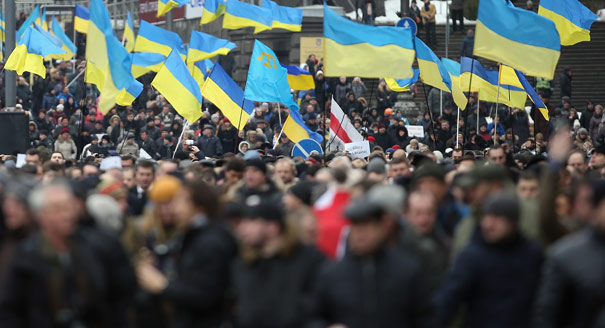
Ukraine’s best hope for peace is to wind down the war with Russia and to use the breathing space for much-needed reform.
Source: CNN
Russian President Vladimir Putin has insisted that the Minsk II ceasefire agreement from February 12 is the road to "a final settlement" of the conflict in Ukraine -- and although the truce is shaky, Ukraine and the West have a strong interest in seeing it hold.
The West is not going to enter into a proxy war with Russia -- and Ukraine's best hope is to wind down the war and to use the breathing space for much-needed reform.Minsk II confirms the military gains Russia has made in Ukraine and gives Moscow plenty of leverage over Kiev. But compared to war, it is the lesser evil.
In fact, the agreement could be turned to Ukraine's advantage, providing the country with the breathing space it urgently needs to enact political and economic changes. A stronger Ukrainian state -- more functional, less corrupt, and better able to deliver to its citizens -- would be much more capable to resist Russian aggression.
It is Ukraine's weakness that has allowed Russia to invade the country in the east. A weak sense of national solidarity and togetherness there, as well as insufficient supervision of the border, allowed unofficial and official Russian troops to enter into the Donbass region. And a badly-trained, badly-equipped and badly-organized army wasn't able to push back.
Ulrich Speck
Former Visiting Scholar, Carnegie Europe
Speck was a visiting scholar at Carnegie Europe in Brussels, where his research focuses on the European Union’s foreign policy and Europe’s strategic role in a changing global environment.
Carnegie does not take institutional positions on public policy issues; the views represented herein are those of the author(s) and do not necessarily reflect the views of Carnegie, its staff, or its trustees.

The EU can impose sanctions but struggles to enforce them without the United States. With Washington increasingly disinterested in backing European interests, the bloc must now fend for itself.


Nicu Popescu, Tiago Antunes
Global and rising powers will need to engage with Africa’s priorities and agency in order to secure the continent’s increasingly attractive partnerships.
Fonteh Akum

Rubio’s recent visit brought welcome attention, but more capital requires governance changes that may be a hard sell for regional governments.

Jennifer B. Murtazashvili

America’s foreign-policy objectives have grown more demanding while Americans have demanded greater focus on their own affairs.

Stephen Wertheim

Japan’s long-term security policy is driven by concerns about China, and there is little appetite for (or interest in) pursuing a confrontation with Moscow.

James D.J. Brown