• Research
  • Emissary
  • About
  • Experts
Carnegie Global logoCarnegie lettermark logo
DemocracyIran
  • Donate
{
  "authors": [
    "Alexey Malashenko",
    "Ulrich Speck"
  ],
  "type": "commentary",
  "centerAffiliationAll": "",
  "centers": [
    "Carnegie Endowment for International Peace",
    "Carnegie Russia Eurasia Center"
  ],
  "collections": [
    "Inside Russia"
  ],
  "englishNewsletterAll": "",
  "nonEnglishNewsletterAll": "",
  "primaryCenter": "Carnegie Russia Eurasia Center",
  "programAffiliation": "",
  "programs": [],
  "projects": [],
  "regions": [
    "Russia"
  ],
  "topics": [
    "Political Reform"
  ]
}

Source: Getty

Commentary
Carnegie Russia Eurasia Center

How Will Nemtsov’s Murder Change Political Life in Russia?

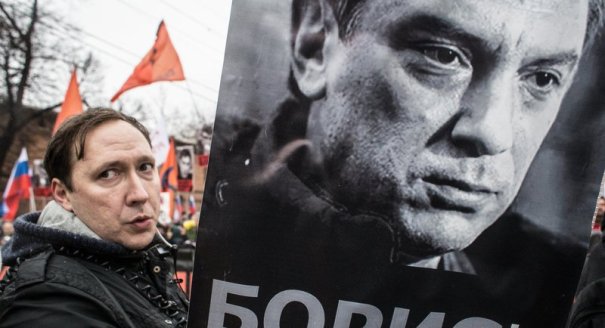
In the wake of the murder of one of Russia’s most fervent opposition leaders, Boris Nemtsov, Russia remains less in a state of shock than in a state of confusion about what this means for the country’s future. Eurasia Outlook asked Carnegie’s experts to share their thoughts on how the event will change political life in Russia.

Link Copied
By Alexey Malashenko and Ulrich Speck
Published on Mar 3, 2015

In the wake of the murder of one of Russia’s most fervent opposition leaders, Boris Nemtsov, Russia remains less in a state of shock than in a state of confusion about what this means for the country’s future. Eurasia Outlook asked Carnegie’s experts to share their thoughts on how the event will change political life in Russia.

Alexey MalashenkoScholar in residence, Carnegie Moscow Center’s Religion, Society, and Security Program

Politicians and ideologues are passionately expressing their views on who killed one of the most prominent, non-system opposition activists, Boris Nemtsov, and why. Though they try to conceal their bewilderment at what has transpired. Several theories are circulating. Vladimir Putin and many others say that the murder was a provocation; some even see a hand of Western special services behind it. There are also those who claim the murder resulted from a routine argument…

But in another few days a different question will emerge. People will ask how Nemtsov’s death will impact the general situation in Russia, particularly as it relates to the opposition movement. As cynical as it might seem, this question, however tacitly, is already present in the minds of politicians.

It is disconcerting to hear that this murder is  described as a “provocation,” but the opinion that it is unquestionably a political killing does not sound foolproof either. All this provides fertile ground for any suspicions, including the ones implicating Nemtsov’s associates—especially in light of the fact that the regime would not really have much to gain from his death.

Nemtsov’s disappearance will not affect the big politics. As one expert has already noted, the president did not consider the late Nemtsov to be his enemy but rather “some dot somewhere in the background.” On the other hand, this death will really upset the Russian propagandists who made the colorful opposition leader one of their favorite targets. As a matter of fact, I am sure that the TV spin doctors will now zero in on the theory of “internal squabbles” within the ranks of the non-system opposition.

As for the opposition itself, it is unlikely to be substantially restructured. It will remain as incoherent as  before and will pose no threat to the regime. Apparently, Nemtsov was its only charismatic member. At the very least, he got recognized and would have certainly accomplished more under a different, more normal political system.

Ulrich SpeckVisiting scholar, Carnegie Europe

The killing of Boris Nemtsov will make it almost impossible for Russia to return to the path of Europeanization under the current government. Even if Putin made a U-turn in Ukraine, which is highly improbable, the murder of a prominent opposition leader in one of most surveilled places in the world—the area immediately surrounding Kremlin—pushes EU-Europe and Russia further apart.

Whatever the circumstances of the killing were, most Western governments and publics will conclude that the Russian government must have either had a hand in it or at least contributed to it by creating an atmosphere of hatred and witch-hunting. The small amount of trust that remained after the attack on Ukraine has now been destroyed. For most Europeans, Putin’s Russia is not going to be a partner anymore; EU-Europe and Russia are drifting further apart.

In the past, the prospect of Europeanization limited the Kremlin’s political options what Berlin or Paris or London have thought was important to the Russian government. If this limitation is now gone, the Russian government may act with less restraint in the future in both foreign and domestic affairs. Instead of moving closer to liberal democracy, as the advocates of Europeanization had hoped, the Kremlin may choose to continue to march in the opposite direction.

About the Authors

Alexey Malashenko

Former Scholar in Residence, Religion, Society, and Security Program

Malashenko is a former chair of the Carnegie Moscow Center’s Religion, Society, and Security Program.

Ulrich Speck

Former Visiting Scholar, Carnegie Europe

Speck was a visiting scholar at Carnegie Europe in Brussels, where his research focuses on the European Union’s foreign policy and Europe’s strategic role in a changing global environment.

Authors

Alexey Malashenko
Former Scholar in Residence, Religion, Society, and Security Program
Alexey Malashenko
Ulrich Speck
Former Visiting Scholar, Carnegie Europe
Political ReformRussia

Carnegie does not take institutional positions on public policy issues; the views represented herein are those of the author(s) and do not necessarily reflect the views of Carnegie, its staff, or its trustees.

More Work from Carnegie Endowment for International Peace

  • Commentary
    Carnegie Politika
    Is There a Place for Russia in the New Race Back to the Moon?

    Despite having the resources and expertise, the Russian space industry missed the opportunity to offer the United States or China a mutually rewarding partnership in the lunar race.

      Georgy Trishkin

  •  A machine gun of a Houthi soldier mounted on a police vehicle next to a billboard depicting the U.S. president Donald Trump and Mohammed Bin Salman, the Crown Prince and Prime Minister of Saudi Arabia, during a protest staged to show support to Iran against the U.S.-Israel war on March 27, 2026 in Sana'a, Yemen.
    Article
    Amid Iran War, Gulf Countries Slow the Pace of Reforms

    The return of war as the organizing factor in Middle Eastern politics has predictable consequences: governments are prioritizing regime stability and becoming averse to political and social reform.

      • Sarah Yerkes

      Sarah Yerkes, Amr Hamzawy

  • Commentary
    Carnegie Politika
    Conspiracy Theories Are Eclipsing the Real Dangers of Russia’s Messaging App Max

    The internet is awash not only with instructions from digital security experts, but also with urban legends and conspiracy theories that divert attention away from the real dangers of Max.

      David Frenkel

  • Commentary
    Emissary
    Russia Will Be More Dangerous After the War with Ukraine

    Putin’s blunder has created new and enduring security challenges for Russia and Europe.

      • Eugene Rumer

      Eugene Rumer

  • Commentary
    Carnegie Politika
    Blocking of Telegram App Sparks Rare Public Rift Among Russia’s Elites

    The prospect of a total block on Russia’s most popular messaging app has sparked disagreement between the regime’s political managers and its security agencies.

      Andrey Pertsev

Get more news and analysis from
Carnegie Endowment for International Peace
Carnegie global logo, stacked
1779 Massachusetts Avenue NWWashington, DC, 20036-2103Phone: 202 483 7600Fax: 202 483 1840
  • Research
  • Emissary
  • About
  • Experts
  • Donate
  • Programs
  • Events
  • Blogs
  • Podcasts
  • Contact
  • Annual Reports
  • Careers
  • Privacy
  • For Media
  • Government Resources
Get more news and analysis from
Carnegie Endowment for International Peace
© 2026 Carnegie Endowment for International Peace. All rights reserved.