

Research
- +6
Yasmine Farouk, Nathan J. Brown, Maysaa Shuja Al-Deen, …
{
  "authors": [
    "Anouar Boukhars"
  ],
  "type": "legacyinthemedia",
  "centerAffiliationAll": "dc",
  "centers": [
    "Carnegie Endowment for International Peace"
  ],
  "collections": [
    "Arab Awakening"
  ],
  "englishNewsletterAll": "menaTransitions",
  "nonEnglishNewsletterAll": "",
  "primaryCenter": "Carnegie Endowment for International Peace",
  "programAffiliation": "MEP",
  "programs": [
    "Middle East"
  ],
  "projects": [],
  "regions": [
    "North Africa",
    "Algeria"
  ],
  "topics": [
    "Political Reform",
    "Security"
  ]
}
Source: Getty
Addressing political and social problems in southern Algeria should be a high priority. Failure to do so would undermine an effective response to the growing threat posed by terrorist and criminal networks.
Source: FRIDE
The Algerian government is under increasing pressure, stemming from political and social turmoil in the south of the country. This comes amidst mounting terrorist threats and economic concerns due to low oil prices. The south holds the majority of the country’s oil and gas reserves and is key for Algeria’s security. The area’s wealth and size (it accounts for more than 80 per cent of the national territory) have contributed enormously to Algeria’s economic standing and geostrategic clout. According to International Monetary Fund 2011 data, hydrocarbons account for over 69 per cent of public revenues and 36 per cent of the Gross Domestic Product.
The vast south was politically and administratively attached to the rest of the country after Algerian independence in 1962. Then the priority was not to foster economic and social integration with the north, but to control and exploit the south’s extensive natural resources. For nearly 50 years, the area worked as a strategic redoubt and a hydrocarbon lifeline underpinning the regime. But after the 2011 Arab uprisings, a host of social imbalances and unresolved ethnic tensions began to affect stability there, alongside an outburst of terrorist attacks.
Three major attacks in less than one year brought Algeria’s south into the eye of the storm: a suicide attack in Tamanrasset in March 2012; an attack against the Algerian National Gendarmerie regional command centre in the town of Ouargla in June 2012; and the dramatic January 2013 terrorist attack at the In Amenas natural gas plant in the southeast Algeria, which was a serious blow to the country’s seemingly invulnerable energy installations.The Arab uprisings were one of the catalysts of the south’s political ‘awakening’. Protests against social exclusion and high unemployment broke out as early as 2011, and grew in intensity in 2013. Social frustration and tension, caused by the widening gap between citizens’ expectations and the state’s incapacity or unwillingness to deliver, exacerbated feelings of perceived injustice and inequality with regard to the north. The south’s sparse population and its geographical distance from the capital Algiers very much limited the movement of people and social interaction between the Arab and Berber north and the Tuareg and black south, also reducing the latter’s political influence in the halls of power.
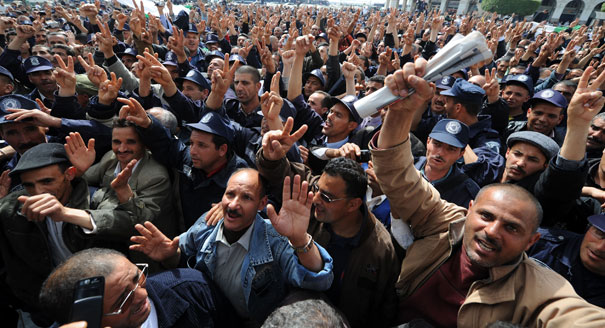
Many see protests, sit-ins and riots as the only means to seek and get redress from the state, which exploited Southern resources but invested very little in the region. The formation of various movements and pressure groups unconnected to traditional parties and tribal leaders elevated the plight of the unemployed and low-wage workers in the south into the limelight. Several civic associations began to mobilise, demanding their constituencies’ share from the oil bonanza. The National Committee for the Rights of the Unemployed created in February 2011, for example, garnered much media attention when it mobilised thousands of protesters in Ouargla in 2013. Similar demonstrations also took place in other southern cities like Laghouat and El-Oued, whereby protesters accused the state and national and multinational companies of discriminating against locals when hiring – while thousands of jobs are created in the hydrocarbon industry each year, they are scooped up by migrants from the north, particularly from Algiers, Oran and Constantine.
Social inequality and bad governance are the central themes of the protests. Demonstrations against corruption, perceived manipulation of social housing and public services, and unequal treatment have become a common fixture in much of the south. In early 2015, new demonstrations broke out over environmental concerns about shale gas extraction. In one occasion, as many as 30,000 protesters reportedly took to the streets in the impoverished town of In-Salah, located in the heart of the Sahara Desert.
This fragile social context can become an incubator of security risks. Some, especially the disaffected youth, are already gravitating towards criminal and smuggling networks long established in Algeria’s south and its periphery. The growing spread and interconnectedness of these networks, increasingly enmeshed into drugs trade, stolen cars, illicit cigarette trafficking, weapons smuggling and counterfeit money and goods, are a source of major concern for Algeria, which also fears cross-pollination with extremist actors roaming the Algerian and Sahelian deserts.
So far, protests have been kept under control through cooptation and/ or repression strategies. If social turmoil is not contained, however, there is also a risk that ethnic and sectarian tensions grow more violent. In August 2013, inter-communal clashes erupted in the town of Bordj Badji Mokhtar, on the border with northern Mali, leaving 15 dead. The incident exposed the deep rifts between Tuareg Idnan and Arab Berabiche, raising concerns among tribal leaders and the government alike. In December 2013, the city of Ghardaïa was also enveloped in sectarian violence. Since then, bloody clashes between the Chaamba Arabs (present in most of Algeria’s south) and the Mozabite Berbers of the Muslim Ibadi sect (an insular group with its own system of values, codes of conduct and rules), have occurred intermittently.
Ethnic and social tensions are particularly dangerous for Algeria because they erode loyalty to the central state. In February 2014, Prime Minister Abdelmalek Sellal spoke of a plot to destabilise Algeria’s social cohesion and territorial integrity, articulating deep-rooted fears that social tensions and external threats might exacerbate latent ethnic divisions and even activate separatist tendencies. He blamed small nefarious groups for instigating violence and sowing divisions between communities.
The south of Algeria is no longer a buffer periphery whose principal value lies in its massive natural resources. Maintaining stability in the region is vital for national security and regime survival. It is both a security and a political challenge. The traditional mix of cooptation and repression to manage dissent in the south is showing signs of strain. Plus, the dramatic slide in oil prices will make it difficult for Algeria to stem political grievances through financial largesse. Addressing political and social problems in the south should be a high priority. Failure to do so would undermine an effective response to the growing threat posed by terrorist and criminal networks.
Former Nonresident Fellow, Middle East Program
Boukhars was a nonresident fellow in Carnegie’s Middle East Program. He is a professor of countering violent extremism and counter-terrorism at the Africa Center for Strategic Studies, National Defense University.
Recent Work


Yasmine Farouk, Nathan J. Brown, Maysaa Shuja Al-Deen, …
Frederic Wehrey, Nathan J. Brown, Bader Al-Saif, …
Carnegie does not take institutional positions on public policy issues; the views represented herein are those of the author(s) and do not necessarily reflect the views of Carnegie, its staff, or its trustees.

Russian strikes are weakening the economy sustaining Ukraine’s war effort. Closing the growing funding gap will require more European support and politically contentious reforms in Kyiv.

Balázs Jarábik

Ex-president Gurbanguly Berdimuhamedov remains interested in politics, but his son Serdar, Turkmenistan’s current president, is becoming increasingly independent and willing to break with his father’s legacy. If their covert rivalry goes too far, both risk losing power.

Galiya Ibragimova

Europe is facing rising populism internally as well as external pressures from Russia, China, Turkey, and the United States.

Dimitar Bechev

A notable degree of participative democracy has firmly arrived in Europe. But to have more far-reaching impact, democratic deliberation needs to move into a radically new phase.

Richard Youngs
Fatima El Mansouri is the country’s first female prime minister. She’s also a privileged insider in a largely ceremonial position.

Sarah Yerkes