

Commentary
Dmitri Trenin
{
  "authors": [
    "Dmitri Trenin"
  ],
  "type": "legacyinthemedia",
  "centerAffiliationAll": "",
  "centers": [
    "Carnegie Endowment for International Peace",
    "Carnegie Russia Eurasia Center"
  ],
  "collections": [],
  "englishNewsletterAll": "",
  "nonEnglishNewsletterAll": "",
  "primaryCenter": "Carnegie Russia Eurasia Center",
  "programAffiliation": "",
  "programs": [],
  "projects": [],
  "regions": [
    "North America",
    "United States",
    "Russia",
    "Western Europe"
  ],
  "topics": [
    "Foreign Policy",
    "Global Governance"
  ]
}
Source: Getty
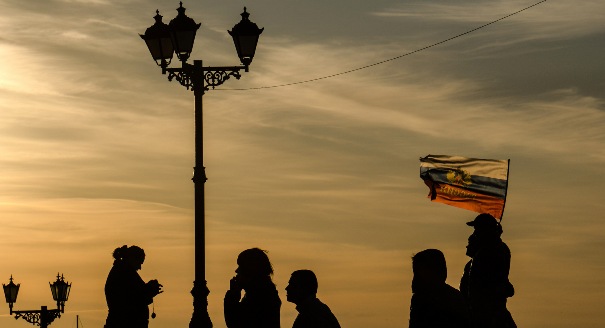
Divisions exist among major nations about how to approach Putin, and his isolation is anything but watertight. At the same time, the Russians themselves are no less defiant of what they see as U.S. global domination.
Source: Global Times
The summit of the G7, held at Schloss Elmau in the Bavarian Alps early this month, did not have Russia at the table, but it had it on the agenda. After having been expelled from what was then the G8, just a couple of months before the scheduled summit in Sochi, Russia is not being brought back to the group, and is not eager to return. A long chapter of Russia’s attempted, and failed integration into the Western community, is over. The Elmau summiteers have agreed to extend the sanctions they imposed on Russia last year, in an effort to change the Kremlin’s policies on Ukraine.
Despite the show of Western unity, nuances in positions of various countries are clearly visible. The German foreign minister, Frank-Walter Steinmeier, will keep the G7 door open for Russia in the future. Two former German chancellors, Gerhard Schroder and Helmut Schmidt, criticized US-driven policies and called for understanding of Russia's motives. Japan's Prime Minister Shinzo Abe has won grudging approval from the US to continue the dialogue with Russian President Vladimir Putin and even to host him in Japan later this year.Another G7 leader, Italy’s Matteo Renzi, actually welcomed Putin in Milan immediately after having returned from Elmau. The two leaders were heard praising Russo-Italian economic cooperation, and lamenting the effect of the sanctions which Renzi had just subscribed to.
While on the same trip, Putin made another visit, with Pope Francis at the Vatican, to discuss the conflicts in Ukraine and the Middle East and the plight of Christians. According to Russian accounts, the meeting went well, despite the US ambassador Kenneth Hackett's urging the Pontific to lean hard on Putin over Ukraine.
Putin’s isolation, even in the West, is anything but water-tight. Since the crisis in Ukraine began in late February 2014, he has visited Austria, France, Hungary and Australia (for the G20 meeting) - and now also Italy. Just last month, he received several European leaders, including German Chancellor Angela Merkel, in Moscow. US Secretary of State John Kerry went to see Putin at his vacation residence in Sochi. Russia is still important to the Obama administration when it comes to its own legacy issues, such as the Iran nuclear deal, or the crises at hand, like in Syria.
Having adjusted to the “new normal” of sanctions and much lower oil prices, the Russians themselves are no less defiant of what they see as US global domination.
In recent weeks, Russian warplanes flew dangerously close to US reconnaissance planes in the Baltic and overflew US Navy ships in the Black Sea. The message these high-wire acts carried were very clear: The US military should not come too close to Russian airspace and its territorial waters. This has resulted in Washington requesting meetings in accordance with the 1972 US-Soviet agreement on preventing dangerous accidents in the air and at sea, probably just what Moscow had wanted.
During his very warm get-together with Putin in Milan, Renzi said he planned to visit the 2018 World Cup in Russia. Just a few days before that, a major corruption scandal had broken out at FIFA, whose long-time head, and friend of Russia, Sepp Blatter was forced to resign after having just won his fifth presidential term. As the scandal potentially threatened the holding of the World Cup in Russia, the Russian media accused the US of a conspiracy to ease out Blatter, take over FIFA and deny Russia the Cup. Putin himself spoke up publicly against the US justice system respecting no national borders, a theme he has been singing since his memorable appearance at the 2007 Munich Security Conference.
As 2015 is nearing half-time, Russia’s confrontation with the US is unabated. Both Hillary Clinton and Jeb Bush, two leading presidential contenders, used harsh language against Russia's policies and Putin personally. The US Congress has voted to send lethal weapons to Ukraine - something Obama opposes. The 1987 INF Treaty banning medium-range missiles in Europe is in trouble, and there are hints at deploying US missiles in the UK. Europe, and particularly Germany, is still with the US, but the game is long and the final outcome is uncertain.
As for Russians, who celebrated their national day on June 12, according to public opinion polls, they have never been as proud of their country in two decades.
Former Director, Carnegie Moscow Center
Trenin was director of the Carnegie Moscow Center from 2008 to early 2022.
Recent Work
Dmitri Trenin
Dmitri Trenin
Carnegie does not take institutional positions on public policy issues; the views represented herein are those of the author(s) and do not necessarily reflect the views of Carnegie, its staff, or its trustees.
AI capabilities are moving fast. Most institutions—including governments—can’t keep up.


Anton Leicht, Scott Singer
The Bureau of Industry and Security needs to adjust its focus and practices to maintain its position as the U.S. government’s primary champion of international technological competition.
Geoffrey Irving

European Commission President Ursula von der Leyen is about to give her annual address on the state of the EU. Here’s what she won’t—but should—say.

Rym Momtaz

Depleted financial reserves and a shrinking tax base mean it is no longer possible to simultaneously deliver high defense spending, price stability, and economic growth.

Alexandra Prokopenko
Understanding the climatic pain points is necessary for policymakers hoping to minimize the war’s negative environmental consequences.



Alejandro Martin Rodriguez, Joy Arkeh, Sarah Yerkes