

Research
- +4
Milan Vaishnav, Rahul Verma, Rukmini S., …
{
  "authors": [
    "Christophe Jaffrelot"
  ],
  "type": "legacyinthemedia",
  "centerAffiliationAll": "dc",
  "centers": [
    "Carnegie Endowment for International Peace"
  ],
  "collections": [],
  "englishNewsletterAll": "ctw",
  "nonEnglishNewsletterAll": "",
  "primaryCenter": "Carnegie Endowment for International Peace",
  "programAffiliation": "SAP",
  "programs": [
    "South Asia"
  ],
  "projects": [],
  "regions": [
    "United States",
    "South Asia",
    "India"
  ],
  "topics": [
    "Political Reform",
    "Democracy",
    "Security",
    "Military",
    "Foreign Policy",
    "Religion"
  ]
}
Source: Getty
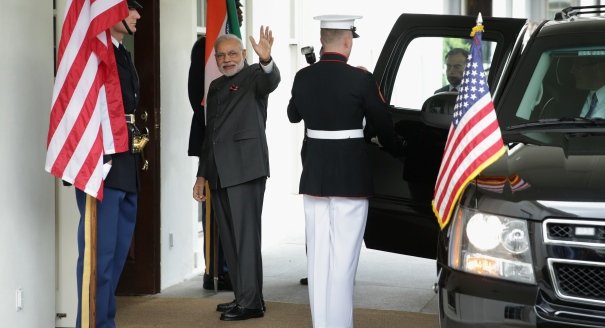
India is less popular with ordinary Americans. But this may not be a problem for U.S.-India relations if hard power considerations make up for it.
Source: Indian Express
For decades, India capitalised on its soft power in its relations with the US. Its good image was largely due to its democratic reputation and a widely shared sentiment that Indians’ religious tolerance was akin to multiculturalism. The popularity of India in America also resulted from the remarkable achievements of its diaspora, the most educated and socioeconomically successful among Asian groups — a model community.
Things are changing. The diaspora, including its Hindu component, is not viewed as favourably today. In a 2014 survey that asked how Americans feel about religious groups, the Pew Research Centre found that Hindus had a 50 per cent rating — Americans had a better opinion of Jews and Catholics, at 63 per cent and 62 per cent, as compared to Hindus, Mormons and Muslims, at 50, 48 and 40 per cent respectively. Evangelical Christians had an even lower approval rating of Hindus, only distrusting atheists and Muslims more. These figures came out while a number of Hindu temples were being attacked in the US, so much so that the department of justice began to record anti-Hindu crimes as a separate category.This changing perception of Hindus has affected India’s image. In another survey conducted in 2013 by Pew, where it asked Americans about their opinion of other countries, Indians were viewed favourably by only 46 per cent of the interviewees. In comparison, Japan and Germany were viewed favourably by 70 and 67 per cent of Americans. Certainly India’s image suffered from press coverage of the recent rapes in its cities. But the aforementioned Pew figures stood in contrast to a similar, September 2014 survey, also by Pew — when the most-publicised rapes had already had an impact — in the immediate aftermath of Prime Minister Narendra Modi’s visit to the US. At that time, 55 per cent Americans held a favourable view of India (coincidentally, the same percentage of Indians viewed America favourably).
The erosion of India’s prestige in American eyes, therefore, seems to be related to their assessment of the religious situation in India. The American press has been highly critical of the instances of church burning, arson, burglary and vandalism that have taken place in India in 2014-15. Usually taciturn US Congressmen made scathing comments in this year’s report by the US Commission on International Religious Freedom (USCIRF). In its section on India, it found that “derogatory comments by politicians”, “violent attacks” against minorities, “forced conversions”, and “ghar wapsi” episodes were regular occurrences. The guilty were named, and a number of three-letter acronyms — the BJP, RSS and VHP — were invoked frequently and unsparingly. The external affairs ministry spokesperson, Vikas Swarup, claimed that the report was based on a “limited understanding of India, its Constitution and its society”. Parallel to the USCIRF report, Pew published in February a study on religion and public life that rated India second on its social hostilities index — an indicator calculated based on incidents of violence, proselytisation and hostile actions towards other religions carried out within a country — ahead of Pakistan and behind only Israel. The report deemed anti-conversion laws in a number of Indian states to be “deeply problematic” and noted that BJP president Amit Shah had called for a nationwide anti-conversion law in 2015. The Pew annual report has kept India on its tier two list of countries since 2009, a list that includes Kazakhstan and Malaysia.
The US Congress’s negative rating of religious freedom in India is partly due to the influence of the American Evangelical lobby, which had paved the way for the International Religious Freedom Act, 1998, and which paid great attention to the 2002 Gujarat violence. Under Felice D. Gaer, who became a USCIRF commissioner in 2001, the Christian-specific agenda of this policy was to become much larger, encompassing the protection of all religions. The 2002 violence took place in the immediate aftermath of these changes, and Gaer tried to enter India to survey the damage from the riots but was denied entry by the government. This happened alongside a visit to Gujarat by two Congressmen who could report on what they had seen. It was largely these individuals and groups who invoked the 1998 act and presented their views to the Dick Cheney office, all of which led to the denial of an American visa for Modi in 2005.
But the Evangelical lobby is not the only player in that game. President Barack Obama himself during his visit in January invited India to be true to its secular tradition in a speech he made at Siri Fort Auditorium. “Your Article 25 says people are free to practise their own religion,” Obama reminded the crowd.
However, religious freedom is not the only irritant today. The US also expressed disapproval when India placed the US-based Ford Foundation on a national security watchlist. The US demanded clarification on what appeared to be a crackdown on and harassment of NGOs, including the blockage of the bank accounts of Greenpeace India and an investigation into the Bill and Melinda Gates Foundation.
The erosion of the soft power component in US-India relations may not be a problem if hard power considerations make up for it. Washington still values New Delhi as a partner against China and in its fight against Islamism. Therefore, India stands to benefit from a well-cultivated alliance with the US on a number of issues, ranging from acceptance into the nuclear club, information-sharing between the intelligence agencies of the two countries, containing Pakistan and bringing stability to the geopolitical region. More importantly, perhaps, economic considerations tend to weigh heavily on the American side, including the high volumes of institutional and direct investment that flows from America to India.
Geopolitical and economic factors may lead the pragmatic Americans to ignore moral issues vis-à-vis India, as has happened vis-à-vis so many other countries, including Pakistan, where military coups have hardly come in the way of US policy when fighting the Soviet Union or the Taliban were top priority. But if India-US relations take this route, they may become purely transactional — unless the reports and surveys mentioned above are taken seriously by the government of India. Interestingly, programmes like ghar wapsi have taken a back seat, and no church has been attacked lately.
Former Nonresident Scholar, South Asia Program
Jaffrelot’s core research focuses on theories of nationalism and democracy, mobilization of the lower castes and Dalits (ex-untouchables) in India, the Hindu nationalist movement, and ethnic conflicts in Pakistan.
Recent Work

Milan Vaishnav, Rahul Verma, Rukmini S., …
Christophe Jaffrelot
Carnegie does not take institutional positions on public policy issues; the views represented herein are those of the author(s) and do not necessarily reflect the views of Carnegie, its staff, or its trustees.

Fatima El Mansouri is the country’s first female prime minister. She’s also a privileged insider in a largely ceremonial position.

Sarah Yerkes

The acknowledgment has sparked fears of a new arms race with China and Russia.

Chris O’Meara
Smaller powers cannot go it alone, but Canadian history shows that integration with the United States will not always be benign.
Paul Samson

The European Commissioner for Trade is headed to China. But after President Xi’s bridge-building visit to Washington, can a more isolated EU overcome Beijing’s stranglehold on critical raw materials? Who will blink first?

Rym Momtaz, ed.

The summit may be remembered as a fatal blunder, when Washington, Beijing, and the AI industry collectively chose ceremony over action.

Jeffrey Prescott