

Article
C. Raja Mohan, Darshana M. Baruah
{
  "authors": [
    "C. Raja Mohan"
  ],
  "type": "legacyinthemedia",
  "centerAffiliationAll": "dc",
  "centers": [
    "Carnegie Endowment for International Peace",
    "Carnegie India",
    "Malcolm H. Kerr Carnegie Middle East Center"
  ],
  "collections": [],
  "englishNewsletterAll": "ctw",
  "nonEnglishNewsletterAll": "",
  "primaryCenter": "Carnegie India",
  "programAffiliation": "SAP",
  "programs": [
    "South Asia"
  ],
  "projects": [],
  "regions": [
    "South Asia",
    "India",
    "Gulf",
    "Middle East",
    "Saudi Arabia",
    "United Arab Emirates"
  ],
  "topics": [
    "Foreign Policy",
    "Political Reform"
  ]
}
Source: Getty
Recent developments demand that New Delhi take a fresh strategic look at the Gulf region.
Source: Indian Express
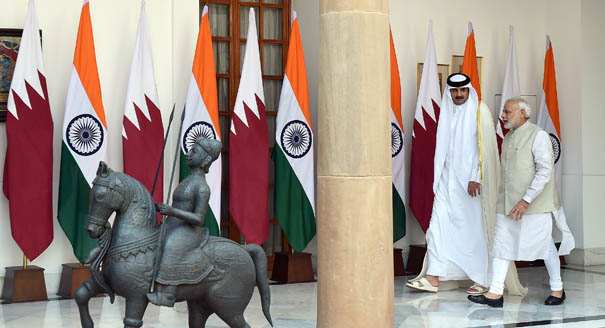
Few parts of the world are more important for India than the Gulf. Yet, India’s political engagement with the region has rarely matched its significance. That Narendra Modi’s two-day trip to the UAE this weekend is the first prime ministerial visit since 1981 underlines the story of New Delhi’s neglect of a country and region that is so proximate in all senses of the term.
Although the modern political evolution of the Gulf was intimately tied to the rise of the British Raj on the subcontinent, independent India’s approach to the Gulf steadily became less strategic. India’s tendency to see the region through an ideological lens, letting its domestic politics define the strategy and allowing the Pakistan factor to limit the prospects for partnership, have long distorted its relationship with the Gulf. The prime minister now has an opportunity to help India discard its economic mercantilism and political diffidence in the Gulf and replace them with a comprehensive strategy. The factors shaping such a strategy are difficult to miss.The oil-rich Gulf remains the main source of India’s growing hydrocarbon imports. It is home to more than six million Indian expatriate workers. They send remittances worth nearly $50 billion every year. With its large foreign currency reserves, the Gulf kingdoms are also potentially a big source of investment in India’s infrastructure.
Within the Gulf, the UAE looms large. It hosts about 2.6 million Indian workers. Bilateral trade with the UAE peaked at $73 billion in 2013 but has since declined to around $60 billion. Even with the lower figure, the UAE is India’s third largest trading partner after the US and China. Like Singapore in the east, Dubai is India’s entrepôt to the west. The UAE airlines move India’s mobile millions to far corners of the world. Prime Minister Manmohan Singh did indeed make plans to visit the country but could not make it. In any case, the Middle East was not at the top of Singh’s travel plans. He barely showed India’s flag in the region. Of the few trips he made, two were to attend non-aligned summits — Iran (2012) and Egypt (2009). He visited Saudi Arabia, Oman and Qatar once.
If the UPA government seemed to neglect the Gulf, there has been some concern that the NDA might do the same. Neither the Gulf nor the larger Middle East figured on Modi’s itinerary during his first year in office. Worse still, the NDA government’s enthusiasm for strengthening ties with Israel was widely interpreted in Delhi as coming at the expense of its historic ties to the Arabs.
That the debate was being framed in these terms suggested how out of touch the Indian political class is with the new geopolitics of the Middle East. No major power, whether it is the US, China or Russia, views ties to the region as a zero-sum game between the Arabs and Israel. No one in the Middle East is asking India to choose between multiple rivals in the region. All want India to show more political interest and greater economic purpose.
Second, the divide between Israel and the Arabs has long ceased to be the primary contradiction in the region. Ever since the Islamic Revolution in Iran in 1979, the Gulf countries have been deeply troubled by the ideology and policies of the new republic in Tehran. Those Arab-Persian and Shia-Sunni contradictions have become so sharp in recent years that many observers now talk of a de facto alliance between some Arab states and Israel to counter the growing power and influence of Iran in the region.
The Gulf Arabs, who have long looked at the US as their main security provider since the British retrenched their historic role east of the Suez in the late 1960s, are now deeply troubled by the nuclear deal between Washington and Tehran and its political consequences. Meanwhile, the rise of violent religious extremism threatens all the states in the region, republics and monarchies as well as the Sunni and Shia. The dramatic rise of the Islamic State is compelling the consideration of utterly unexpected alliances.
These developments demand that Delhi take a fresh strategic look at the Gulf. If the PM is ready to inject some strategic content to its engagement with the Gulf, the UAE is a good place to start.
While the large diaspora, energy security, trade and investments are all of great importance to Modi’s foreign policy agenda, it is the arena of strategic cooperation that demands serious attention from the PM. This would include not only counter-terrorism, intelligence exchanges, military exercises, and maritime security, but also a close and sustained consultation on the construction of a stable balance of power system in the Gulf and preventing the destabilisation of Afghanistan.
Former Nonresident Senior Fellow, Carnegie India
A leading analyst of India’s foreign policy, Mohan is also an expert on South Asian security, great-power relations in Asia, and arms control.
Recent Work

C. Raja Mohan, Darshana M. Baruah


Alexander Gabuev, Paul Haenle, C. Raja Mohan, …
Carnegie does not take institutional positions on public policy issues; the views represented herein are those of the author(s) and do not necessarily reflect the views of Carnegie, its staff, or its trustees.

Before the next wave of EU enlargement takes place, the union needs to grapple with thorny questions of how power is distributed among its members.


Emil Sondaj Hansen, Ditte Brasso Sørensen
The real test may come after the leaders leave the room.



Sheena Chestnut Greitens, Oriana Skylar Mastro, Yukon Huang, …

The Horn of Africa countries are among those facing a new security calculus.


Andrew Leber, Lesley Anne Warner

The European far right might fail to steer EU policy in the direction Russia wants, but they will create enough chaos inside Europe to benefit the Kremlin.

Dimitar Bechev

The new U.S.–Denmark–Greenland agreement will help Washington exert political, economic, and financial dominance under the guise of security. Yet, it acknowledged Copenhagen’s and Nuuk’s sovereignty on the island.

Marc Pierini