

Commentary
For every ruble allocated to social policy, health, and education in 2027, double that amount is earmarked for the army, the police, and the security services.
Alexandra Prokopenko
{
  "authors": [
    "David Gamtsemlidze"
  ],
  "type": "commentary",
  "centerAffiliationAll": "",
  "centers": [
    "Carnegie Endowment for International Peace",
    "Carnegie Russia Eurasia Center"
  ],
  "collections": [],
  "englishNewsletterAll": "",
  "nonEnglishNewsletterAll": "",
  "primaryCenter": "Carnegie Russia Eurasia Center",
  "programAffiliation": "",
  "programs": [],
  "projects": [],
  "regions": [
    "Caucasus",
    "Russia",
    "Georgia"
  ],
  "topics": [
    "Foreign Policy"
  ]
}
Source: Getty
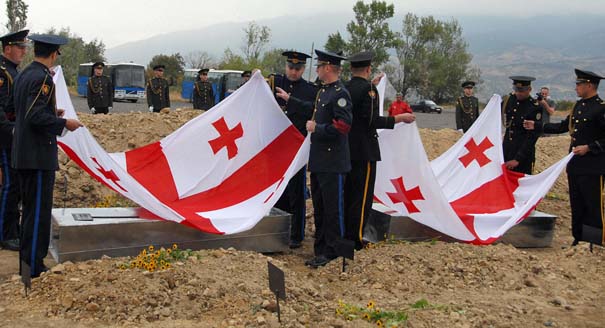
The start of an investigation by the International Criminal Court into the August 2008 Georgia-Russia war could be embarrassing for Russia, but have graver legal consequences for Georgia.
Most of the world has moved on from the August 2008 war in Georgia, as it focuses on more immediate conflicts in Ukraine and Syria. But an investigation by the International Criminal Court has now been set in motion which could see that conflict capture global attention once again. And, ironically, it could end up being more harmful for Georgia, the party that first demanded a probe and that suffered more in the conflict.
The International Criminal Court's chief prosecutor Fatou Bensouda visited Tbilisi earlier this month after making a 160-page request to three judges to authorize an investigation into war crimes and crimes against humanity committed in the five-day war that began in South Ossetia. Before she made the trip, she released an informative video address.
The prosecutor’s points echoed several of the Georgian views on the causes and consequences of the conflict.
Bensouda noted that dozens of ethnic Georgian civilians were killed, tens of thousands of Georgians were expelled, and more than 5,000 dwellings in Georgian villages were destroyed “as part of a forcible displacement campaign conducted by South Ossetia’s de facto authorities.”
She said that the ethnic Georgian population of South Ossetia was reduced by 75 percent—a suggestion of ethnic cleansing which would be a crime against humanity. However, it is important to note that so far the accusation is being leveled against “South Ossetia's de facto authorities,” and not against Russia.
Many were surprised that in her video address Prosecutor Bensouda said nothing about the killing of civilian Ossetians during the same period, August 8-12.
In December 2008, the Russian Prosecutor’s Office estimated that 162 civilians and 48 military personnel had died in the August conflict—a revision downwards of much higher figures given by the Russian side during the conflict itself.
Tbilisi explains Bensouda’s failure to mention this specifically as confirmation of their version of the conflict. The Georgian prosecutor’s office submitted documents to The Hague alleging that, of the 162 Ossetian civilians mentioned by Russia, 160 were actually combatants from South Ossetian militias and not civilians. They also note that Russia has been unable in all these years to present a list of civilians who died in the conflict.
The ICC prosecutor’s 160-page document of October 13 does refer to reports by Amnesty International and Human Rights Watch on Ossetian civilian casualties but says that “owing to the insufficiency of the information available,” her office is not yet ready to confirm reports that war crimes may have been committed.
The Georgian side will be pleased that Bensouda’s initial report contains more detailed references to the August 7 shelling of a peacekeeping post in the village of Avnevi that killed two Georgian peacekeepers from the trilateral Georgian-Ossetian-Russian force and wounded five. Former Georgian President Mikheil Saakashvili repeatedly hinted that it was this incident that prompted him to launch his military assault on Tskhinvali on the night of August 7-8.
Unfortunately, that is the limit of the good news for Georgia. Worryingly for Tbilisi, the ICC prosecutor also referred to the killing of seven Russian peacekeepers by Georgian forces in Tskhinvali and the destruction of their Russian peacekeeping facility.
An attack against peacekeepers is a serious international crime. All of the Georgian government’s excuses—such as that the shelling was “unintentional” and that the Russian peacekeepers allegedly “participated in hostilities on the side of South Ossetia”—will be dismissed in court as irrelevant. The Russian peacekeepers were legitimate peacekeeping forces, deployed to the conflict zone at the request of Georgia and in line with the 1992 Dagomys Agreement.
This aspect of the investigation could have very unpleasant consequences for Georgia.
This is because Georgia (but not Russia, or indeed the United States) is a signatory of the Rome Statute of 1998 which led to the formation of the ICC. According to the court's charter, it only has jurisdiction over the citizens (including servicemen) of countries that ratified the statute. That means that Georgia—but not Russia—is now required to cooperate fully with The Hague on the forthcoming investigation.
So the court could theoretically require the interrogation, or perhaps eventually the extradition, of former Georgian president (and now governor of Odessa) Mikheil Saakashvili on the war crime of killing peacekeepers.
That would not be a source of great regret for the current Georgian government, with its deep hostility to Saakashvili. But it would be very awkward for them if the court requested the extradition of current or former military officials who were involved in the attack on Tskhinvali. Even the suggestion of this could cause great tensions in the Georgian military and have serious political implications.
As the court’s investigation gets underway, the Georgian authorities may now regret the signature former president Eduard Shevardnadze put on the Rome Statute. Shevardnadze believed that it would serve as a defense of weak Georgia against its strong neighbors, but it may end up being a trap from which his successors will find it hard to extricate themselves.
David Gamtsemlidze is a historian and writer for Kommersant based in Tbilisi.
David Gamtsemlidze
Carnegie does not take institutional positions on public policy issues; the views represented herein are those of the author(s) and do not necessarily reflect the views of Carnegie, its staff, or its trustees.

For every ruble allocated to social policy, health, and education in 2027, double that amount is earmarked for the army, the police, and the security services.

Alexandra Prokopenko

The acknowledgment has sparked fears of a new arms race with China and Russia.

Chris O’Meara

Smaller powers cannot go it alone, but Canadian history shows that integration with the United States will not always be benign.
Paul Samson

The European Commissioner for Trade is headed to China. But after President Xi’s bridge-building visit to Washington, can a more isolated EU overcome Beijing’s stranglehold on critical raw materials? Who will blink first?

Rym Momtaz, ed.
The summit may be remembered as a fatal blunder, when Washington, Beijing, and the AI industry collectively chose ceremony over action.

Jeffrey Prescott